NavList:
A Community Devoted to the Preservation and Practice of Celestial Navigation and Other Methods of Traditional Wayfinding



From: Trammell H
Date: 2026 Jan 20, 08:17 -0800
I don't think all of the extra web traffic was me reloading the page while practicing my lunar math, but you never know...
Right, "LHA" was in quotes in Brunner's figure since it isn't the hour angle, but the difference in azimuth as you mentioned. I'll update my notes since that is a much better description.
It seems that I've rederived the "Direct Triangle" approach that you show in the workshop materials, although using different trig functions. Does the tangent in calculating the ΔZ have bad behaviour as the height of the moon or sun increase, or in practice you wouldn't be shooting them at near 90 degrees overhead anyway?
For my tests I'm using the haversine form that has one less trig operation:
Hav(ΔZ) = (Hav(OLD) - Hav(Hs-Hm)) / Cos(Hs) / Cos(Hm)
Hav(LD) = Hav(ΔZ) * Cos(Hs') * Cos(Hm') + Hav(Hs'-Hm')
In practice what I'm actually computing is:
Log(Hav(ΔZ)) = Log(Hav(OLD) - Hav(Hs-Hm)) - Log(Cos(Hs)) - Log(Cos(Hm))
Hav(LD) = e^(Log(Hav(ΔZ) + Log(Cos(Hs')) + Log(Cos(Hm'))) + Hav(Hs'-Hm')
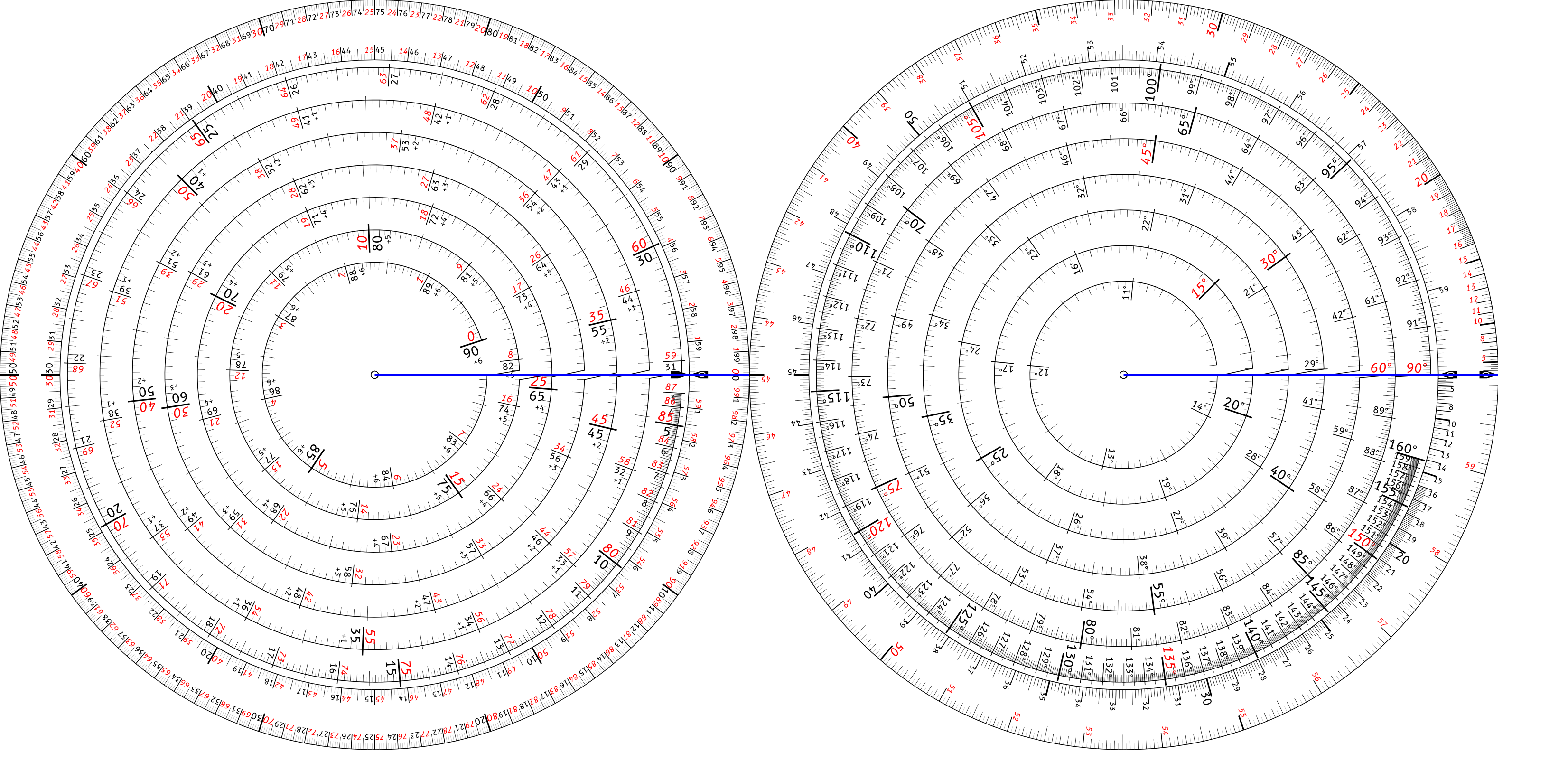
Since that removes all of the multiplications and can be done on my spherical triangle slide rule (the left side of the attached image shows the non-log Haversine, the right side shows the Log Haversine and dual Log Cos scales)