NavList:
A Community Devoted to the Preservation and Practice of Celestial Navigation and Other Methods of Traditional Wayfinding



From: Trammell H
Date: 2026 Jan 23, 07:10 -0800
I saw your post about the upcoming workshops and got interested in understanding the techniques. I'm hoping to sail from the Galapagos to Easter Island this summer on a small bark that doesn't have a Harisson Chronometer, so we'll need some way to track the time. I'm really bad at arithmetic so having something that does the interpolation and deals with the sexagesimal math is very helpful -- most of my mistakes are forgetting the carry the sixty or other oopsies.
You can print your own versions of my sliderules -- I'm using the local copy shop that can print and laminate A3, then cutting and gluing the two larger disks together. The cursor is a 3D printed with a piece of red thread to act as the pointer. You can also play with an interactive version that is not fully developed yet: https://osresearch.github.io/sunwheel/ and the printable version https://github.com/osresearch/sunwheel/blob/main/rule-a3.svg
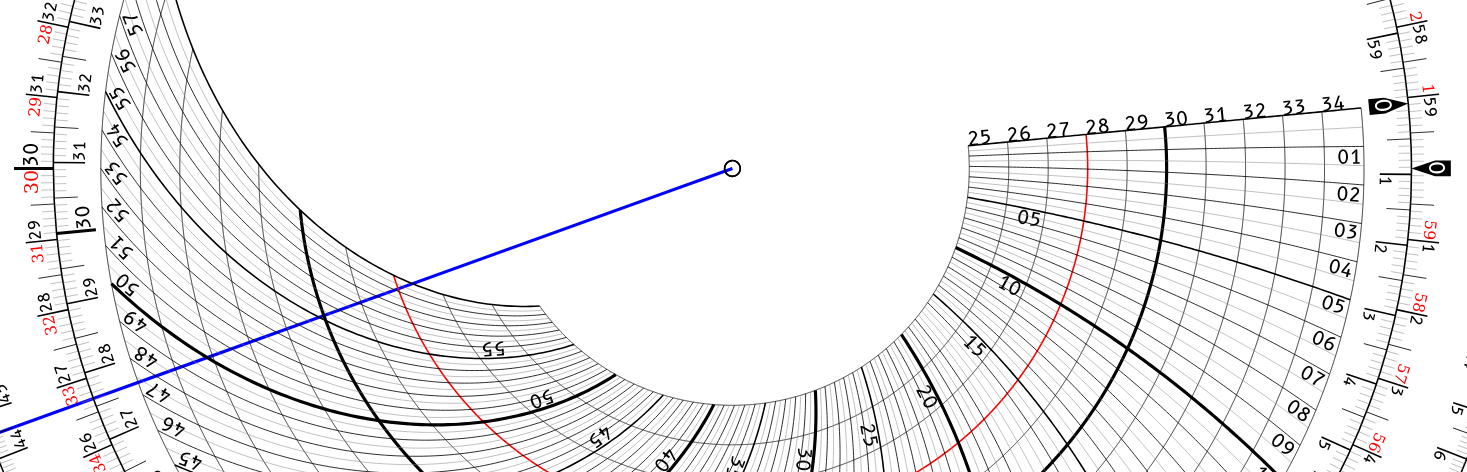
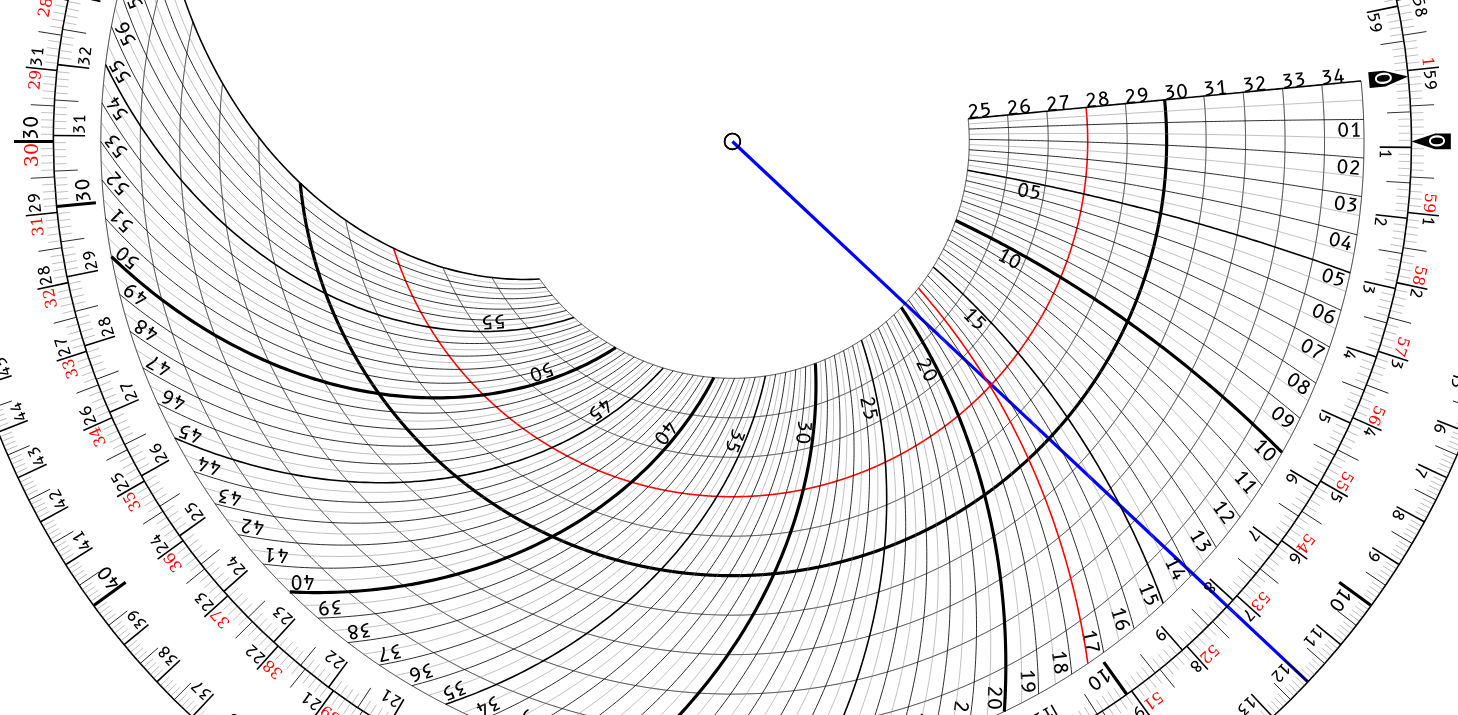
The back of that rule is also something I'm working on for the lunars. It will help calculate the augmented semidiameter as well as the parallax based on the height of the measurement, and based on the corrected lunar distance, the inner scale computes the time past the hour with about 15 seconds accuracy. In the attached image you can see how you point the inner index at the minutes of the start of the hour on the outer scale (59.1'), move the pointer to the minutes at the start of the next hour (26.7') to find the circle to follow (which corresponds to the change in minutes of lunar distance per hour). Then move the pointer to the minutes (or decimal degrees) of the lunar distance. Where the pointer and the interpolation circle intersect directly reads out the time past the hour (around 17:15 since the red circle was slightly below the intersection in the previous step).