NavList:
A Community Devoted to the Preservation and Practice of Celestial Navigation and Other Methods of Traditional Wayfinding



From: Frank Reed
Date: 2026 Feb 27, 09:55 -0800
A fascinating lunar!
First step, we need to understand the inputs. There are no altitudes given which means the altitudes would have been calculated from the known latitude (known by Noon Sun and DR typically) and the known Local Mean Time (which would have been determined by some other means, but in this case, it is "given" to us). Local Mean Time in modern terms is analogous to knowing the LHA of Aries. It's not identical to that since LHA Aries is identical to Local Sidereal Time, but Local Mean (Solar) Time is related in a simple way, and the key concept is that LMT, like LHA Aries, tells us the east-west (visually "left-right") orientation of the sky at the time of the observations.
With known and thus "fixed" LMT, if we choose to examine the effect of changing the UT/GMT time, which is typical in a lunar analysis, we need to adjust longitude to offset the change in UT in order to keep the LMT constant. In the case under consideration, a GMT of 22:08:00 at longitude 173.20° yields the same apparent sky and the same LMT as a GMT one minute later at 22:09:00 but only if we bump up the longitude by a quarter of a degree to 173.45°.
Lars, you mentioned using "contemporary methods" to work this lunar. We could consider that next, but it's tough to decide since in this late era, decades after lunars were "commonly" used at sea, the actual lunar clearing math would depend on the background and preferences of the navigators themselves. Did they have a copy of Norie's Navigator maybe? Was it a very recent edition because they wanted the latest and the best? Or might it have been the captain-navigator's copy from thirty years earlier, worn and beaten but trusted? In any case, I'm convinced it's a good idea to get the numbers right using modern tools first.
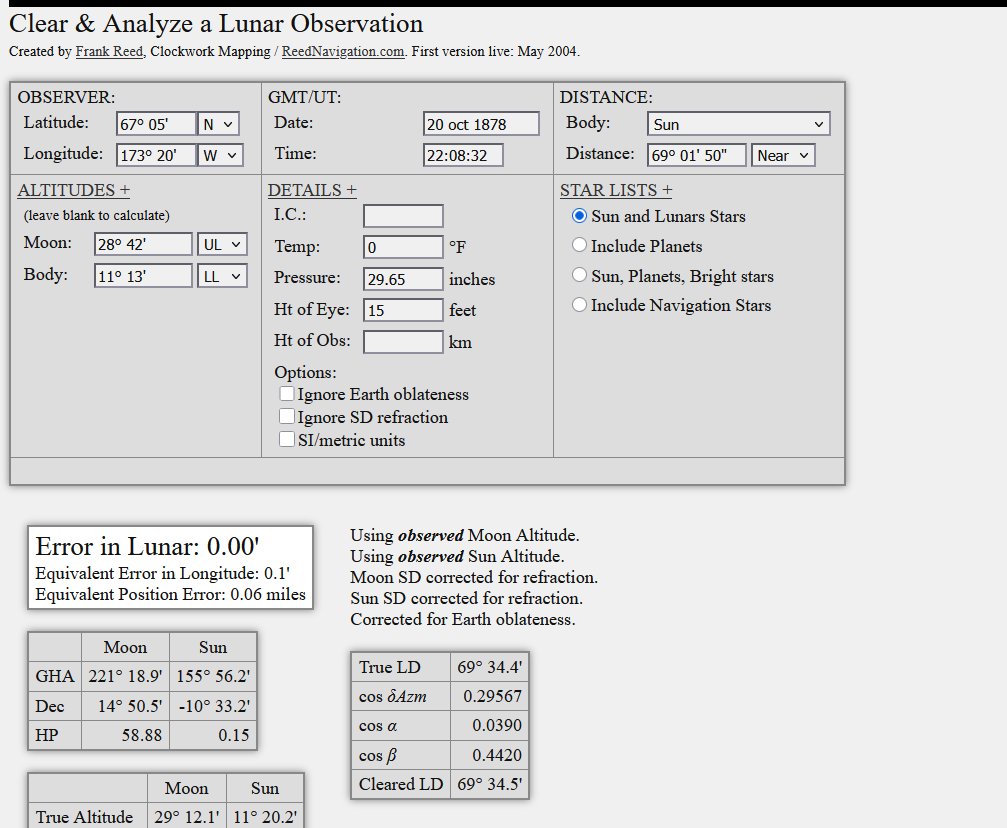
Using my web app for clearing lunars, we can enter the observed data and test different combinations of GMT and longitude keeping the LMT fixed at 10:22:35am (the adjustment from the listed "astronomical"-style of LMT is just a subtraction of twelve hours). Trying different times, I find a best match at 22:08:32 though, of course, this should be interpreted as +/-10 seconds under the best of circumstances. Attached image below shows the results. For anyone who's thinking about working this lunar, puzzling over the absence of observed altitudes, you can use these computed altitudes to enter into your favorite clearing procedure, if you want.
If we take this GMT seriously, the matching longitude to get that fixed "known" LMT is 173.33°. If I zoom in close on Google Maps at that longitude near the coast of easternmost Siberia, I find a 'pin' marked Pitlekaj almost perfectly aligned with the coordinates. The pin was tagged by a Swedish (apparently) tidal researcher many years ago who selected that spot as the wintering location for the expedition, after the vessel had become surrounded by ice. The tidal analysis web page is an old "web 1.0" page dating from nearly thirty years ago: https://holt.oso.chalmers.se/hgs/vega/vega.html. That's many years before Google Maps even existed, so someone must have made this connection back to the tidal analysis long after it was published in that web page.
The Wikipedia article on the expedition includes a photo of the "Vega" stuck in the ice for the winter. Note that the caption has a typo, but the image filename has it right. The name of the village (now gone) as recorded by the Vega expedition was apparently Pitlekaj, nor Piltekaj (but Pitlekai is also common and not invalid). The Wikipedia article lists the wintering location as near the modern Chukchi village of Neshkan. That would be about 10 nautical miles east of the estimated position of Pitlekaj. Excellent lunar observations from a non-moving platform (like the ice itself, or the vessel trapped in ice) could yield that level of accuracy to distinguish between the two, but only just.
I have not done a thorough proofreading, so please let me know if you find significant error. :)
Frank Reed
Clockwork Mapping / ReedNavigation.com
Conanicut Island USA
PS: Speaking of lunars... Upcoming ReedNavigation.com online workshops: Celestial Navigation in the Age of Sail, and Lunars and Longitude, and Advanced Lunars.