NavList:
A Community Devoted to the Preservation and Practice of Celestial Navigation and Other Methods of Traditional Wayfinding



From: Frank Reed
Date: 2025 May 1, 11:04 -0700
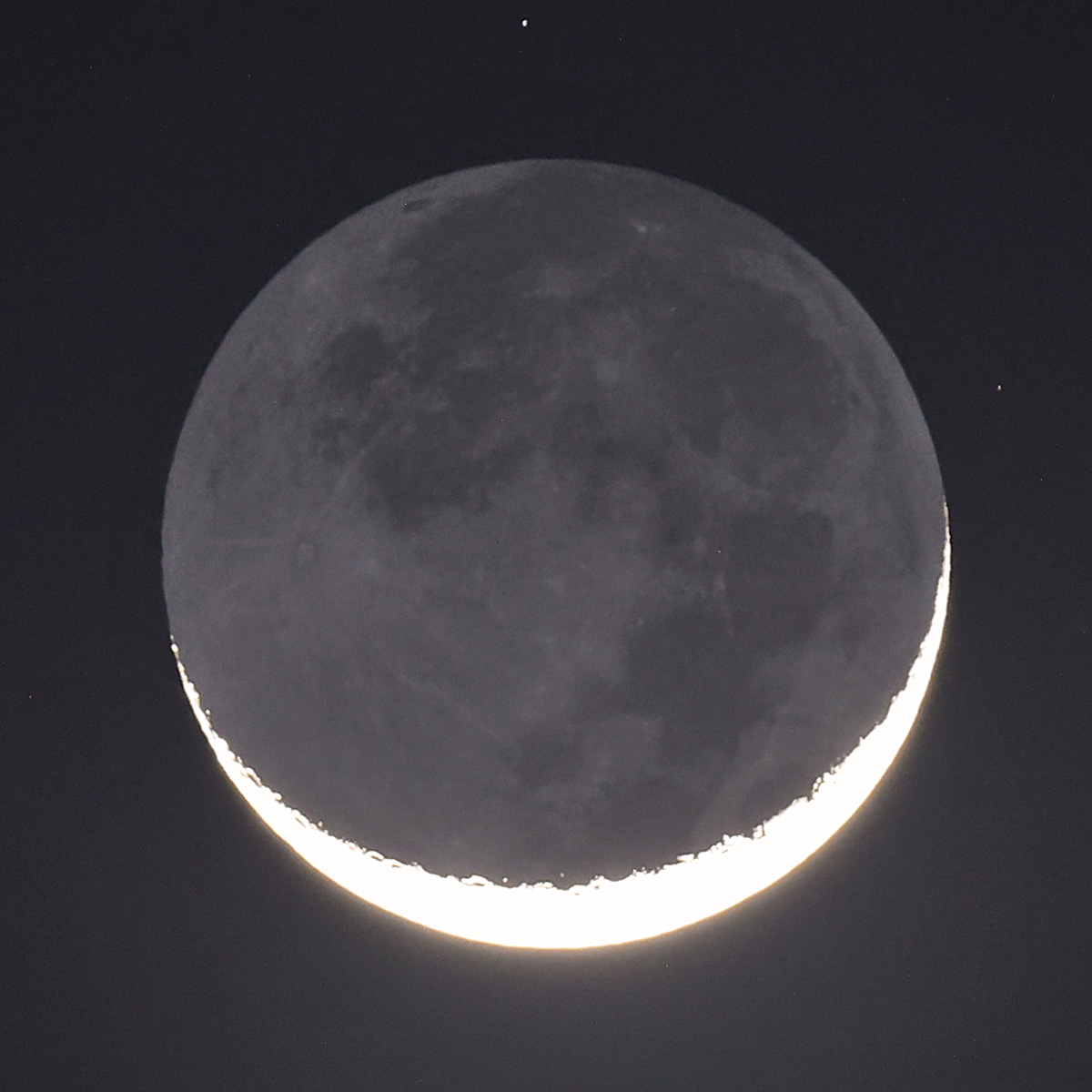
I have described in posts over some years how it is possible to get a position fix using "lunar distances". That's longitude and latitude by lunar distances. Using the image below, figure out where the photo was taken. And trust me: this isn't just for fans of computations. Anyone can do this by playing around in higher quality astronomical simulation software, like "Stellarium", and I encourage any and all of you to puzzle it out. It will teach you something about the process of navigation, both here on Earth and in interplanetary space. Yes, seriously!
Look at the Moon in the sky, and then find two stars in roughly perpendicular "position angles" from the Moon --maybe one star at "12 o'clock" directly above the Moon (towards the local zenith) and another at "3 o'clock", to the right of the Moon. For sextant angles, these should be bright stars, but working with a telescope or photographically, these can be relatively faint starts. If we know the exact date and time of the photo [and we do: 29 April 2025, 02:58:19 UT], and if we can measure the exact angular distance from the Moon to each of the stars, then we can work out our position on the Earth. Small errors in the angular distances yield large errors on the ground at the rate of about six nautical miles (under good geometries) for every tenth of a minute error in the measured "lunar distances". With a sextant, that's fine work, but photographically, not so bad.
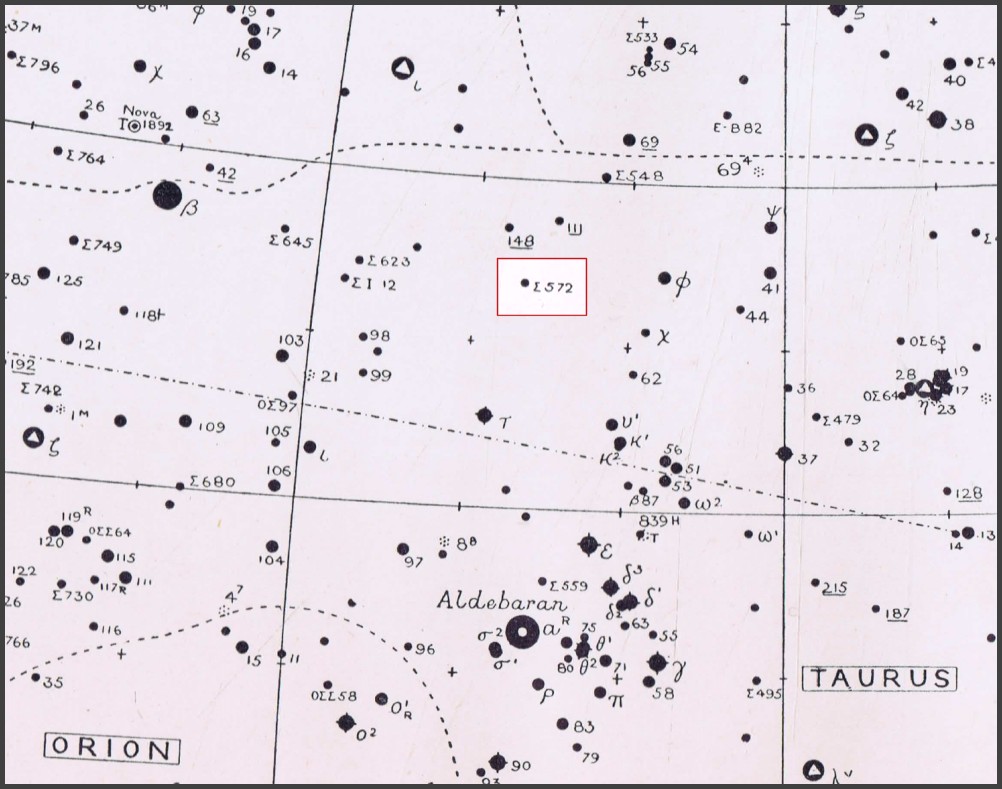
I spotted this pretty photo of a crescent moon with bright earthshine two days ago and got permission to borrow it this morning from the observer. For a "DR" starting point, I only tell you that the photo was taken from somewhere in the western hemisphere. The date and time: 29 April 2025, 02:58:19 UT. As with any case of measuring "lunar distances", we do need to be able to identify the stars we use. In this photo, the relatively bright star above the Moon is a star that has been catalogued as a double since at least 1822. It is "Σ 572" (That's sigma for "Struve" and without the Greek letter, it's also listed as STF 572). Here's an online entry with details on its binary nature: Σ 572 at stelledoppie.it. I'm including a small capture from a portion of chart 5 in the original edition of Norton's Star Atlas from 1910 (available in high-resolution at archive.org, by the way). I have highlighted Σ 572 mostly to illustrate how long this star has been known and studied, despite being only about magnitude 6.5. The fainter star to the right of the Moon has the variable star id "V833 Tau". Here's an online entry with details on this second star: V833 Tau at SIMBAD. You don't need the details if you search for these in "Stellarium" but the details do include alternate designations (like SAO, HIP, HD, Gaia catalog numbers) which can help confirm that you have the right stars. Note that some of the "stars" in the original image are just hot pixels.
Can you determine your latitude and longitude? And what kind of error bars can you place on that position? Suppose that your angular "lunar distance" measures are uncertain by some amount (you decide how much, based on the photo). How much would that shift your position? And suppose the UT time of the photo is wrong by +/-1 second. How much would that affect your position?
Frank Reed
Clockwork Mapping / ReedNavigation.com
Conanicut Island, North America