NavList:
A Community Devoted to the Preservation and Practice of Celestial Navigation and Other Methods of Traditional Wayfinding



From: Frank Reed
Date: 2025 May 1, 08:23 -0700
David C, you wrote:
"The interviewee stated that the very last American sail whaling ship to visit NZ was the Charles W Morgan in 1895. Was this the same ship? Do any of the Morgan's logs cover its travels in NZ waters?"
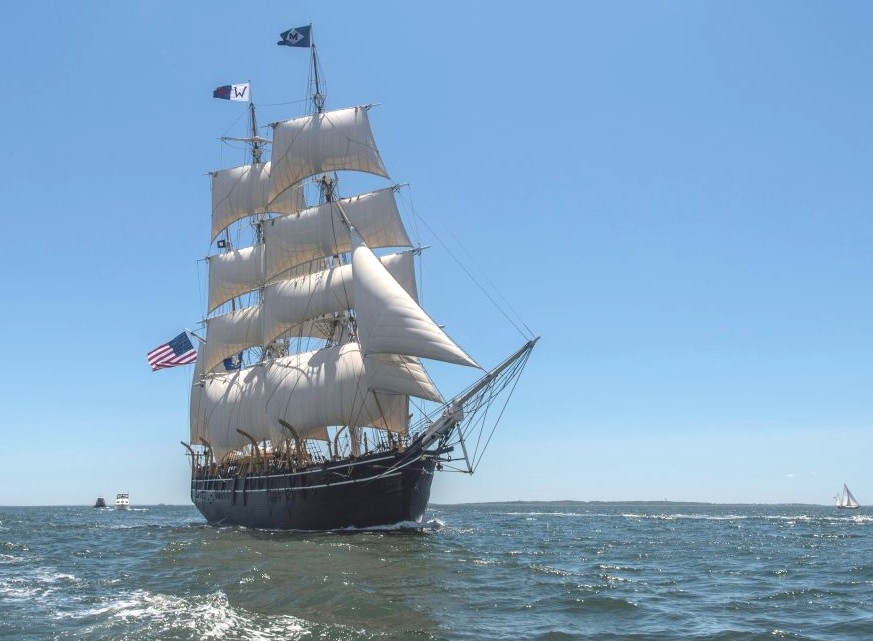
Yes, there is only one! And of course this is now the last survivor of the 19th-century American whaling fleet, the premier exhibit vessel at Mystic Seaport Museum, where I have long affiliations, and where I sometimes teach celestial navigation even now. The Morgan has been restored and renewed many times. At this point it is roughly 10% "original fabric" mostly in the keel and the stern below the waterline. If you see any recent photos of it, like the one I am including in this post, it's interesting to consider that not one plank, beam, or spar that you can see in photos above the waterline, and certainly not the sails or any other more ephemeral components, is older than about twenty years. Wooden ships must be continuously rebuilt if they are expected to remain afloat and seaworthy (whether there is money to sail or not). Of course, this is a decision, a choice on the part of the owners and caretakers of this historic artifact. They could have hauled the vessel out of the water in the 1940s not long after it arrived at the museum. Or again in the early 1970s when they decided to remove it from a sand berth where it had been beached for decades... But the decision was made, and now the Morgan demands continuing renewal.
In 1895 the Charles W Morgan was already among the last representatives of the traditional whaling ships. It's an odd thing in the history of technology and industry: the sailing ships in the American whale fishery c.1900 were essentially unchanged from the ships in the boom period, roughly sixty years earlier. The techniques of whaling, the pursuit in small open boats, the bloody and wasteful processing of the whales, and the suite of tools: harpoons, spears, cutting blades, tryworks, and oil barrels... had scarcely changed. In part this was because some of these ships were so well-built. The Charles W. Morgan was built in nine months in 1841 near the peak of the whaling boom and launched on that first whaling voyage almost immediately, in early September 1841, joining hundreds of other New England vessels in a fleet far larger than the US Navy at that time. New England whaling "owned" a large fraction of the Pacific Ocean.
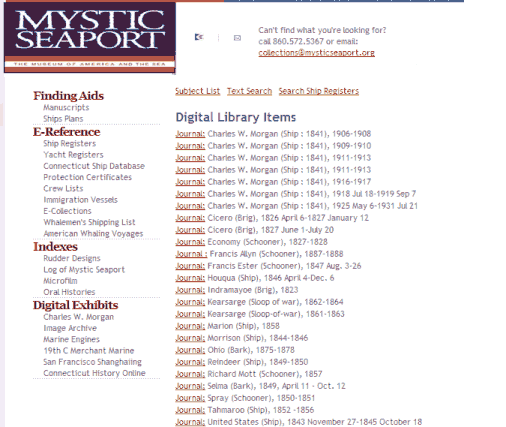
My workshop "Celestial Navigation in the Age of Sail" focuses on one of the Morgan's whaling voyages in 1897. That year, and in most years in this period, they did their "fishing" in the waters around Japan, especially the Kurile Islands, and into the Sea of Okhotsk. There are logbooks and other records surviving for some but not all of the voyages in this period. I haven't looked at any that mention New Zealand specifically...
Frank Reed