NavList:
A Community Devoted to the Preservation and Practice of Celestial Navigation and Other Methods of Traditional Wayfinding



From: Frank Reed
Date: 2025 Jun 14, 08:56 -0700
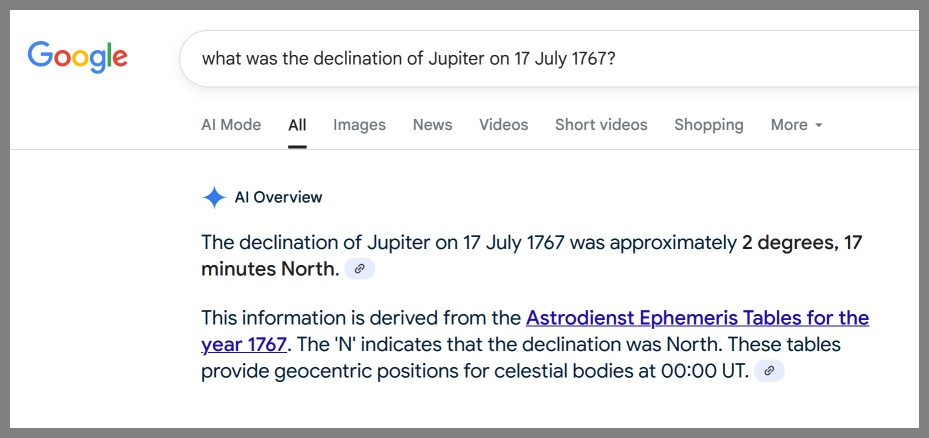
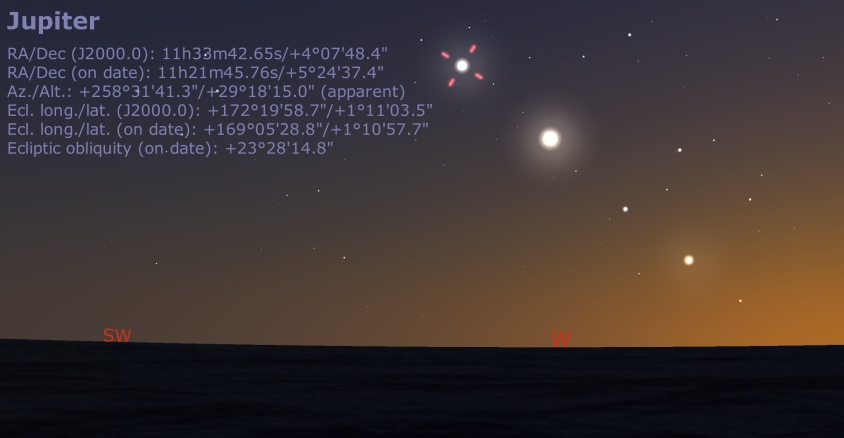
I was thinking about the first published edition of the British Nautical Almanac today. It has ephemeris data for the year 1767. I decided it would be fun to ask Google if it could look up the declination of Jupiter for a random date: 17 July 1767. Its A.I. agent did as requested and also provided its source, which is an astrological ephemeris --see below. The astrological ephemeris appears to have good data, which is not unusual (astrologers generally follow the rules), but apparently the A.I. tool either did not properly read the tabular data, or it defaulted to a "close enough" hallucination. I can't see any obvious route that leads to the A.I. listed value for the Dec of Jupiter on this date. Anyone else? Did it get the month wrong? Or did it mis-read the astrological symbols for the planets? More generally, what do we learn about A.I. from its peculiar choice of an astrological ephemeris here? As in so many other cases, this A.I. tool acts like a "nerdy child" raised on the internet. It knows how to look things up, but it doesn't do it quite right, and it has no "judgement" whatsoever, no apparent standard of quality.
Just some "food for thought"...
Frank Reed