NavList:
A Community Devoted to the Preservation and Practice of Celestial Navigation and Other Methods of Traditional Wayfinding



From: Paul Hirose
Date: 2025 Apr 18, 12:00 -0700
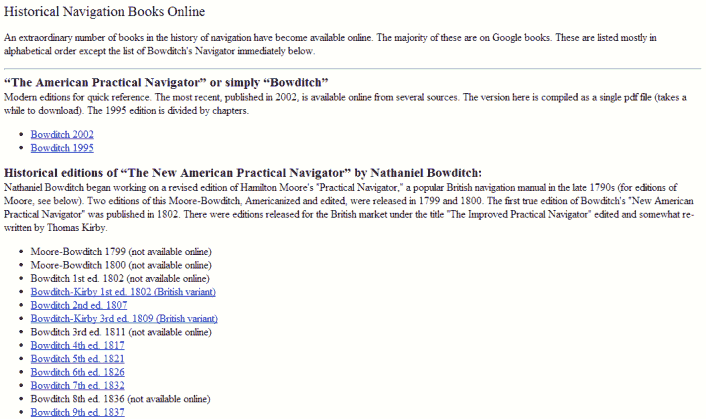
For many years Bowditch had (and may still have) a remark on the Carnegie Institution dip of the horizon measurements. For instance, the 1981 edition of volume 2 says, "An investigation by the Carnegie Institution of Washington showed that of 5,000 measurements of dip at sea, no value differed from the tabulated value by more than 2′.5, except for one difference of 10′.6."
https://archive.org/details/americanpractica0002nath/page/546/
I have traced this as far back as 1943. In that edition the words are a little different:
https://archive.org/details/bowditch-1943-new-american-practical-navigator/page/n161/
It says the measurements occurred "in the course of the Magnetic Survey of the Oceans." Following that clue, I found "Results of dip-of-horizon measurements made on the Galilee and Carnegie, 1907–1917."
https://zenodo.org/records/2244911
The document mentions 3000 observations and mentions some devices employed to measure dip. One, by Zeiss, is described at considerable length.
And there's "Ocean Magnetic Observations 1905-1916"
https://archive.org/details/carnegieinstitut17503carn/page/154/
The latter says "observations were also made to determine the amount of atmosphere refraction by measuring the dip of the horizon with the dip-of-horizon measurer made by Cars Zeiss, of Jena. A future special report will deal with this subject."
I have not seen that special report. Nor have I found the original source for the dip statistics on 5000 observations, mentioned in Bowditch.
In "Ocean Magnetic and Electrric Observations, 1915-1921" (Carnegie Inst. 1926) see "Progress in Astronomical Airplane Navigation."
https://archive.org/details/oceanmagneticele00carn/page/326/
In conclusion, the author says, "the rapidity with which aircraft travel makes it necessary to keep fairly accurate knowledge of the geographical position at all times. Future air-travel will demand a more accurate method for knowing this position than can be provided by astronomical means. This method undoubtedly will be furnished in the very near future by improvements in radio knowledge and in the adaptation of instruments for the navigation of aircraft by the use of radio."
--
Paul Hirose
sofajpl.com