NavList:
A Community Devoted to the Preservation and Practice of Celestial Navigation and Other Methods of Traditional Wayfinding



From: Frank Reed
Date: 2026 Apr 3, 13:54 -0700
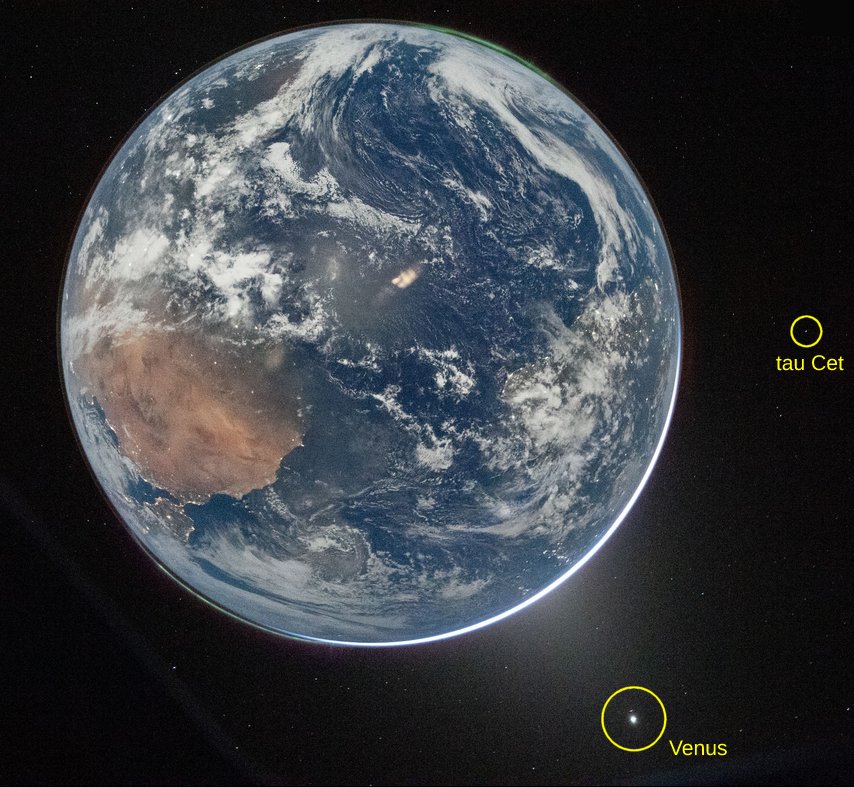
NASA today released a photo taken by handheld camera shooting out one of the windows from the Orion spacecraft. They have not explained very well that this is a photo of the dark side of the Earth... the Earth at night. You can see the lights of cities.
The image is South up. You can see the Straits of Gibraltar toward the lower left. And of course the big, barren tan/brown region in the photo is an actual big, barren tan/brown region: the Sahara. Since the exposure picked up all these features on the dark side of the Earth, it also picked up many faint stars and at least one bright one. Toward the lower right, that's bright Venus. The Sun is behind the Earth. The illumination on the Earth's limb that we see is very early twilight over Central America.
I was going to torture you all and ask if you could identify any stars in the photo. But no, that would be cruel! Instead I used my apparently superhuman star identification sense and looking around the limb of the Earth I spotted a familiar pair of triangles located about halfway between the navigation star Diphda and the South Galactic Pole. These are 5th and 6th magnitude stars, but for reasons that only the pattern-processing parts of my brain can explain... these jump right out whenever I see them in a photo. That places Diphda just behind the Earth's limb, along with are a number of stars in Cetus.
There's a star in Cetus with some pop culture fame this month. It's the nearby star "Tau Ceti" which has been used in science fiction many times. Currently it is the focus of much of the plot in the mega-hit movie "Project Hail Mary". So this photo from Artemis captures the Earth at night, the planet Venus, and the pop culture star of stars this Spring, Tau Ceti. Nice. :)
Frank Reed
Clockwork Mapping / ReedNavigation.com
Conanicut Island USA