NavList:
A Community Devoted to the Preservation and Practice of Celestial Navigation and Other Methods of Traditional Wayfinding



From: Frank Reed
Date: 2025 Sep 21, 14:12 -0700
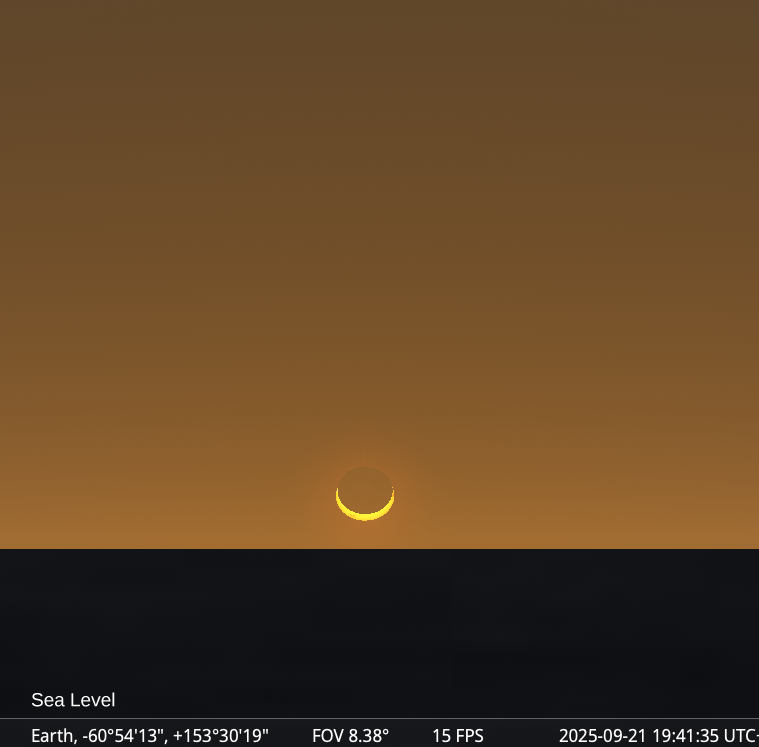
According to Wikipedia, today's eclipse had its greatest depth in the Southern Sea approaching Antarctica from New Zealand. The "crescent Sun" would be sitting just above the horizon very close to due east. From that location the eclipse remains partial but 88.5% of the Sun's diameter is covered.
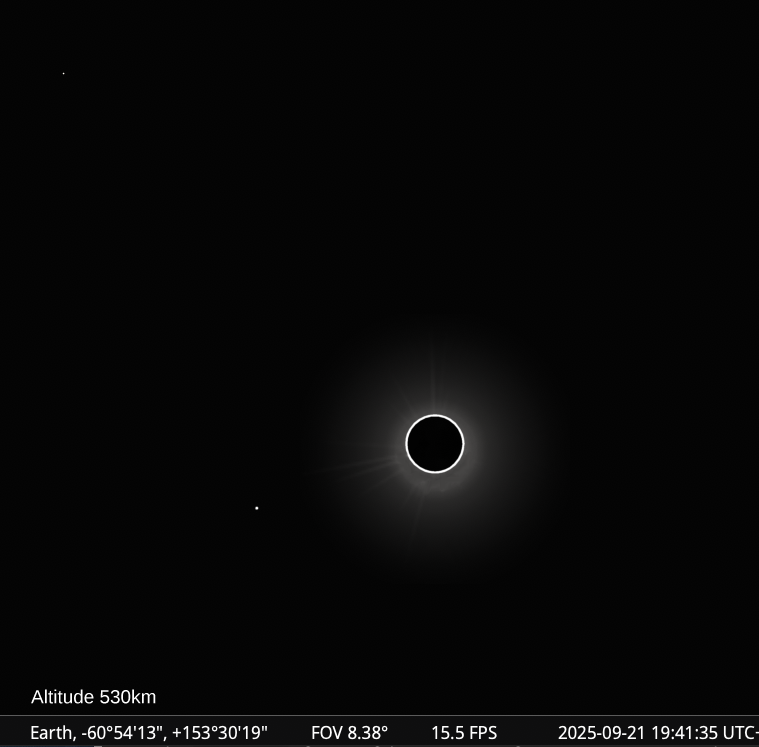
That got me thinking... If I "jump" up in the air, I could leap into the cone of the eclipse? Oh, but the SD of the Moon today is less than the SD of the Sun so that would only get me an annular eclipse. Still, I wondered, how high do I have to jump? I worked out that it's about 530km high. At that height there are plenty of satellites, so some of them would have passed through the annularity cone.
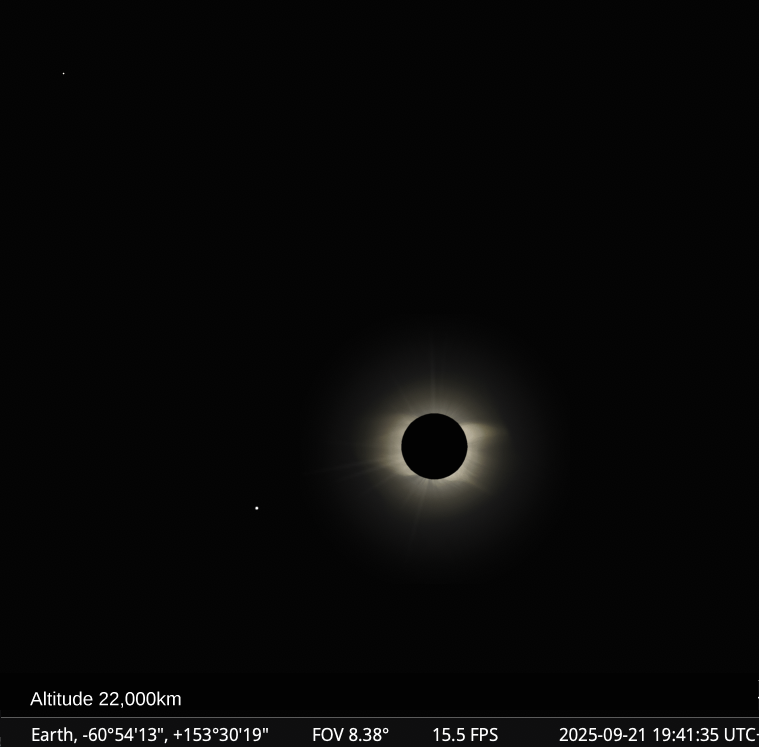
From 530km high as my starting point, if I don't fall back under the influence of gravity, I could "turn hard left" and zip out towards the east --just point at the center of the eclipsed Sun-- and fly towards the Moon until its diameter increases sufficiently to turn my annular eclipse into a total eclipse. That happens about 22,000km above the Earth in that direction. From there the brilliant disk of the Sun is eclipsed, and the corona would be visible. Many stars would be visible, but if you were to look at the Sun and its corona, your dark adaptation would reduce and you would see only a fraction of the stars...
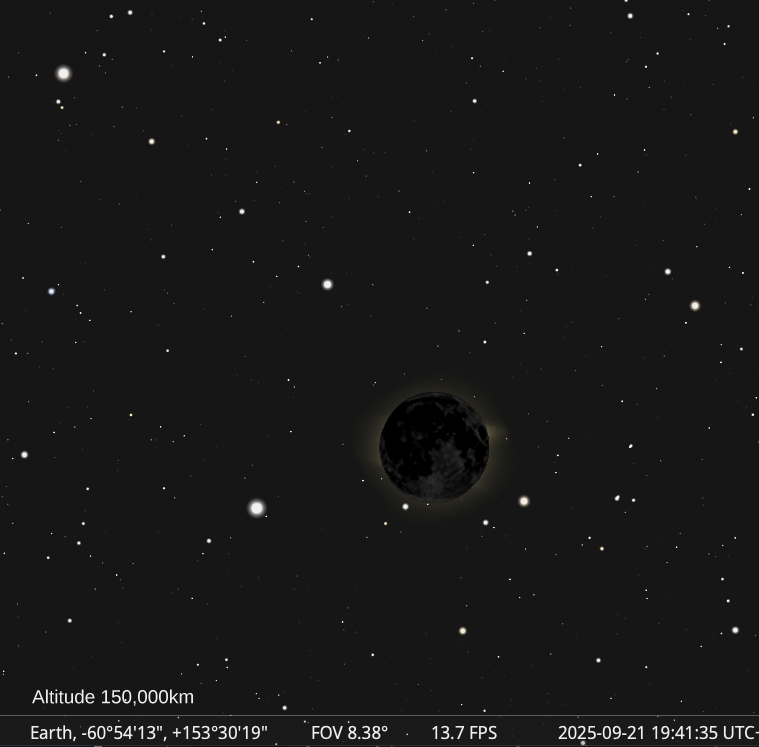
I can continue further. If I keep on in that same direction, I can further increase the Moon's apparent diameter and hide most of the corona, too. Then the usual thousands of naked eye stars would be visible easily and the features on the Moon's face, illuminated by bright earthshine, would be visible, too. See the attached images for illustration...
Frank Reed