NavList:
A Community Devoted to the Preservation and Practice of Celestial Navigation and Other Methods of Traditional Wayfinding



From: Frank Reed
Date: 2025 Jun 27, 04:11 -0700
Nice navigation, David Pike. Was the clue about a nearby star the key? Yes, that's Tau Ceti. And yes, you're right about the location at KSC and the landed booster from the Axiom-4 launch. That booster sent four astronauts into orbit just minutes before...
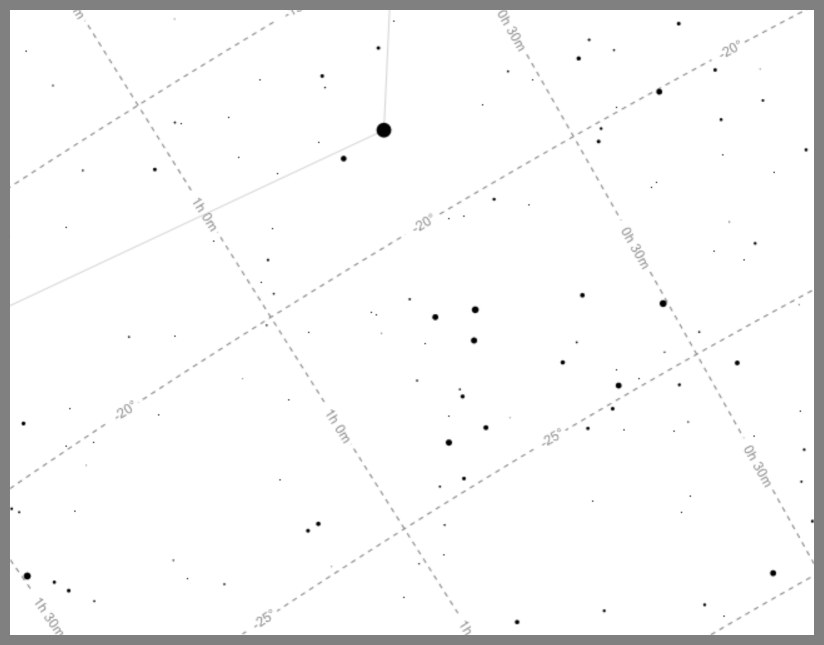
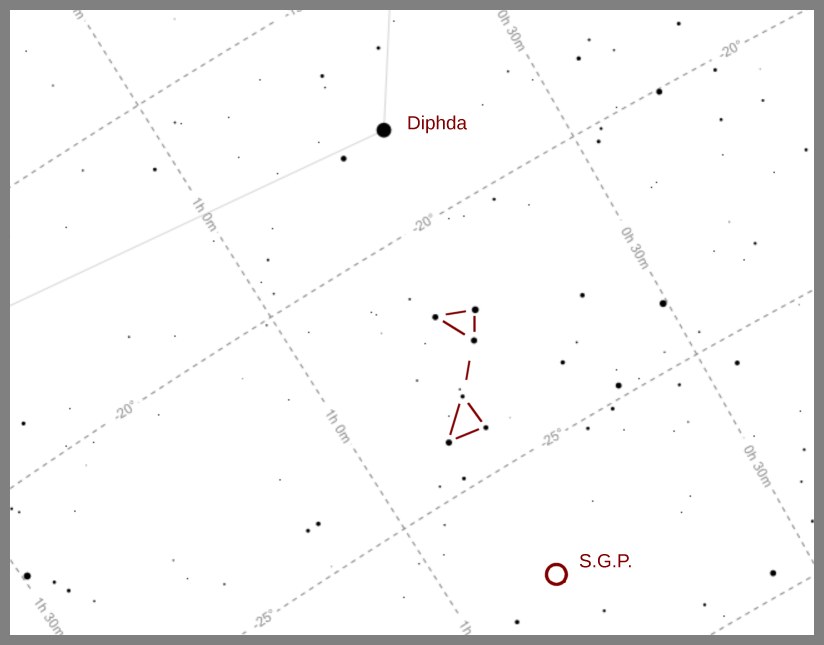
The constellation Cetus is difficult to spot since it has no bright stars and few recognizable "patterns". But there are two patterns that I have found familiar and useful over the years. There's a pair of relatively faint, small, nearly equilateral triangles quite close to Diphda. These "jump out" in some photos, including this one --once you get to know them (and I don't expect anyone else to know them yet, but, as I said, for me, this was the key to puzzling out the star field). This pair of little triangles is useful both for identifying Diphda and for finding the "SGP" or "South Galactic Pole". See the images below.
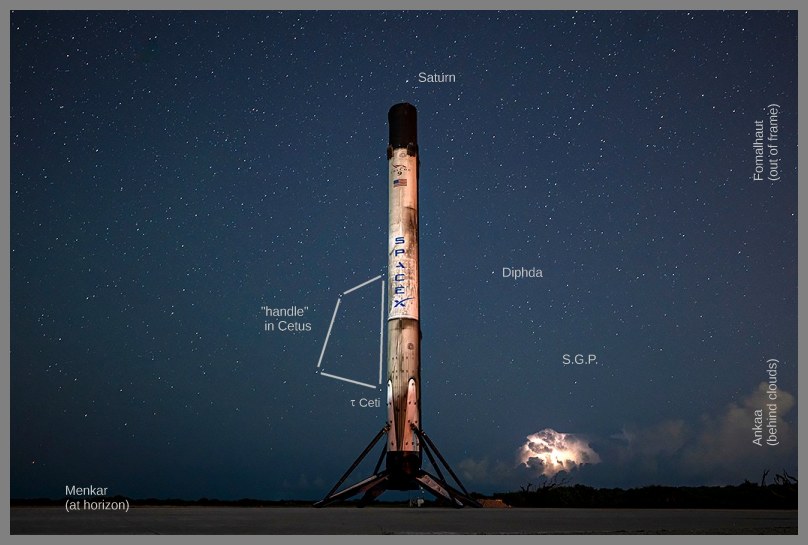
The second feature that I find useful in Cetus is a large "teapot handle" about 10° across consisting of tau, eta, theta, and zeta Ceti. The shape closely resembles the handle of the popular "teapot" asterism in Sagittarius which is made from the stars tau, zeta, phi, and sigma Sagitarii (the latter is "Nunki"). The handle in Sgr is about 5° on its long side, while the "handle" in Cet is 10° on the long side. Notice in the photo that the long side of the "handle" happens to be resting vertically against the side of the rocket. You could grab it and pick it up! See the marked-up image below.
By the way, the glowing mass that looks like a "burn in the background" is an internally illuminated thunderstorm. These often turn up in time exposures in flat country this time of year. They can be quite spectacular.
Frank Reed