NavList:
A Community Devoted to the Preservation and Practice of Celestial Navigation and Other Methods of Traditional Wayfinding


From: Frank Reed
Date: 2025 Apr 21, 08:22 -0700
Somehow, seeking the most complicated, arcane, and mathematically "ornate" solutions to problems has become popular among some navigation enthusiasts in the past few years as celestial navigation continues its decline. Don't forget this: easy solutions are brilliant solutions. The goal of my app is to make the comparison between sextant reading and reality easy. Whether that's easy enough to be brilliant, depends on the reviewer.
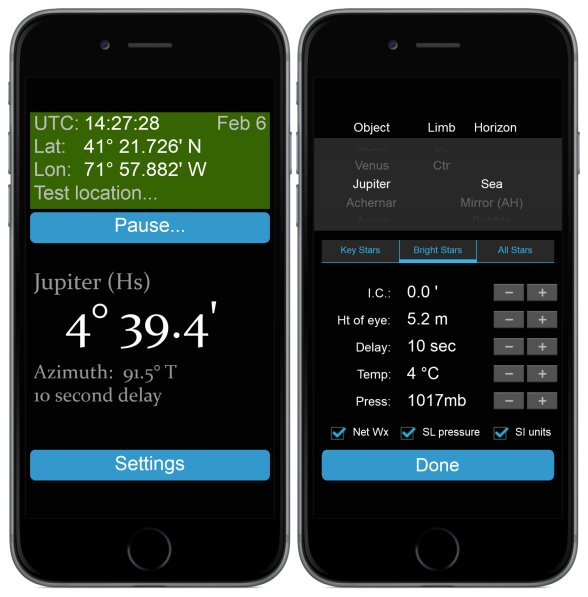
How do you test your observing skills and your sextant using my app? First, you need to decide that you are in a regime where you "Trust the GPS" (see my outline and advice on the app here: ReedNavigation.com/GPSantiSpoof/ ). Next hit the Settings menu and enter a few details. What object are you looking at? Select an appropriate limb and horizon type. What is your height of eye? The selectable heights might seem odd (...17.9, 18.8, 19.6, 20.6... in feet). Why those numbers? Decide on a delay. I suggest ten seconds since most navigators can learn to count to ten in seconds, and that's a reasonable amount of time to get to the app and press "pause". Enter your index correction (I.C.) if any. Adjust the temp and pressure if you need to (these weather data, Wx, are picked up from the internet if possible, but you may prefer to enter them manually). Then you're all set.
The altitude you get from the app is exactly what you should see on your sextant. There's nothing to do. Just compare and go. Pause ten seconds after your call of "now" or "mark" when you take the sight. Then un-pause to go again. Write down the difference if you're collecting stats on your sextant. If you're learning, and you find errors larger than ten minutes in your first hour or larger than three minutes in any later hours, then start thinking about what you might be doing wrong.
A reminder: standard celestial navigation is never quite correct on our gravitationally "lumpy" planet. Carefully surveyed latitudes and longitudes, which is what we get from GPS/GNSS, too, differ in some parts of the world by a mile or even more from astronomically-measured latitudes and longitudes. Few sources in modern celestial navigation analysis even acknowledge this at the most basic level. But it's built right into my apps. The altitude you see in the app includes that DOV or gravitational "deflection of the vertical". Note: DOV is near zero in "old", quiet geology, like nearly all of the US east coast; it is significant in "young", geologically active regions, like the Caribbean. If there are active volcanoes, ocean trenches, earthquakes near you, you can expect "measurable" corrections due to gravitational anomalies. You don't have to think about it. It's built into the app. It's easy.
Finally, yes, it works at sea and in other off-internet locations (like the hills of Marin County, California). No internet is required for normal use.
Frank Reed
Links to download the app, standard or pro, here: ReedNavigation.com/GPSantiSpoof/ .