NavList:
A Community Devoted to the Preservation and Practice of Celestial Navigation and Other Methods of Traditional Wayfinding



From: Frank Reed
Date: 2025 Sep 14, 12:08 -0700
I wasn't quite sure what you meant, at first, but then I remembered that in UK latitudes, the Moon in some seasons is barely visible thanks to negative Dec and positive Lat [meridian altitude =(90-Lat)+Dec so if Lat is +50, for example, and Dec is -28, then the maximum altitude of the Sun will be about 22°!]. Since the Moon right now is at high positive Dec, it's a good opportunity to see both Moon and Sun high in the sky, about 40° above the horizon at 10am, as you mentioned, and nicely separated. They're separated in azimuth which permits a nice mid-morning two-body fix by altitudes. They're also widely separated in angular distance across the sky, which allows a nice "lunar" or "lunar distance" sight. This was one of those times when 18th and 19th century navigators would have said "the Moon is in distance". That, by context, meant that the Moon was close to 90° in distance from the Sun, and, therefore, it was a good, convenient time for daytime lunar distance sights, as it is, also, this weekend.
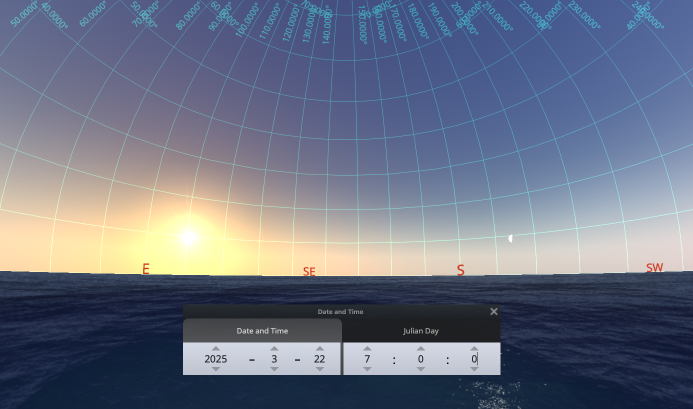
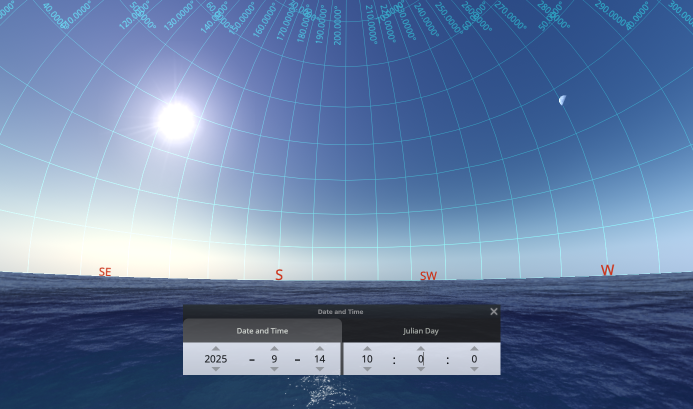
I compared today with a similar date six months ago. Stellarium simulations for 50°N, 1°E attached below... The Sun and Moon could both be found in the sky then, too, but their altitudes were much lower, and the period of time when both were in the sky was much shorter. Also, that was at 7am, which is a bit less "civilized" (for me, at least!). For anyone thinking of demonstrating lunars in the UK, you have to plan a little more carefully for appropriate dates.
Frank Reed