NavList:
A Community Devoted to the Preservation and Practice of Celestial Navigation and Other Methods of Traditional Wayfinding



From: Frank Reed
Date: 2026 Jan 4, 17:33 -0800
David Pike, you wrote:
"If you can see the First Point of Aries, then you are truly blessed."
Yes. Ram Vision. I can see that little Aries symbol on the sky out of the corner of my eye. But if I look straight at it, it disappears.
And yes, this year, Saturn is our "Aries finder". It's very close to the Aries meridian as well as the celestial equator. That places it close to 0° RA (equivalently 0° SHA) and 0° Dec.
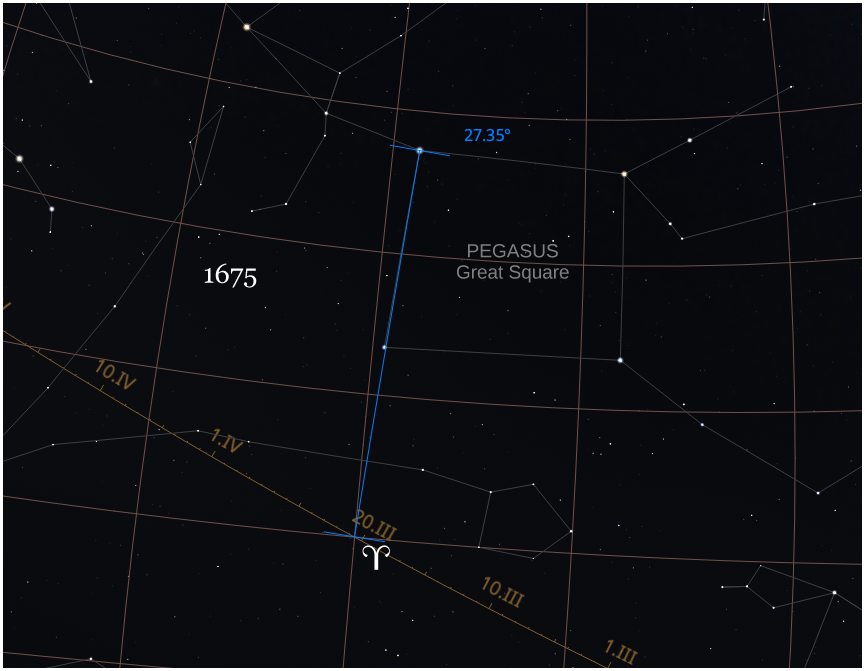
It used to be easier to locate that fiducial point in the sky. If you looked up at the sky in... oh, let's August of 1675, just to pick a random month in the history of nautical astronomy... you would have had an easy trick for finding Aries. Go to the trailing edge of the Great Square of Pegasus. Draw a line from Alpheratz, at the north trailing corner of the Great Square through the south trailing corner. That length is 14°. Extend the straight line down toward the south almost that same length, and that will put you right at 0° Dec, 0° RA/SHA (within a degree, really close). This was no coincidence. It was by royal decree! When Charles II established the Royal Observatory at Greenwich that year, he also arranged to move the stars in the Great Square so that they would line up perfectly with that founding stone of celestial coordinates. ...It's good to be the king.
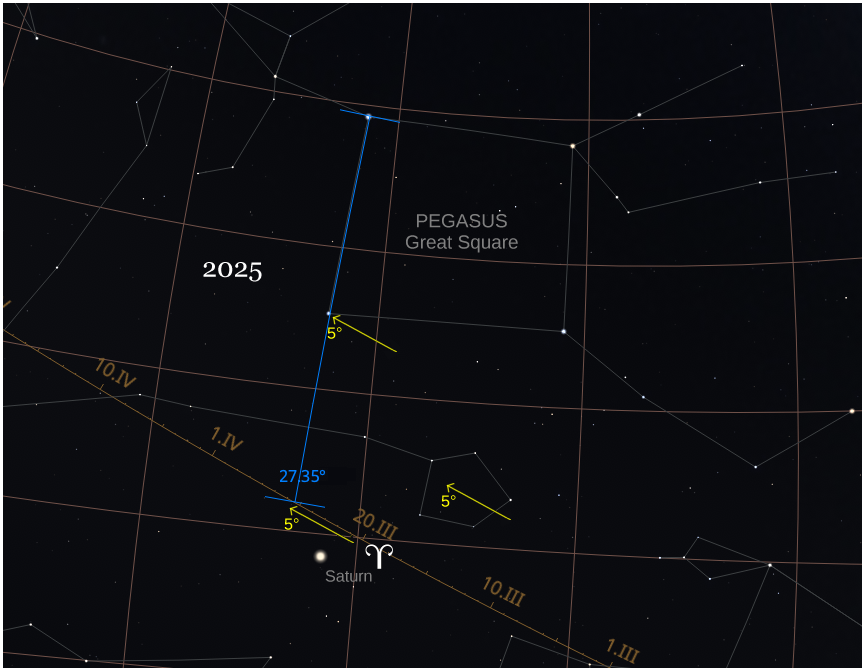
Now we move ahead 350 years. Last year was the 350th anniversary of the founding of the Greenwich Observatory, devoted to solving the problem of longitude. In those three and a half centuries, the Earth's axis has precessed. It amounts to just about 5° in 350 years. Precession, at the level of a very good approximation, is very simple when we look at the changing positions of the stars relative to the ecliptic. The celestial sphere is simply (approximately) rotating about the axis perpendicular to the ecliptic, about the ecliptic poles, so the stars appear to slide across the sky, through the RA/Dec coordinate grid, on paths parallel to the ecliptic. That means that the line through the trailing side of the Great Square no longer points at the Aries point. Instead it points, at the same distance, a little less than 28°, to a spot just five degrees up the ecliptic, in the same direction that the little constellation of Aries has moved over the centuries. Or to turn it around that key crossing point in celestial coordinates is drifting down the ecliptic and has shifted by 5° away from the constellation Aries in the 350 years since this nice Great Square trick worked so well.
The Great Square trick is still rather good. If you can remember to take a 5° dogleg at the bottom, you can still get very close to the right spot. But remember, there's nothing there! There are no bright stars, not even any middling bright stars, in that little region of the sky. Saturn is conveniently close this year, but it won't be next year.
Frank Reed