NavList:
A Community Devoted to the Preservation and Practice of Celestial Navigation and Other Methods of Traditional Wayfinding



From: Frank Reed
Date: 2026 Jan 17, 14:48 -0800
You're flying on an interstellar journey, passing near Earth. Let's assume you're travelling at 10% of the speed of light so that aberration of starlight is not a complicating factor. Also assume in this scenario that you are flying straight towards the First Point of Aries --towards SHA=0° and Dec=0°.
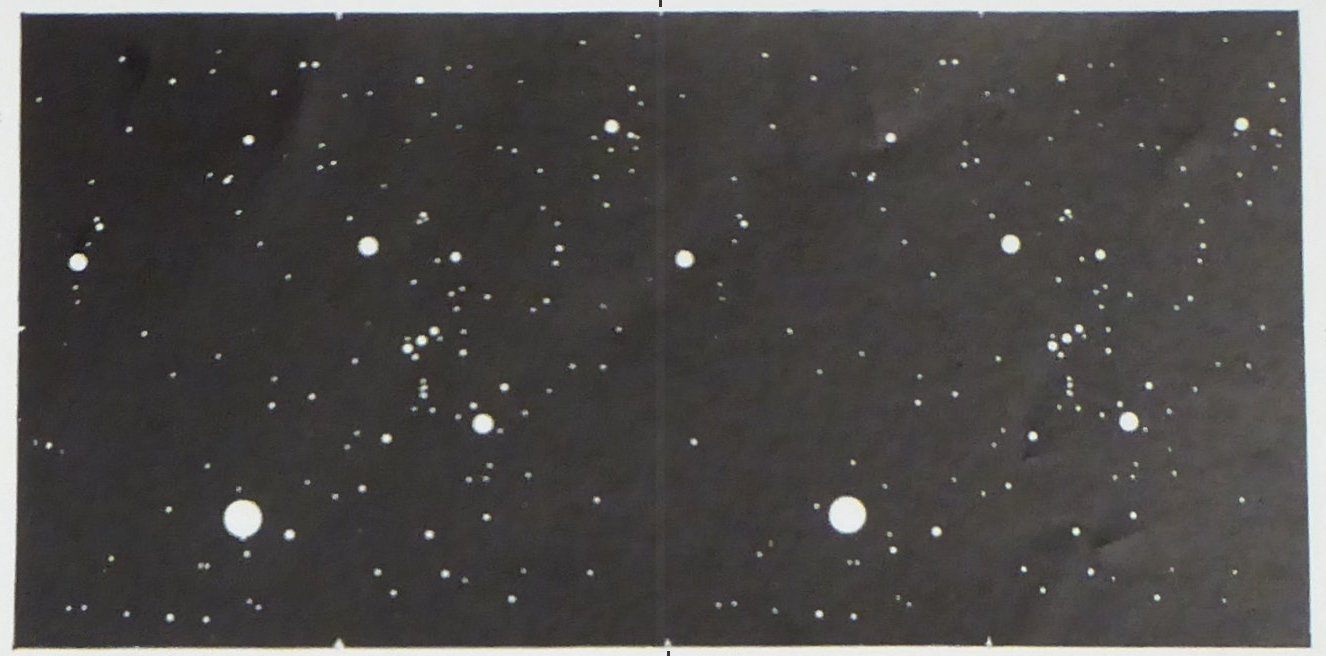
On your journey you draw the stars you see and compare the views after a few years side-by-side. That's what is in the image below. I'm sailing towards Aries, and looking abeam to "port", I see the constellation Orion and the stars around it, including Sirius, Procyon, and Aldebaran, among others. The stars of Orion are extremely distant, so their positions do not change noticeably as we fly. But Sirius and Procyon are among the closest stars. Their positions shift.
In the combined view below, you can imagine that you drew the left-hand view first and the right-hand view some years later. See the change? The nearby stars, Sirius and Procyon, have moved. So navigate! How far have you travelled? And for extra credit, how many years have elapsed between the two different views?
If you're thinking about spherical trigonometry, step back... You need very little math to solve this, and the only navigation background you need is an understanding of coastal piloting. Think of the stars of Orion as a moderately distant coastline... Think of Sirius and Procyon as two lighthouses on nearer islands... This image was actually published 120 years ago as a "stereoscope" view, and a sailor familiar with coastal navigation back then would have had the navigational skill required to solve this.
Some info you'll need [you could confirm on Wikipedia]: The distance to Sirius is 8.61 lightyears. The distance to Procyon is 11.46 lightyears.
Frank Reed