NavList:
A Community Devoted to the Preservation and Practice of Celestial Navigation and Other Methods of Traditional Wayfinding


From: Frank Reed
Date: 2025 Jan 10, 19:11 -0800
David P:
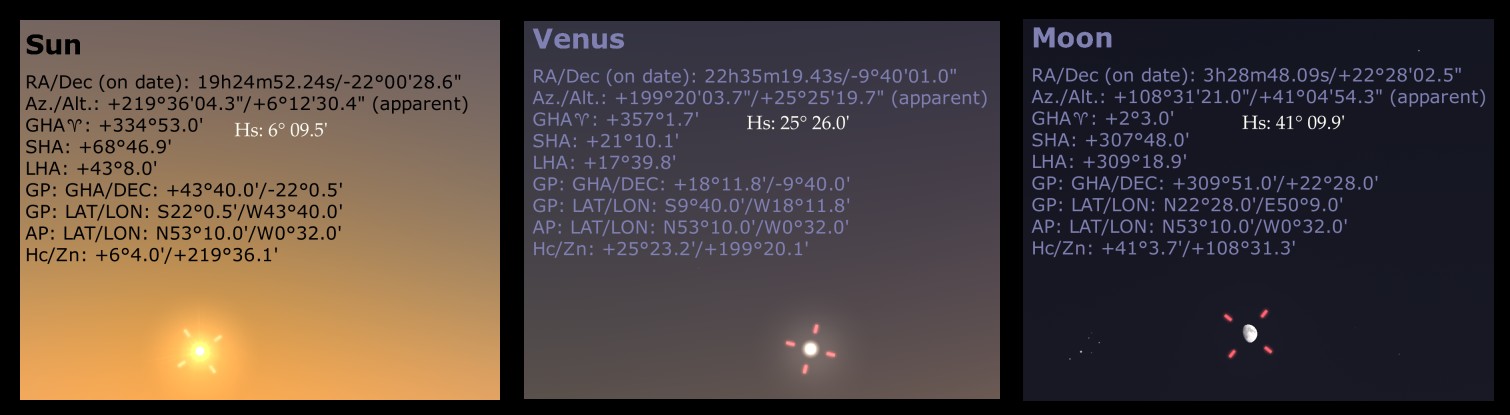
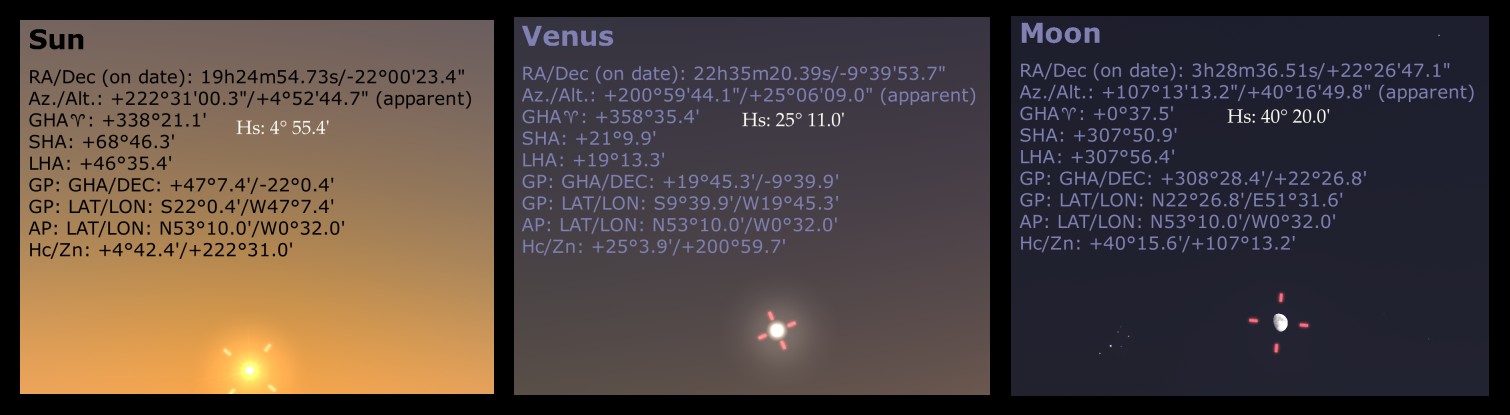
Here's a different way to look at the analysis. I simulated the view from your "DR" at the required UT times in Stellarium. Then we can directly compare the apparent altitudes with your observed Hs values. This works well with Stellarium and aviation sextants since Stellarium's altitudes have no dip and assume center of body. The altitudes do include refraction and parallax, so actually this is just what we're looking for... The refraction has been adjusted for temperature and pressure given your values (*). I ignored your index corrections since they were all a minute of arc or less.
I prepared a little tableau for each observer (DP and JGP, as indicated by the file names). I like the way the sky proceeds from late in the afternoon through early and later twilight, darker and darker from left to right, as we pass from Sun to Venus to Moon sights. Both tableaus attached below...
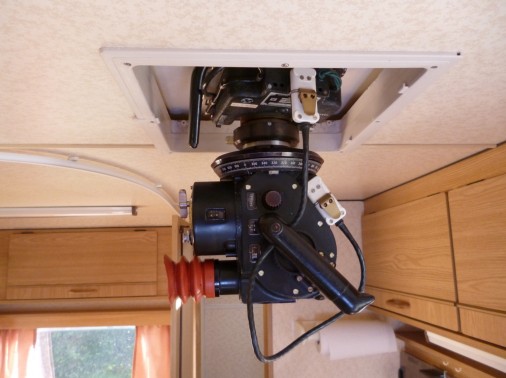
I highly encourage any of you who missed the details to go back and read about David Pike's "Astrovan", his educational sextant observation platform. It's a wonderful thing! Here's the link to his post in late November (now with file preview images), and don't miss the alien invasion of the Astrovan in early December. One file in David's original post was a PPT presentation. Since some of you may not have a viewer available for a PPT, I have made a pdf of the images in that presentation, which I am also attaching below.
Key note: Although we are accustomed to cleaning up observed sights, rendering them to Ho values, and then comparing (subtracting) from Hc values to get intercept distances, it is equally valid to compae calculated Hs values directly with observed values. That process yields identical intercept distances. In the Stellarium simulations below, I have added in the corresponding Hs values (again, I have ignored index corrections) right below the predicted apparent altitudes. They should match. The differences are the intercept "a" values, and in this case, observers at known location, the intercept values are a direct measure of observation error.
Frank Reed
* To adjust refraction for temperature and pressure in "Stellarium", you'll need to poke around a bit. Open the "Sky and viewing options" dialog (F4). The box on the top left covers "Sky" options and the fourth item down is "Atmosphere visualization". On that line in the dialog window, you will see a "wrench" icon. Hit that and you'll see "Refraction settings" where you can adjust T and P.