NavList:
A Community Devoted to the Preservation and Practice of Celestial Navigation and Other Methods of Traditional Wayfinding



From: Frank Reed
Date: 2025 Sep 6, 10:03 -0700
David P., you wrote:
"Ah! You mean that black patch at the left is the photograph, and that little white dot is a star. I thought it was a speck of dust on my screen."
It's not obvious, right? That's why I previously asked Dave Walden for some clarification. You added that the puzzle, as originally (presumably) intended by DW is "way above my paygrade."
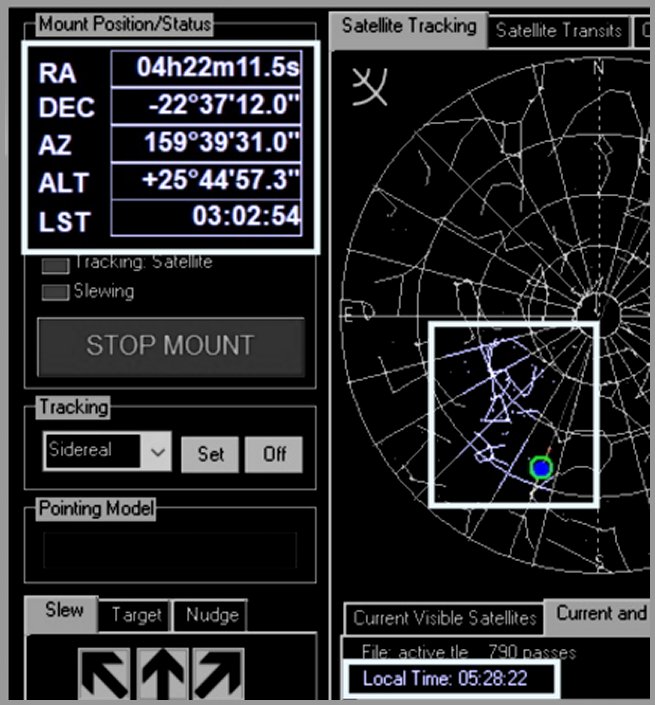
But there's still a puzzle here that I believe you and some others would enjoy. If we take a slice out of that screen capture, as attached below, it shows some details that you can use to get a fix. Note that the date, which was implied in the original post, and found in one far corner of the original image, was 1 Sep 2025. We can also count as "known info" that Dave Walden is somewhere in the general vicinity of Washington, DC / Northern Virginia (based on other posts he has made) which implies a zone offset to UT of 4 hours. The time is indicated as local time in the screen capture. Note also that the app is showing a value for LST (Local Sidereal Time).
Why does this info provide a position fix? The app as displayed, we may suppose, is showing us the coordinates of some point in the sky in both equatorial coordinates (RA and Dec) and also in local coordinates (Azimuth and Altitude). It may be useful to convert from the astronomers' friends, RA and LST, to coordinates for navigators, SHA and LHA Aries, would be equivalent. See how this would work? If you have the exact azimuth and altitude of a navigation star, let's say Rigel (which isn't far away from the specified location in this puzzle), at a known UT, then we have a position fix! The available coordinate data are not tied to a known navigation star, but the principle is exactly the same. It's one way to get an interesting puzzle and solution out of this. There's a long way around to the solution, by writing equations and solving triangles and all that. There's also a shorter way, using sky simulation software/apps. Set the date and time. Drop in a lat/lon. Does the transformation from RA and Dec to Azm and Alt yield the right values? Try another lat/lon? Better? Continue... Worse? Go back...
Anyway, you and some others may find this a worthwhile, fun, and arguably instructive puzzle when viewed this way. I think so at least!
Back to Dave Walden's original puzzle, that's more difficult. You have to calculate the predicted satellite position and see how it compares with that streak in the little photo. Since I was able to identify the "bright" star (magnitude 6 if I remember correctly), that, too, is a solvable puzzle and certainly more interesting as navigation. But we can get to that later... :)
Frank Reed