NavList:
A Community Devoted to the Preservation and Practice of Celestial Navigation and Other Methods of Traditional Wayfinding



From: Ian Staniforth
Date: 2026 Apr 6, 12:36 -0700
Hi Dave. Sure. Here goes...
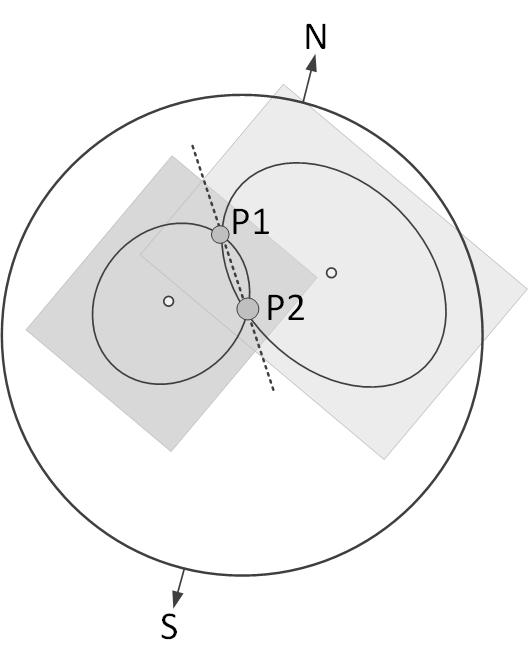
The set of points for which the measured height Ho of a celestial object is the same defines a "circle of equal altitude" on the globe - first described by Sumner in 1843. The circle has centre (GHA,dec) and radius z=90°-Ho. Two objects therefore define two circles which intersect at two distinct points (there is a degenerate case when the azimuths differ by 180°). James Van Allen* published an analytical solution to the "two star sight problem" in 1981. His method starts with the observation that a circle on a sphere is defined by the intersection of a plane with the sphere in 3-space. He derives the equations for the two planes corresponding to the two circles in 3-dimensional rectangular coordinates. He then solves the resulting linear simultaneous equations to obtain the line of intersection of the planes. This line intersects the sphere at two points - the solutions of a quadratic equation. The rectangular coordinates of these two points are converted back to polar coordinates to give the Lat,Lon of the two intersection points on the sphere. Choose the solution closest to the DR position (or take a third sight, which will give a unique pairwise solution).
* Van Allen, J.A. (1981), An Analytical Solution of the Two Star Sight Problem of Celestial Navigation, NAVIGATION, 28(1), 40-43. [Preprint available as a pdf file at https://apps.dtic.mil/sti/tr/pdf/ADA098626.pdf ]
Yes, it's THAT Van Allen (of belt fame).
There are now many equivalent methods in the literature. Andrés Ruiz, who is occasionally on here, published a vector solution in 2008.
I've tried to give simplified descriptions of some of the modern methods, along with programs that implement them, in my book Notes on Celestial Navigation.
Best
Ian