NavList:
A Community Devoted to the Preservation and Practice of Celestial Navigation and Other Methods of Traditional Wayfinding



From: Frank Reed
Date: 2025 Feb 18, 13:11 -0800
Rafael C.:
Yes indeed, that distinctive shape is the Vera C. Rubin Observatory in Chile. It's in the news currently due to a mining project that threatens to produce massive light pollution. I wouldn't call it a "cheat" to get the lat/lon from knowledge of the observatory's location, because there are really two distinct puzzles here. Where is this place (which we know from identifying the observatory)? And what do the stars and my drawn-in horizon imply for the location? Not necessarily the same!
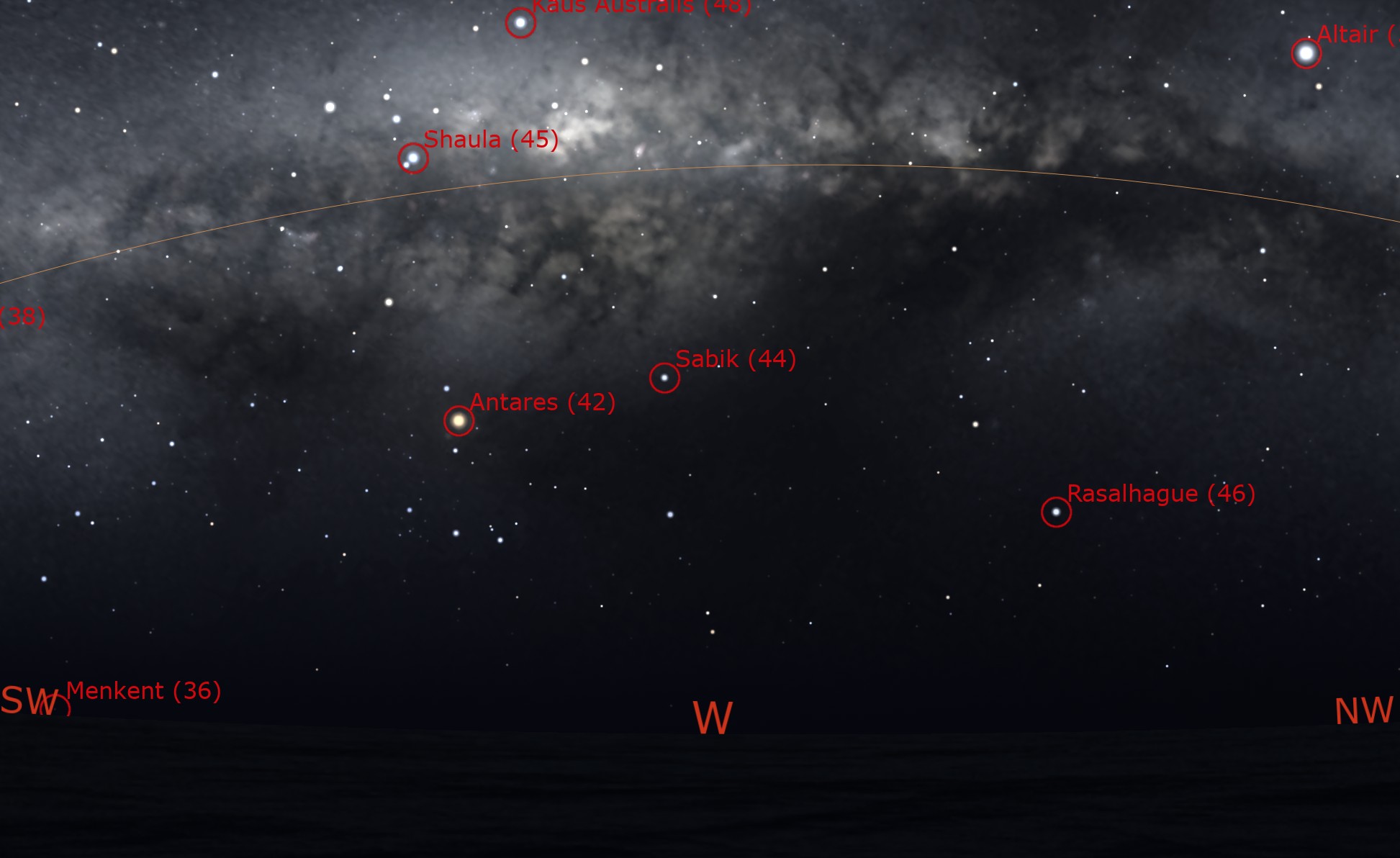
Davis P: I'm attaching a Stellarium simulation of the sky from the true location (see above) for Oct 20 at about 0045 UT. It generally matches what we see in the image. I cranked up the Milky Way brightness. I used the Stellarium plugin to show the official nav stars, and I've also asked it to draw in the internationally agreed-upon galactic equator, which does, reasonably well, match the visual appearance of the Milky Way in this, the densest portion of the Milky Way star clouds. Does this help rationalize the orientation for you?
I find it more useful to think about the apparent positions of the galactic poles when I'm trying to picture the orientation of the band of the Milky Way from any given location.
The SGP, South Galactic Pole, is in the faint constellation Sculptor, but it's just a little south of the nav star "Diphda" in Cetus, and that's not hard to locate. If Diphda is near the zenith, the Milky Way is running around the horizon. If Diphda is low in the sky, near due South, then the band of the Milky Way should be high overhead running from East to West. And so on.
The NGP is in Coma Berenices. I find it using the Alkaid-Arcturus rubber band. Don't have one? Then just fill one in by imagination. Hook a rubber band with its ends at those two stars. Grab it from the middle and pull it down toward Leo symmetrically --the Alkaid side and the Arcturus side stay the same length. When you have pulled out far enough so that you have a right angle, you're there. That spot is quite close to the NGP. And like its southern counterpart, if you see that location high overhead, then the Milky Way is running around your horizon and thus invisible. Or if the NGP is on your horizon, the star clouds of the Milky Way are running high overhead.
And yes, these things are useful for celestial navigation because they give you the overall "lay of the land". :)
Frank Reed