NavList:
A Community Devoted to the Preservation and Practice of Celestial Navigation and Other Methods of Traditional Wayfinding



From: Frank Reed
Date: 2025 May 27, 06:56 -0700
Flying over the Atlantic last October, the sky from my side of the airplane (last window seat on left, so looking north on the flight towards the UK) was filled with "northern lights" as well as the circumpolar northern stars. I have never seen Ursa Major looking so brilliant peering out a window. Although the cabin lights were set to minimum level, seeing all that upper atmospheric and celestial beauty required holding my hands to the window to block the interior lighting and more importantly to block reflections from the cabin lights off the window.
As we got closer to Ireland during the flight, I began to notice "stars", but well below the horizon, so not stars. At first just a couple visible at a time... later a dozen or more. My initial thought was that these were probably just reflections from cabin lighting, but it was quickly obvious that these were ships. This highlighted a phenomenon that has become a curse on the night sky beginning very roughly ten years ago (??). As the cost of LED lighting plummeted and as very bright LED lighting became available, it seems that ocean-going vessel owners/managers/regulators discovered that the lights could be left on 24 hours a day. Ships at sea now blaze like casinos on the Strip in Las Vegas. Only a short time ago, sailors and officers on large merchant vessels crossing oceans had the pleasure of spectacular night skies (at least when the sky was clear, and the Moon did not interfere --so maybe ten days out of a month). Of course, out of all the things that might interest a common sailor and given all the other hardships of a boring sailing life disconnected from most normal communication and social interaction (also radically changed within the past few years), the benefit of "pretty stars" was quite small. And yet, what a shame it is... They were among the few remaining professions who could see the Milky Way almost any clear night. And of course it's another guarantee that 21st century sailors find no value in celestial navigation. They can't see the stars... Among the many negative pressures working against celestial navigation, this is not in the top five. But it certainly makes a difference.
It occurred to me that it was time to write something on this topic last night when I saw that my local sky was, yet again, diminished by light pollution. A decade ago, the limiting magnitude at the zenith on a clear moonless night was around 5.5 --nice. This past winter, the limit was around 3.5 to 4.0. Last night it was around 3.0 --really terrible. That's a transition from dark "semi-rural" to bright "suburban" skies. And yes, it makes me sad! And the immediate cause of this is shipping. Those big ships that are lit up in the middle of the ocean also leave the lights on continously when in port. This now seems to be standard procedure so I suspect it's a regulatory requirement or possibly a universal requirement from insurers. Anyone know?
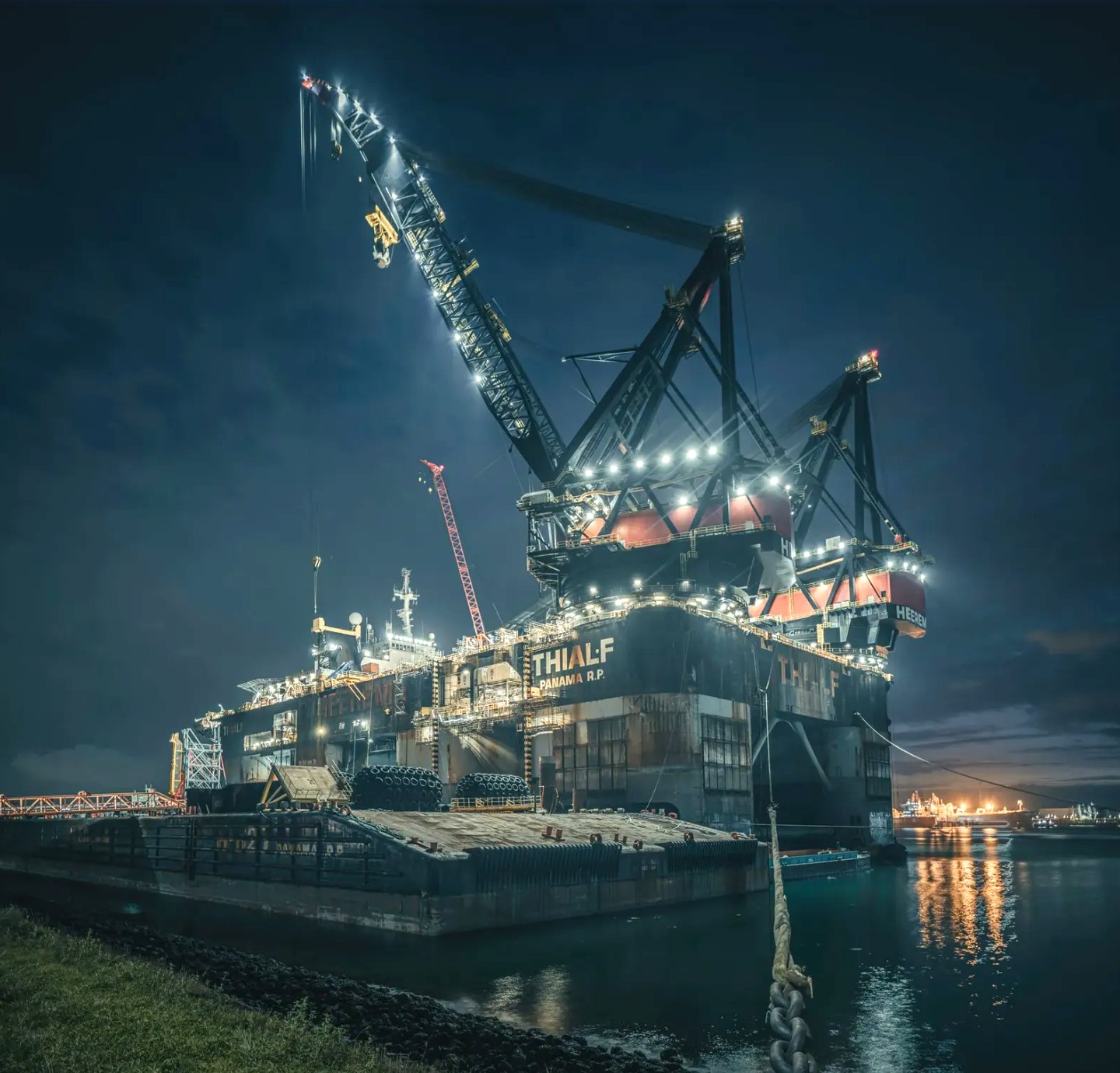
A few days ago, a giant "ship" arrived in Newport harbor. It's the Thialf, and it's "huge". I put "ship" in quotes since it's a self-propelled construction platform with two enormous cranes. It's presumably here to work on the large wind power projects south of here. These projects looked likely to be cancelled by the Trump Administration, but that hasn't happened so apparently money is flowing again. Wikipedia has an article on Thialf, emphasizing its giant size, and there are a few photos. This "ship" is presently anchored (?) one nautical mile away from me, but it seems like it's much closer --like a quarter of a mile-- since the scale is hard to comprehend. I also found a photo on marinetraffic.com showing it lit up at night, which I'm including below. It's ridiculous. It's the brightest thing for maybe twenty or thirty miles around... Las Vegas in my backyard...
Frank Reed
Clockwork Mapping / ReedNavigation.com
Conanicut Island, North America