NavList:
A Community Devoted to the Preservation and Practice of Celestial Navigation and Other Methods of Traditional Wayfinding



From: Frank Reed
Date: 2025 Nov 20, 11:55 -0800
Bill Lionheart, you wrote:
"But what did they do when there is no night?"
Just to reset the scenario here...
You are an early twentieth century explorer/adventurer in the high Arctic or Antarctic. You are trying the reach the pole. Let's assume that you are within a hundred miles or so of the pole. How can you determine your position with celestial sights, focusing on the normal exploration/adventure season, which means summer --no stars visible.
There are really two distinct questions to consider: What could they have done with good expertise in celestial navigation? And what did they actually do with often flawed understanding of celestial navigation? The second is clearly more interesting, but, unquestionably, it varied from one expedition to the next. Navigation knowledge and skill were not prerequisites for polar adventures. That second question cannot be answered without diving into the primary source evidence from the expeditions themselves or, in the case where the records died with the navigator, by looking at prior expeditions by the same adventurer, or looking at records from expeditions that may have influenced the lost navigator.
But what could they have done, if they were smart and skilled?
Celestial navigation in the arctic regions is fundamentally the same as celestial navigation in temperate latitude, and in the tropics, and even right on the equator. However, there is a major difference in plotting a celestial fix when a navigator is very close to one of the poles. This is a "coordinate singularity", not a failure of the fundamental principle of celestial navigation; it's a detail in the behavior of latitude and longitude. But since that coordinate singularity --the pole, where longitude is undefined-- was the target of most early polar expeditions, we can use this singularity to our advantage.
What tools do we have available? Clearly a functioning sextant is essential, but it can be rather basic in quality, so long as it does not become unmanageable in very low temperatures. An artificial horizon of some sort would be standard, presumably a bottle of liquid Mercury and a small basin. These were standard fare. And finally a navigator should have a chronometer. Here is where things become tricky. Many navigators gave up on celestial navigation near the pole if the chronometer stopped working. But we need to ask: how much would their navigation be impacted if their backup chronometer (even a common watch) was wrong by some large amount, like an hour or two? Even modern navigators are often surprised when they realize that this has no impact on latitude. We know it, but we don't own it.This is important for a polar navigator!
One easy plotting-related trick: apply the usual intercept method, but use the pole itself as your AP. The computation of Hc and Z is then trivial: Hc = Dec (-Dec in the Antarctic), and you substitute the GHA of the body for the azimuth, Z (360-GHA may be useful in the Antarctic, but, formally, you can live without that). It's important to take some time to think that through! If you compute the appearance of the sky as seen from the north pole, the true altitude (Hc) is identical to the body's Declination.
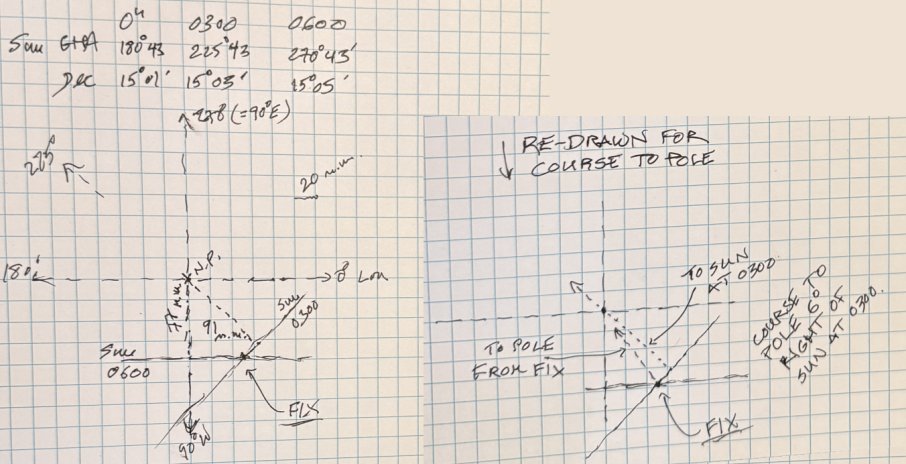
Let's do a quick example. You believe you're in the vicinity of 88.9°N, 60°W on 1 May 2026 --only 66 nautical miles to go until you reach the pole! But which direction?? You believe that the UT is about 0300, but this could be wrong by as much as half an hour. You observe the Sun's altitude with your artificial horizon (Sun-direct centered on Sun-reflected for the sake of this scenario). You divide by two, and correct for refraction, including a potential low temperature correction. Your Ho (the corrected altitude which can be directly compared with the Hc) is 13°32'. You grab your almanac and find that the Dec of the Sun at 0300 is 15°03' and its GHA is 225.7°. As always, for an intercept value, we get the difference Ho-Hc. It is 91'. We have observed an Ho lower than the calculated altitude at the pole, so this intercept is away from longitude 225.7°. You draw that intercept vector and the Sun LOP perpendicular to it on a little chart. Like my example plot, attached below, this does not require detailed drafting work.
From a single altitude of the Sun, we can say that were are on that single Sun LOP, as drawn. We don't know where we are along it, but we can also see that our minimum distance from the pole is identical to the calculated intercept: 91 nautical miles. Farther than expected... Oh no, that is only the minimum. If we are 200 miles out, we could be in real trouble!! To continue, we need another Sun sight. So let's have lunch, feed the dogs, make some repairs, and wait... Almost exactly three hours later, we get a second sight of the Sun. This time the Ho is 13°48'. Checking the almanac data, the GHA of the Sun has advanced by 45° to 270.7° (we didn't really need an almanac for that!) and the Dec of the Sun is now 15°05'. Thus the intercept distance is 77' and that is measured away from 270.7 on our little chart. We cross the lines. That's our fix. And we can easily see that our position is about 92 nautical miles from the pole.
Two remaining questions: Suppose our spare chronometer is off by an hour? And whether it is wrong or right, which way should we proceed to get closer to the pole?
If the chronometer is wrong, this simply rotates the entire plot at the rate of 15° per hour. This has almost no impact on our distance from the pole except that our estimate of the Sun's Dec might be wrong by a mile or two. This is almost certainly less concern than the quality of the sextant sights. As for the direction to the pole, that is directly indicated on the plot! Any uncertainty in azimuth (longitude here) disappears if we measure the direction to the pole relative to the direction of the Sun at the time of the first sight. And to "store" that direction, we put drive two ski poles into the snow and ice when we take the first Sun sight aligned along that direction. We read off the direction with ease from the plot (see the lower half of my example plot) and then reference it to the direction to the Sun at 0300 stored by the two ski poles. And that's it. We have 92 miles to go, on a course about 6° to the right of the Sun's direction at 0300 watch time... Mush!
Frank Reed
Clockwork Mapping / ReedNavigation.com
Conanicut Island USA