NavList:
A Community Devoted to the Preservation and Practice of Celestial Navigation and Other Methods of Traditional Wayfinding



From: Frank Reed
Date: 2025 Jun 3, 10:24 -0700
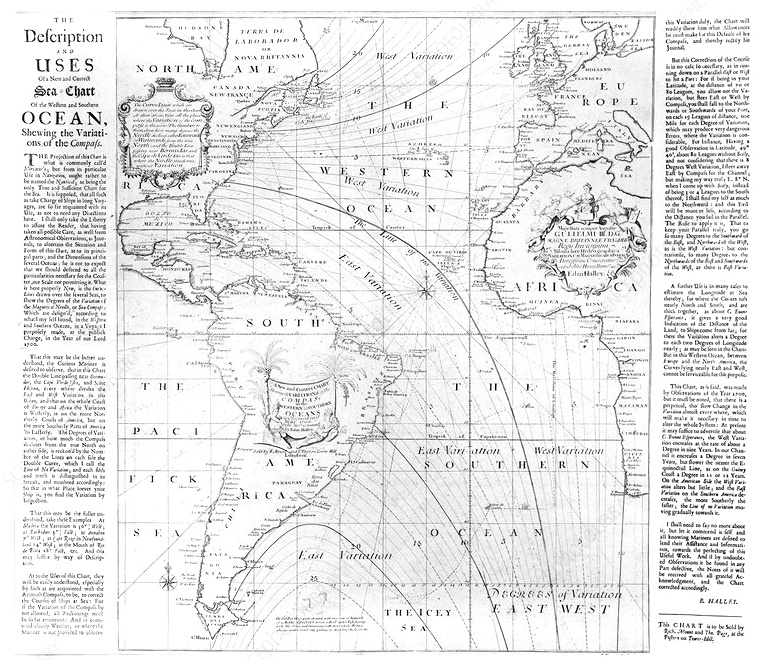
Three centuries ago, Edmond Halley was sent on a little sailing expedition in the Atlantic to assess the possibility of using the variation (also known as "declination") of the magnetic compass as a measure of longitude on the globe. What were the problems back then? Was there any hope of using this method for longitude in at least some parts of the globe?
Setting aside the historical context, suppose you want to try this today. In what parts of the globe could you apply this method as a low-accuracy means of determining longitude? How "low" is low-accuracy here? Where would this work well? Where would it fail completely? What sort of instrumentation would you need (let's assume entirely non-electronic, in keeping with the standards of NavList)?
Back to history, the chart below is a summary of Halley's expedition (as I understand it). Can anyone find a better version of this, with the marginal text included, especially? There must be one available online somewhere. I didn't look very hard...
Frank Reed