NavList:
A Community Devoted to the Preservation and Practice of Celestial Navigation and Other Methods of Traditional Wayfinding



From: Frank Reed
Date: 2025 Dec 5, 19:47 -0800
Huub Robroek,
Two days ago, you wrote:
"From my participation in one of Frank’s Lunar webinars I remember mentioning large errors in my lunar observations, also caused by “pretty sights of 2 objects”. Frank then showed that a short lunar distance can cause large errors.
Another good reason to participate in Frank’s classes."
Thank you for saying so. I appreciate that.
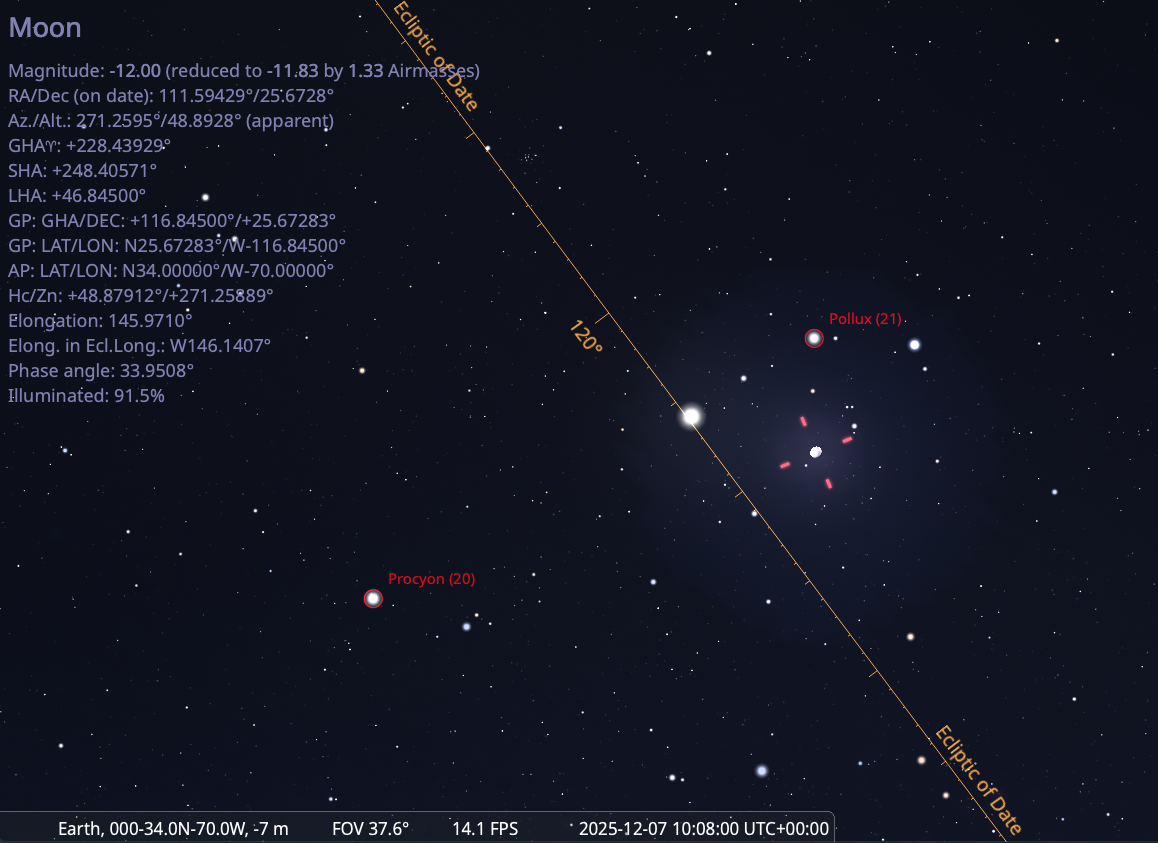
If anyone has clear skies tomorrow at or before dawn (not me) at UT around 10h +/-a few hours, you'll have an opportunity to see one of those "pretty Lunars" cases. In fact one-and-a-half: the very short "Jupiter-Moon" lunar will be very attractive, even "striking", while the "Pollux-Moon" lunar is less impressive but still nice.
In the attached Stellarium simulation, we see the Moon, Jupiter, Pollux, and Procyon. Jupiter is on the arc from Procyon to Pollux this month, breaking the symmetry of the Winter Hexagon. I've also turned on the ecliptic in Stellarium, and it's helpful to know that the Moon's motion among the stars is nearly parallel to the ecliptic. Tomorrow the Moon is aimed rather closely at the mid-point between Pollux and Jupiter, which means its motion is angled at about 45° relative to each. Though these are "pretty" circumstances, they are classic "bad" cases for lunars as determinants of absolute time (Greenwich Time). Since the Moon is not moving directly towards either Jupiter or Pollux, the relative rate of change of the lunar distance angles is lower than usual. That's an issue. And second because of this geometry and because the distances are short, the interpolation for time using classic historical methods would have been non-linear. This doesn't mean that we can't shoot these lunars and get some value from them... just not for time determination using traditional techniques.
I would add that this pairing of angles, with the Moon at a right angle corner relative to Jupiter and Pollux, is nicely arranged for "lat/lon by lunars at known UT". This technique requires observations ten times more accurate than traditional lunars before it has any practical merit, but it is a method for getting a latitude and longitude fix without using a horizon (or, if you prefer, using the limb of the Moon as your horizon). This was the sort of observation that was planned for the Apollo sextant on those missions to the Moon over fifty years ago... This is one of those topics that has previously had short shrift in my "Lunars" workshops so this, and quite a few other topics, will be added to "Advanced Lunars" starting early in 2026. Details soon...
Frank Reed