NavList:
A Community Devoted to the Preservation and Practice of Celestial Navigation and Other Methods of Traditional Wayfinding



From: Frank Reed
Date: 2025 Dec 15, 10:55 -0800
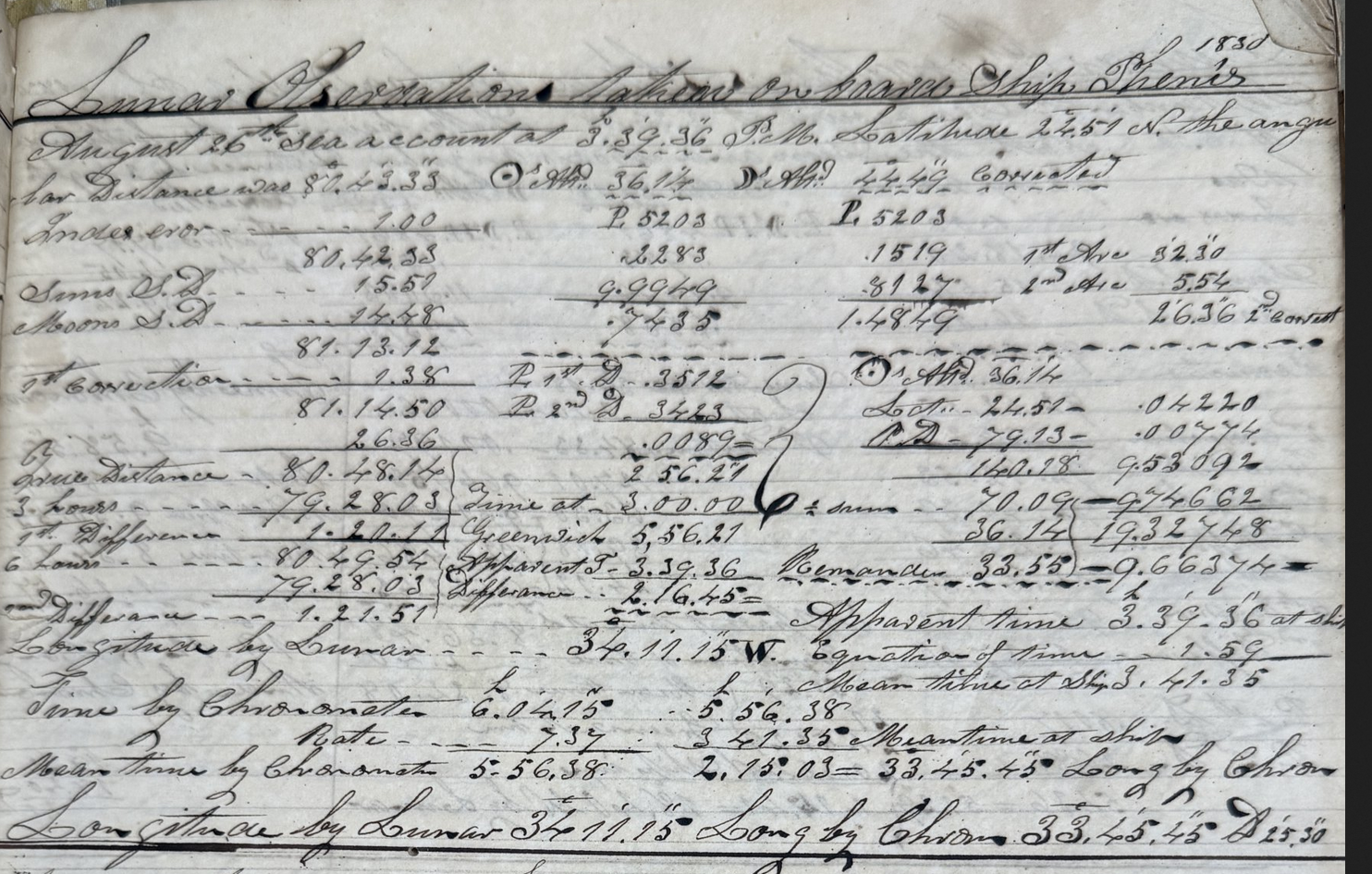
I thought it might be interesting to look through this lunar from 25/26 August 1830 piece by piece. The first step is to read the details on the page. The line at the top, in attractive maunscript "cursive" script tells us "Lunar Observations taken on board ship Themis". Our navigator tells us that the date is "26 August, sea account" and the year is 1830. We also have a latitude shown in the calculations of 24°51'N and the work ends with a longitude near 34°W (that's good enough for now). Note that t the date could be "tricky" since this is a "sea account" calendar. We will find that the date --by our calendar-- is actually 25 Aug 1830.
The altitude of the Sun was apparently 36°02' off the sextant, and using the usual +12' "pre-clearing" correction for S.D. and dip, the altitude of the Sun's center was 36°14'. The altitude of the Moon, raw from the sextant, would have been 45°09' and the "pre-cleared" altitude of the Moon's center is 44°49' after the usual -20' for an Upper Limb S.D. and dip correction. I'll look at the actual lunar distance and an interesting omission/error in another post.
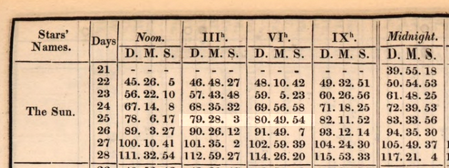
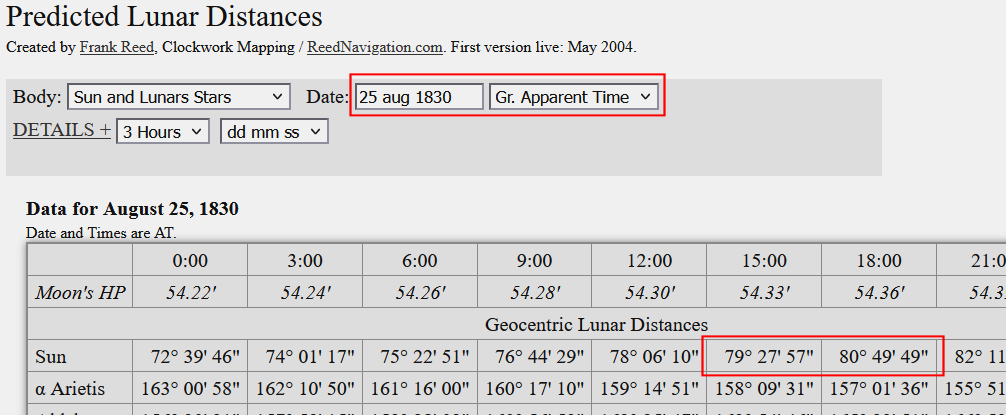
How can we confirm the date and time? There are two ways. First, if we look around on the page of work, we find that the navigator recorded two "lunar distances" marked "3 hours" and "6 hours" (on the far left of the page). These are often found in detailed lunar distance calculations like this set, and they are simply values pulled from the almanac. The predicted, geocentric lunar distances were tabulated every three hours in this period. At 3h, our navigator has written down 79°28'03", and at 6h, 80°49'54". We can compare this with accurate values based on modern ephemerides for the Sun and Moon. For example, you can use my web app for lunar distances here: https://clockwk.com/apps/predict/. Enter the date, 26 August 1830, and you will find no matches. So go back one day... The distances for 25 Aug 1830 are very close. At 3h (actually 1500), we find 79°27'04" and at 6h (1800), 80°48'57". These both differ by about one minute of arc from the values that our navigator recorded. That's very close and confirms the date, but it's not good enough. A minute of arc error would have been counted as poor in 1830. The key missing detail is that the lunar distances in 1830 were published for GAT, Greenwich Apparent Time, not GMT (GMT or UT is normal for us but not in 1830). There's an option to change the time variable in my web app, and when you do, we find that differences are considerably smaller: at 1500, 79°27'57", and at 1800, 80°49'49". Those differ from the values recorded in the logbook by only 6 seconds of arc and 5 seconds of arc respectively. The date is confirmed.
The modern, accurate lunar distances listed above differ from the values recorded by 5 or 6 seconds of arc. We can also check the Nautical Almanac from 1830 (available online), and sure enough the values given by our navigator match the published values perfectly, to the second of arc. That confirms that these numbers are indeed the almanac numbers, copied down for the interpolation work, and it also lets us see that there is a small, irreducible source of error in this lunar analysis from 1830. The numbers in the almanac are wrong by a few seconds. Let's assume that the error is a clean six seconds of arc. Due to the Moon's rate of motion relative to the other celestial bodies, 1" of arc in the distance yields an error of approximately two seconds in the resulting Greenwich Time at the end of the work or equivalently half a minute of longitude or half a nautical mile at the equator. Our almanac data error of 6" then amounts to an error of 3 nautical miles at the equator (less 10% in this latitude). Nothing to worry about. In short, the almanac data is comfortably close to exact in this lunar analysis.
We can also determine the date and the Greenwich Time to within a few minutes and from that the longitude within a degree or so directly from the altitudes of the Sun and the Moon --completely ignoring the observed lunar distance! This was not well-known in the 19th century, but among those few who knew it was possible, a good fraction probably understood that it was not an exact method of getting longitude. Nonetheless, it works ...crudely. This is an example of an "NCW" method for longitude ("Not Completely Worthless"). It's sometimes described as Chichester's method for longitude by lunar altitudes, and John Letcher re-invented it, too. It's a method that was first proposed in the early decades of longitude by lunars, but, to be clear, it's "not great"...
Given our latitude of 24°51', the observed altitudes of the Sun and Moon can be correct at only one combination of longitude and Greenwich Time. We don't need some "method" for this. All we have to do is simulate the sky. You can do this in a text-based simulator, like my USNO Clone web app, or in the recent (slightly broken) USNO web app, or you can use a visual simulation like Stellarium. As long as you understand what each is displaying, you can compare the observed altitudes of the Sun and the Moon with expected values.
If we only observe the Sun, or if we only observe stars at night, the trade-off between an hour of time and 15° of longitude (a bit different for stars, but very close) prohibits any determination of Greenwich Time. This is reminding us that the sky looks nearly the same as the same local time on any day everywhere on Earth, for a given latitude. So the sky that I see in evening twilight at 41.5°N latitude is the same sky that anyone else in the same latitude will see in evening twilight. Similarly if I step outside exactly two hours after local noon today and check the Sun's altitude and azimuth, the numbers I find witll match those seen by observers thousands of miles from me (in the same latitude!). So neither the Sun alone nor the stars alone can provide any information on absolute time or longitude.
If we throw the Moon into the mix, everything changes. For example, tomorrow morning if I step outside an hour before sunrise at the local time when the planet Mercury is just rising, I will find the crescent Moon lined up in RA (equiv. to SHA) a few degrees south of the star Zubenelgenubi at an altitude of 12°22'. An observer in the same latitude in northern Spain about five hours earlier in UT terms (but at the same local time) would have seen the thin crescent Moon further to the right of Zubenelgenubi at an altitude of 14°03'. The change in the Moon's position reveals the UT and the corresponding longitude difference.
We can apply this logic to the Sun altitude and Moon altitude recorded by this navigator on 15 August 1830. The altitudes have to match at the correct UT. And when we do this, we have a good match at UT 1800 and longitude about 34°W. That's nice and seems to correspond well with the navigator's result from the complete lunar analysis. Does this mean we can just dispense with the lunar itself?? Oh but we can repeat the simulation, and we have a somewhat better match at UT 1824 and longitude about 40°W. So this sort of analysis, without really excellent constraints on the measured altitudes, can put is in the right part of the world and give us a crude value for Greenwich Time, but no better than that. Despite the crudeness of the result, the fact remains: the altitudes of the Sun and Moon alone, at a given latitude, tell us the approximate UT/GMT and longitude. This provides a nice confirmation on the date and approximate time of this navigator's work.
Frank Reed