NavList:
A Community Devoted to the Preservation and Practice of Celestial Navigation and Other Methods of Traditional Wayfinding



From: Frank Reed
Date: 2025 Dec 31, 15:24 -0800
Lars Bergman,
In your excellent article (PDF here) on the navigation practiced aboard that ship in 1926, you wrote:
"The hour angle was calculated using the formula suitable for logarithmic calculation
sin²(t/2) = sec φ ∙ csc p ∙ cos(s/2) ∙ sin(s/2-h),
where t is the hour angle, φ latitude, p polar distance, h the true altitude and s = φ + p + h. "
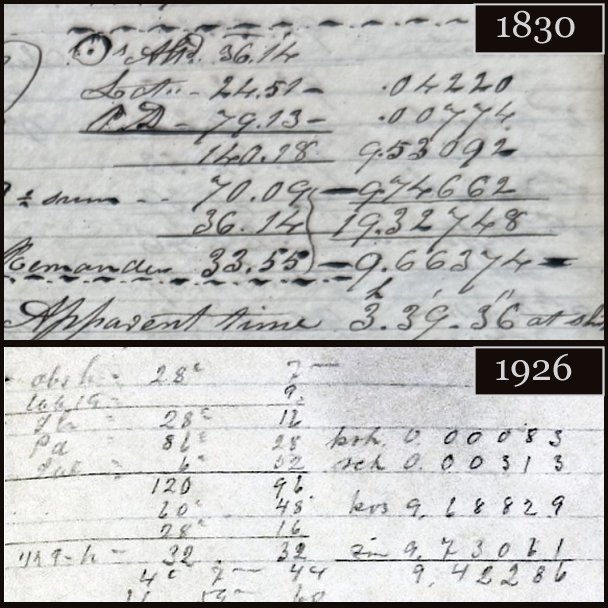
The longevity and nearly universal application of this calculation is really amazing! This is a key element of my "Celestial Navigation in the Age of Sail" workshop (schedule for 2026 now posted). I typically spell out the arguments of the trigonometric functions on the right-hand side of this as "Lat", "PD", "hSum" (for half the sum of Lat, PD, and Alt), and "Rem" (for the 'remainder' we get after subtracting the Alt from the hSum). This form, of course, was popular because it lent itself so easily to logarithm calculation. The right-hand side is a product of four trigonometric functions so in the form of traditional logarithms, it was equivalent to adding four numbers from a lookup table.
I'm including an image here comparing this computation from 1830 with the one in your article from 1926. The 1830 case is cut from that "1830 Lunar" example that I posted recently.
All through the era of "scientific navigation" from the late 18th century right up to the second half of the 20th century, this is how "Local Apparent Time" was calculated from a common altitude sight. This was the math that turned a sextant into a sundial, the critical local or "at ship" side of the determination of longitude.
Frank Reed
Clockwork Mapping / ReedNavigation.com
Conanicut Island USA