NavList:
A Community Devoted to the Preservation and Practice of Celestial Navigation and Other Methods of Traditional Wayfinding



From: Frank Reed
Date: 2026 Apr 3, 12:18 -0700
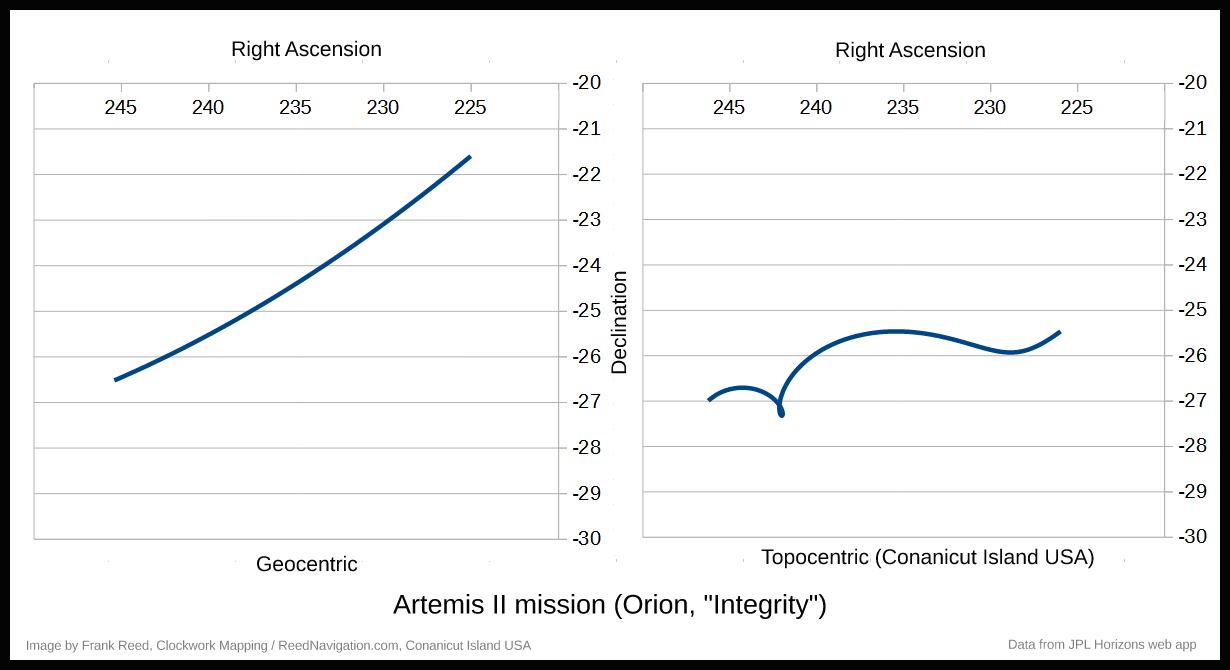
As the Artemis II mission heads towards the Moon, its apparent position among the stars wobbles back and forth. The apparent "wobble" is due to the motion of terrestrial observers as the Earth turns. The same phenomenon causes the Moon's position to oscillate each and every day. This is parallax... topocentric parallax of the same type as the Moon's parallax in altitude, proportional to its "HP" value that we find in almanac tables. In the graphic below I pulled position data for 42 hours starting at 0600 UT today (3 Apr 2026) from JPL Horizons. On the left we see the smooth motion in RA and Dec corresponding to the spacecraft's orbital motion in Earth-Moon space. On the right we see motion that is almost spiraling like a corkscrew. This is the observer's rotation about the Earth's axis in the course of a day superimposed on the spacecraft's own motion.
Note that the "Right Ascension" or RA is displayed in degrees in these graphs, as is fairly common today (traditionally RA was expressed in hours, etc.). If you feel the need to convert to navigation terminology, it's simple: SHA = 360° - RA.
Where on the sky is this? There's an easy trick: find the Moon! The Moon will be passing south of Zubenelgenubi in about 24 hours, and that's where these astronauts are heading... They're on their way to Zubenelgenubi! Actually they're more nearly on their way to Antares, but I couldn't help getting a Z. reference in the story.
Frank Reed