NavList:
A Community Devoted to the Preservation and Practice of Celestial Navigation and Other Methods of Traditional Wayfinding



From: Todd Spath
Date: 2025 May 20, 18:37 -0700
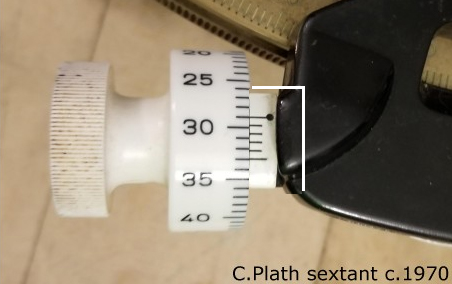
Your image caption asks "Which is more accurate?" To the extent that "accurate" indicates giving the correct measurement, I would argue that you can't tell from the picture. For all I know, both have had their index mirrors knocked out of place or one has a worn misadjusted pivot. Assuming nothing bad had happened, I would go to the most recent calibration records (also not in evidence). Most of your replies have been about Precision instead. The 1970 example with the vernier certainly has finer indicated precision, 0.2 MOA vs 1. MOA. Whether this is false precision (ie: swamped by variability) or is better from a human factors perspective under certain conditios is debateable. I've spent plenty of time with vernier machinist tools, so I'm comfortable with them. This drum and vernier are not my favorite. Firstly it reads "backwards" from my sensibility (ie: the higher angle is below the smaller angle). One of your replies states the vernier is in increments of 12 seconds, which is the same as 0.2 MOA. The fact that there are no numeric markings on the vernier scale means that user has to figure this out for themself. I confirmed the verier scale by shifting it in photoshop to confirm that the last mark was indeed aligned 1 MOA from the dotted mark. Otherwise, it could have been 10 second increments for the same number of lines.