NavList:
A Community Devoted to the Preservation and Practice of Celestial Navigation and Other Methods of Traditional Wayfinding



From: Frank Reed
Date: 2025 Jul 14, 11:54 -0700
Plane or plain? This is tricky for at least two reasons: first, the scale in question became popular before English spelling became standardized. And second because both meanings actually fit! Sailing using the geometry of the "plane" (here in the modern sense of a geometriclly flat surface) can also be described as "plain" in the sense of "unadorned" or "simple".
The scale seems to follow the lead of the sailing. If it's plane sailing then it's a plane scale. There are some examples, too, of authors historically noticing the small "pun" here... "plane sailing sure is plain!" (sorry I don't have an example, but you'll hear this even today in classrooms at maritime schools where the "sailings" are still required).
Robin Stuart, you mentioned an early example: "Much earlier authors all seem to call it a Plain Scale. In John Collins' 1659 work The Mariner’s Plain Scale New Plain’d ". That title looks like a bit of a pun with a different angle. I would say that the spelling of the word here is irrelevant to the "correct" modern choice since this date is long before English spelling had standard rules. Imagine a spelling bee in 1659 in London...
Host: "Spell SPEAR"...
Contestant 1: "S-P-E-E-R"...
Contestant 2: "S-P-E-A-R"...
Contestant 3: "S-P-E-R-E"...
Host: "Err... Um... Congratulations! Y're alle winners!!".
Robin, you mentioned "The 1851 edition of Bowditch [...] calls it a Plane Scale."
Regarding the date of this reference, Nathaniel Bowditch's New American Practical Navigator was first published under Bowditch's name and with the "American" title in 1802. Large portions of it were not changed at all until decades after Bowditch died in 1838. There were significant additions in 1826 and 1837, but nothing like a proper revision, as we would understand it today. A prominent case: Sumner's method for generating celestial lines of position finally gets a little less than one page in the 1855 edition. It doesn't "fit" in the chapter where it has been added (a brief chapter on determining latitude on land using an artificial horizon), but it "fits" --it fits in the pre-existing plates for printing and was apparently added here because it was relatively easy from a production perspective.
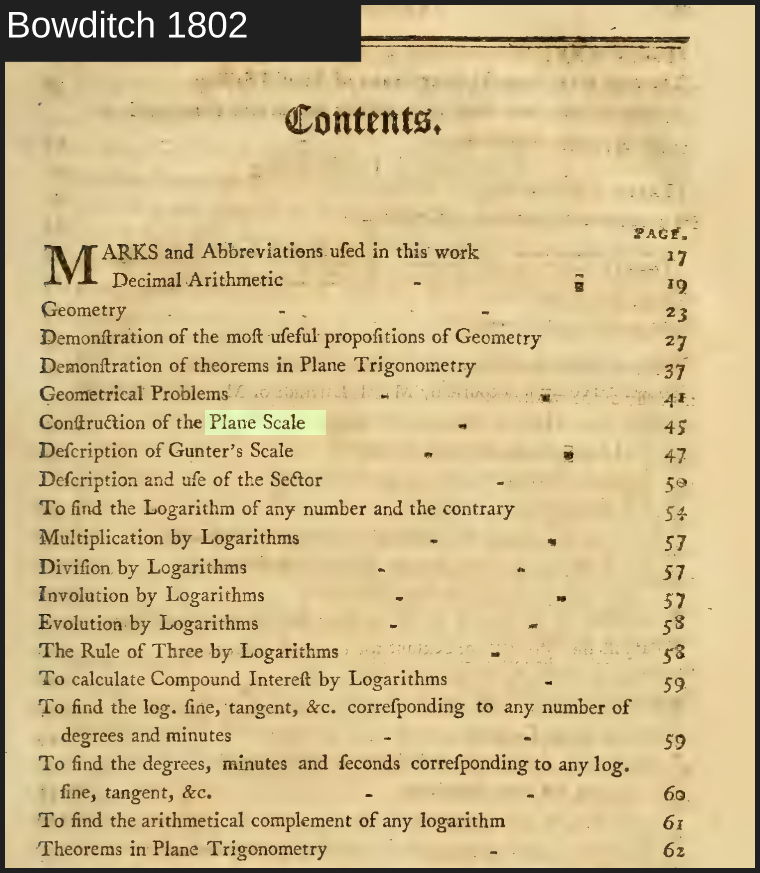
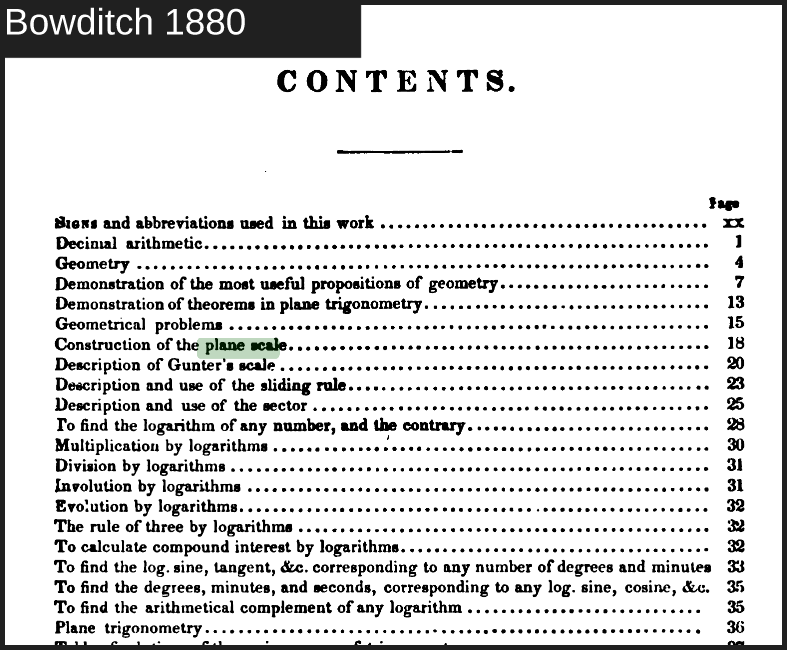
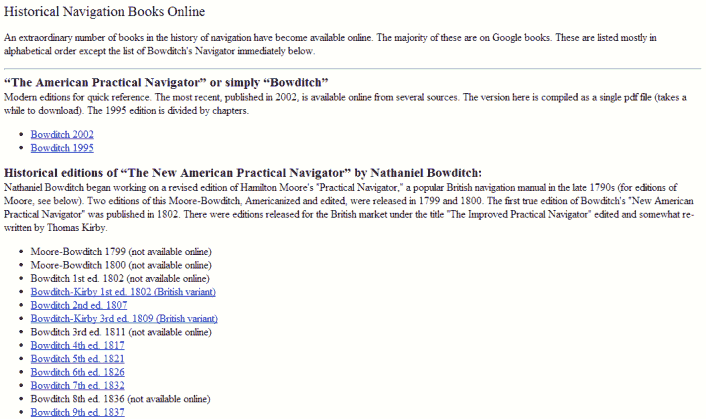
We (NavList community) have a list of Bowditch editions and other historical works here. This includes local links to PDFs, and also external links to Google Books, archive.org, and a few other sources. I'm attaching screen captures of the Contents pages of the 1802 and 1880 editions/printings of Bowditch's 'Navigator'. Plane scales in 1880?! Wow! And look at all that material on lunars!! Who said lunars were over and done by about 1850 anyway (that would be me)?! But no, it's misleading... all we're seeing here is a book that is largely frozen in time.
Also, just a reminder for anyone pondering Bowditch, a large fraction of the original 1802 edition was copied word-for-word from earlier sources, primarily John Hamilton Moore's New Practical Navigator as well as other British sources. It's not primary source evidence for navigation practice. Nonetheless, anything in this period is a safe bet for standardized usage of language and spelling since English spelling was rapidly stabilized in the late eighteenth and early nineteenth centuries. So "plane" is plainly a good choice... :)
Frank Reed