NavList:
A Community Devoted to the Preservation and Practice of Celestial Navigation and Other Methods of Traditional Wayfinding



From: Frank Reed
Date: 2025 Apr 25, 05:10 -0700
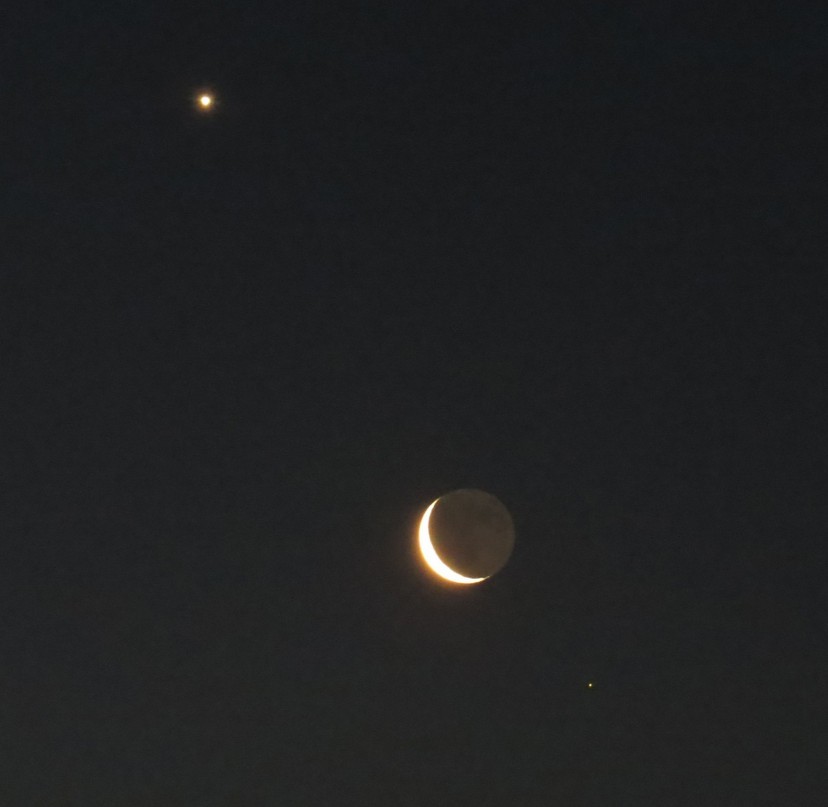
I saw a photo earlier today (source withheld to keep it interesting!) of the Moon, Venus, and Saturn in the pre-dawn sky. The only hint of local time in the photo is the slight brightening towards the lower edge of the image. That's sunrise on its way... Let's assume that the photo is aligned within 1° of proper vertical. That is, if the photographer had strung up a weight on a string (a "plumb bob") in the foreground, then that string would be almost perfectly perpendicular to the lower edge of this image.
The Moon can help us determine UT by its distance from stars and planets as it moves across the celestial sphere. That's the traditional idea of a "lunar" for longitude. In this image that would be tough since the planets are aligned nearly perpendicular to the Moon's motion vector. As an alternative, consider the line through the Moon's horns (the sharp points of the crescent) and extending in both directions. The distance of that line from the other "stars" can help determine absolute time.
Given the limitations and uncertainties of the image, where are you? Where was the photographer when this photo was taken? What sort of "error bars" can we put around that estimated position? What sort of scenario in marine celestial navigation could benefit from a similar analysis?
Frank Reed
[I have added a detail to this puzzle in a follow-up post to make it more interesting from a navigation perspective and also more "solvable" and therefore more fun! Let's assume that we do have a measure of the local apparent time to accompany this "lunar-like" photo. Specifically, let's assume that the observer who saw this scene also "started a stopwatch" at the time of the photo, and let's assume sunrise occurred exactly 46 minutes later. By "sunrise" I mean the upper limb of the Sun is at altitude 0.0 degrees, just clearing the horizon, which you may assume to be a "sea" horizon. The observer is near enough sea level so that height of eye can be ignored.]