NavList:
A Community Devoted to the Preservation and Practice of Celestial Navigation and Other Methods of Traditional Wayfinding



From: Frank Reed
Date: 2025 Apr 25, 14:56 -0700
David Pike, you wrote:
"Don't look at this if your still working on your own solution."
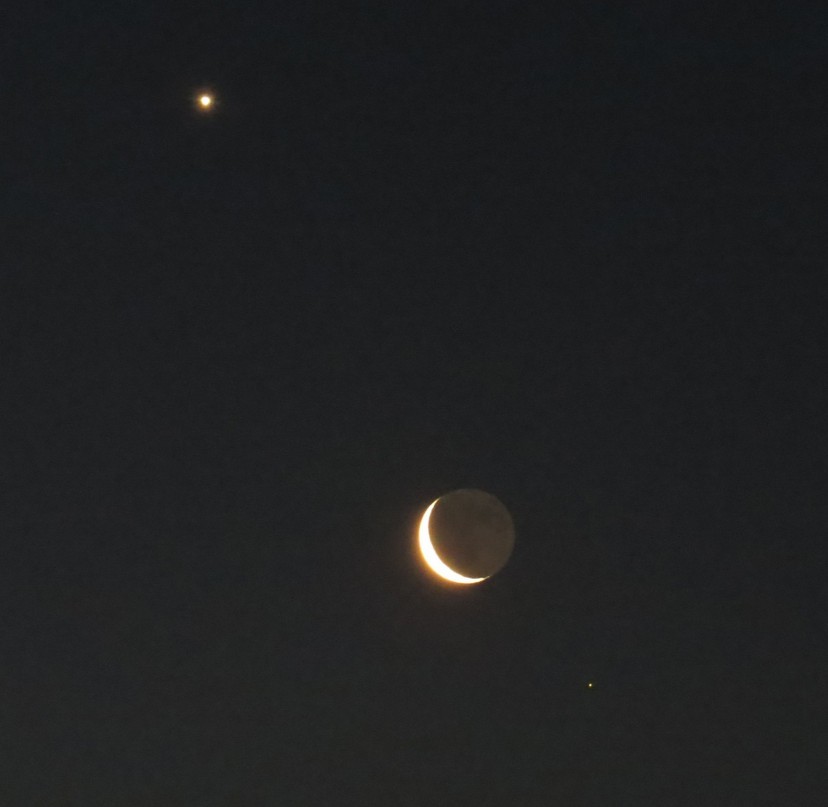
The link you posted is actually useful in an interesting way because it is not a match for what we see in the photo. Like many online descriptions of conjunctions involving the Moon, that one is written by someone with a "home market", and for the Moon, this matters. From a particular longitude, the Moon may be lined up with a planet just before sunrise while in a significantly removed longitude, like on a different continent, no interesting alignment happens at all. And that's the case here.
I'm going to add a detail to this puzzle to make it more interesting from a navigation perspective and also more "solvable" and therefore more fun! Let's assume that we do have a measure of the local apparent time to accompany this "lunar-like" photo. Specifically, let's assume that the observer who saw this scene also "started a stopwatch" at the time of the photo, and let's assume sunrise occurred exactly 46 minutes later. By "sunrise" I mean the upper limb of the Sun is at altitude 0.0°, just clearing the horizon, which you may assume to be a "sea" horizon. The observer is near enough sea level so that height of eye can be ignored.
Don't forget to pay a little attention to the orientation of the Moon --its tilt-- relative to the local vertical in this photo. That will narrow down the latitude significantly, which feeds into the rest of the solution. Where should we begin?? Simulate the event in Stellarium or some equivalent "planetarium" app.
Frank Reed
File: