NavList:
A Community Devoted to the Preservation and Practice of Celestial Navigation and Other Methods of Traditional Wayfinding



From: Frank Reed
Date: 2025 Jun 7, 07:45 -0700
For center-of-mass proper motion of bright stars (let's say brighter than magnitude 3.0 to put a limit on it), you can also use "old" coordinates. Ground-based astrometry was far less accurate than Hipparcos astrometry (Gaia isn't relevant since it wasn't designed to observe bright stars), but ground-based observatories have astrometric records covering roughly a century, so it works out to similar or even superior accuracy for the center-of-mass.
Among those bright stars, there are very few true multiple systems to worry us: Sirius, Rigil Kent., Procyon, and Castor. There are couple of others brighter than magnitude 3.0, but far less concern. Castor is not among the 57+1 "official" navigation stars, so skip it? But it can easily be used for navigation... maybe it deserves equal treatment.
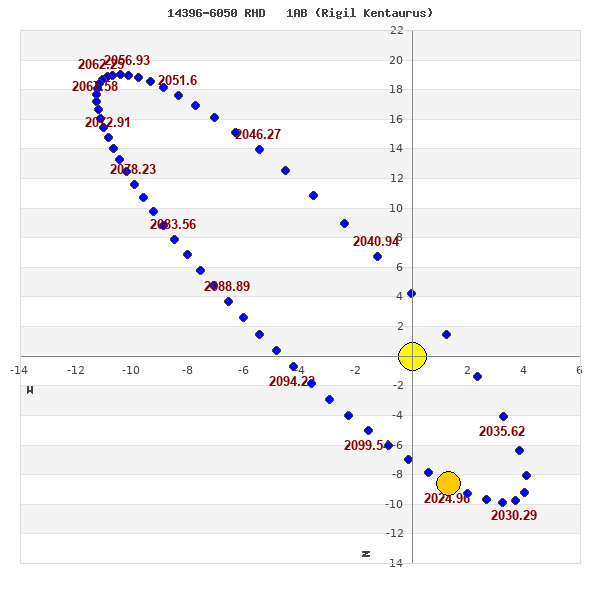
If you get into binary stars, you'll quickly start looking at elliptical orbits and solving Kepler's equation and all that. But this is a waste of time (quite similar to re-calculating the coordinates of the planets of the Solar System for every second of UT). Each system has one significant binary orbit which has been calculated as exactly as required and usually with considerable intrinsic uncertainty. All we need is a small array giving orbital offsets annually for one full orbit. And it's not even necessary to calculate them. They can be pulled from a number of sources. For example, there's a nice orbit graphic for Rigil Kentaurus A/B at stelledoppie: alpha Centauri (copy below). On the other hand, one could go all-in Keplerian for each orbit once (just for fun) and then use the graphic for confirmation.
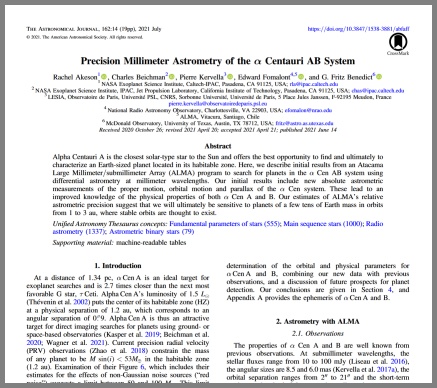
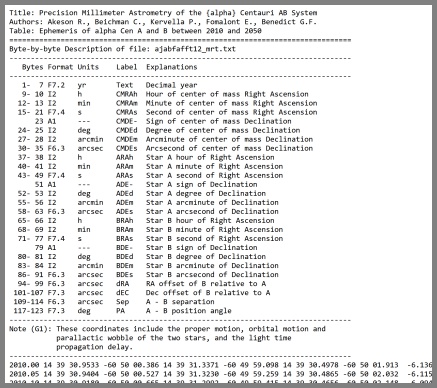
As for confirming the details of the center-of-mass proper motion and expected future coordinates, I recommend the article by Akeson, et al. on precision astrometry of alpha Centauri (pdf and txt table below).
Frank Reed
Clockwork Mapping / ReedNavigation.com
Conanicut Island, North America