NavList:
A Community Devoted to the Preservation and Practice of Celestial Navigation and Other Methods of Traditional Wayfinding



From: Frank Reed
Date: 2025 Sep 16, 12:24 -0700
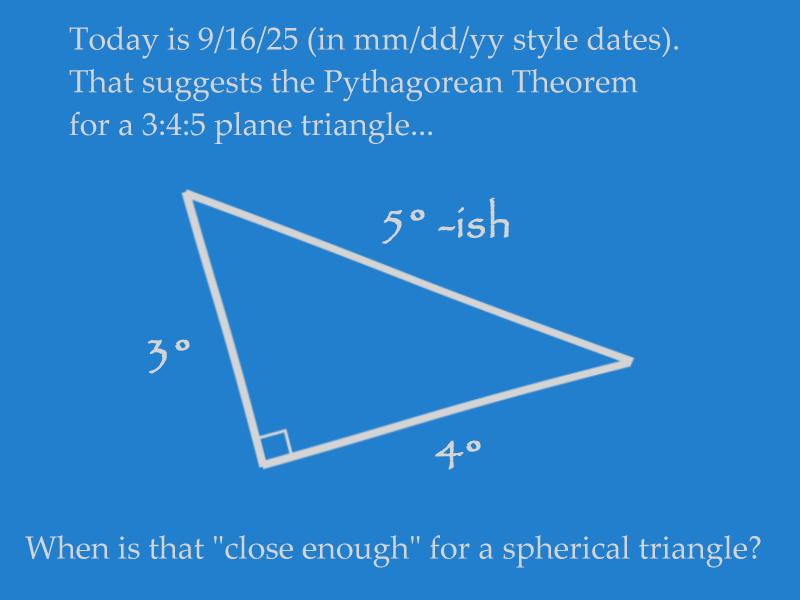
DO WE LIKE TRIANGLES? Of course we do! I saw a comment today taking note of today's date as a 3:4:5 triangle in the Pythagorean Theorem. Written in mm/dd/yy format (popular US style), today is 9/16/25. See it??
Of course, celestial navigation deals in spherical triangles instead of plane triangles, and arguably the 3:4:5 triangle doesn't exist!
So we have a math puzzle: When is it "close enough"? Suppose I draw a little right triangle (corner angle exactly 90°) on the celestial sphere, or I draw a triangle on an idealized spherical globe of the Earth. If the two shorter sides of the triangle are exactly in the ratio 3 to 4, the hypotenuse side will be nearly 5 units. How big can the triangle be before the difference from 5 proportional units is greater than 0.1 minutes of arc (the usual minimum for celestial work)? And how big for 1.0 minutes of arc? How about one whole degree of difference [try a right triangle with sides of 30° and 40°... how long is the third side... nearly 50° or not?]?
This is not an entirely trivial issue. If you have latitudes and longitudes of points in some small enough neighborhood of your home base, you can calculate distances and angles and other geometric relationships, just as if the Earth is subject to plane geometry, and you can ignore great circle distances and all that [just remember to scale longitude differences by a factor of cos(latitude)]. Similarly, on the celestial sphere, if I have coordinates of some stars in a small region of the sky, I can treat the geometry as "flat" in a small enough region. So how small is "small enough" for that neighborhood around some selected center?
Frank Reed
Clockwork Mapping / ReedNavigation.com
Conanicut Island USA