NavList:
A Community Devoted to the Preservation and Practice of Celestial Navigation and Other Methods of Traditional Wayfinding



From: Frank Reed
Date: 2025 Apr 17, 08:38 -0700
I wrote:
"...there's no visible Milky Way in the evening sky, at some point during the evening."
and David P, you replied: "Thank goodness, I was beginning to feel my vision had really deteriorated."
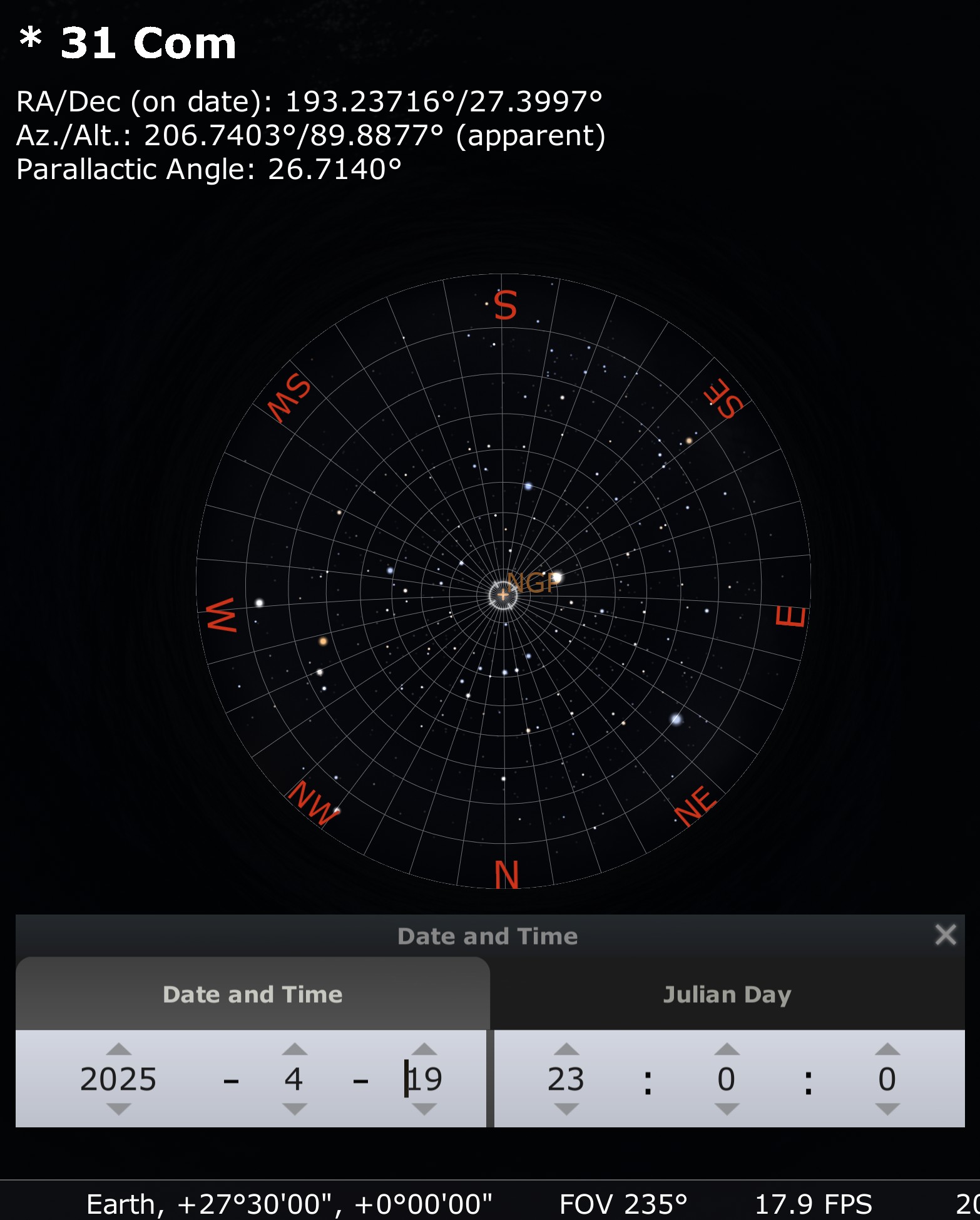
Heh. Yeah. It can be a little disconcerting! The ideal location and time, where the Milky Way is running around the horizon this time of year, puts the North Galactic Pole at the zenith. In "Stellarium", you can turn on an indicator to display the NGP. Can you get that to display in the web app version of "Stellarium"? In the desktop version, it's under the "Sky and Viewing Options window" (accessible from the left-side palette of controls) and then under the "Markings" tab. You have to look carefully among the many options for "Galactic Poles". Tick the checkbox, and that marker should appear.
From your latitude in the UK, you'll see, of course, that the NGP passes maybe 25° south of the zenith so you do get some remaining bit of Milky Way every night. It's Cassiopeia low on the northern horizon. At the ideal location/time, with the NGP near the zenith, Cygnus and Sagittarius are on the horizon on the eastern side of the sky, Orion on the horizon setting in the west, Cassiopeia right at the horizon in the north, and Crux at or just below the horizon in the south. This happens at 11pm local mean time on April 20 (midnight "daylight time" in most areas where this is visible). That makes this week the beginning of the "Null Milky Way" in the evening sky. It happens at 9pm LMT on May 20. By June 20, it's 7pm LMT (8pm with DST), but the Sun is still up or has barely set, so that's the end of the "Null Milky Way" season.
Frank Reed