NavList:
A Community Devoted to the Preservation and Practice of Celestial Navigation and Other Methods of Traditional Wayfinding



From: Frank Reed
Date: 2025 Dec 19, 07:40 -0800
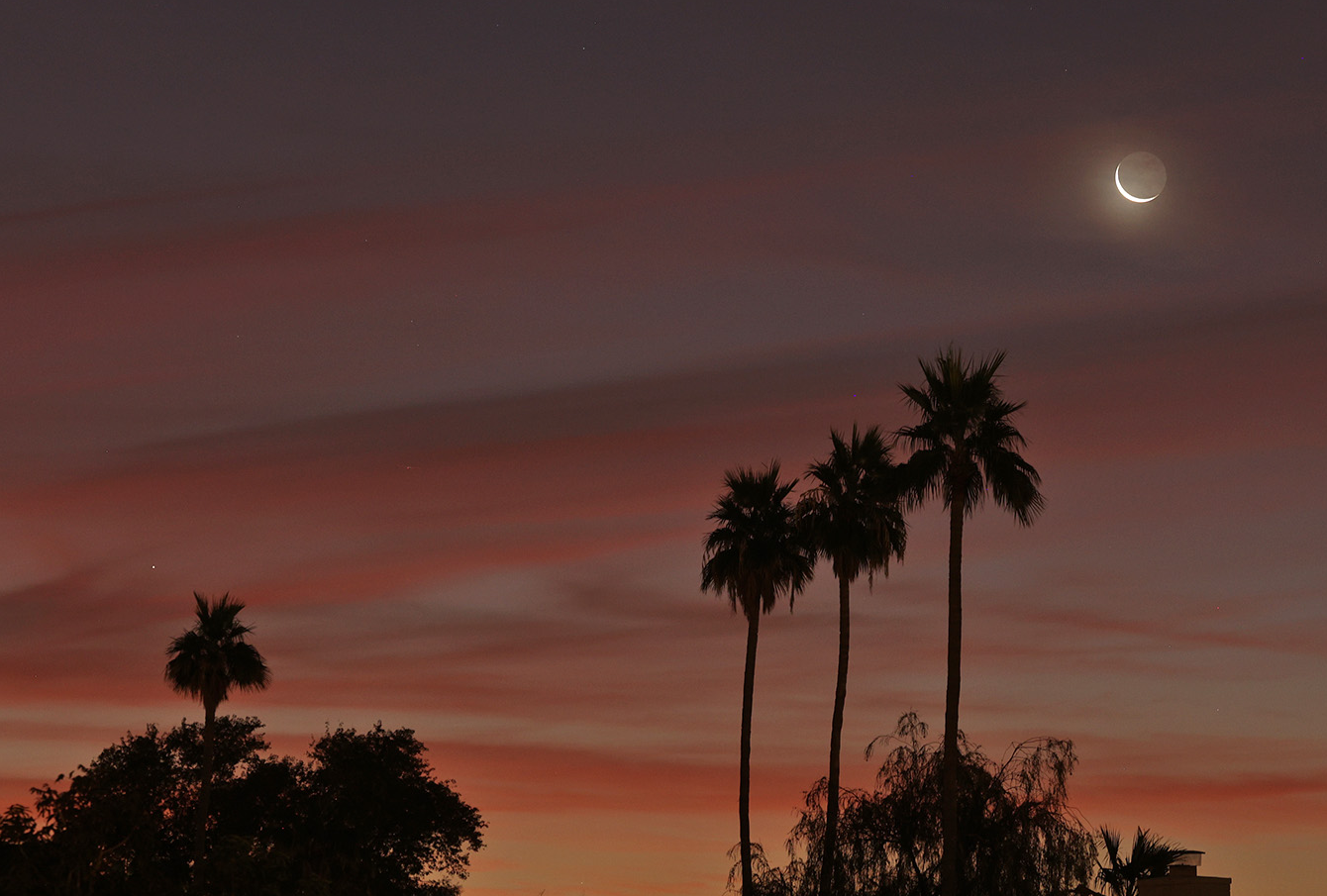
A day later, 17 Dec 2025, Tom Polakis captured this image of Mercury and the Moon among the stars of Scorpius and Libra just before dawn, at 13:30 UT (+/-) from southern Arizona.
The image offers a few challenges. Can you identify the stars? I see β Sco above and to the right of Mercury. Antares is also probably in-frame but hidden by some clouds or treetops. Any others?
Among the fainter stars, there's one just above and a little to the left of the Moon. That's 42 Libra (simulate the scenario in "Stellarium" to see it), faint but visible without a telescope at magnitude 5. It's nearly on the projected line passing through the Moon's horns, which means it would be useless for determining Greenwich Time, the traditional purpose of lunar distance observations. Could you use it as part of a position fix by lunar distances (assuming 13:30:00 UT exactly)? Combine the distance from that star with the distance from another nearly perpendicular (β Sco or even Mercury), and you can get a rough fix in latitude and longitude. Given the limitations of the photo, "rough fix" here is probably +/-50-100 miles. Not much practical use, but if you think in terms of "forensic photography" that would put you in the correct corner of North America with no further information ...and no horizon.
Celestial from a photo requires an assumption of linearity across the field of view (maybe close enough, maybe not!) and also an angular scale. The diameter of the Moon may be the best bet for the scale. Optionally, you could get an angular scale as well as the position of the Moon from stars quite close to it (like 42 Lib), and that's more likely to give an accurate position.
Reminder: yes, you can get latitude from a lunar distance observation, as well as longitude, at known GMT/UT!
Frank Reed