NavList:
A Community Devoted to the Preservation and Practice of Celestial Navigation and Other Methods of Traditional Wayfinding



From: Bob Bossert
Date: 2025 Aug 24, 12:03 -0700
Thanks Frank.
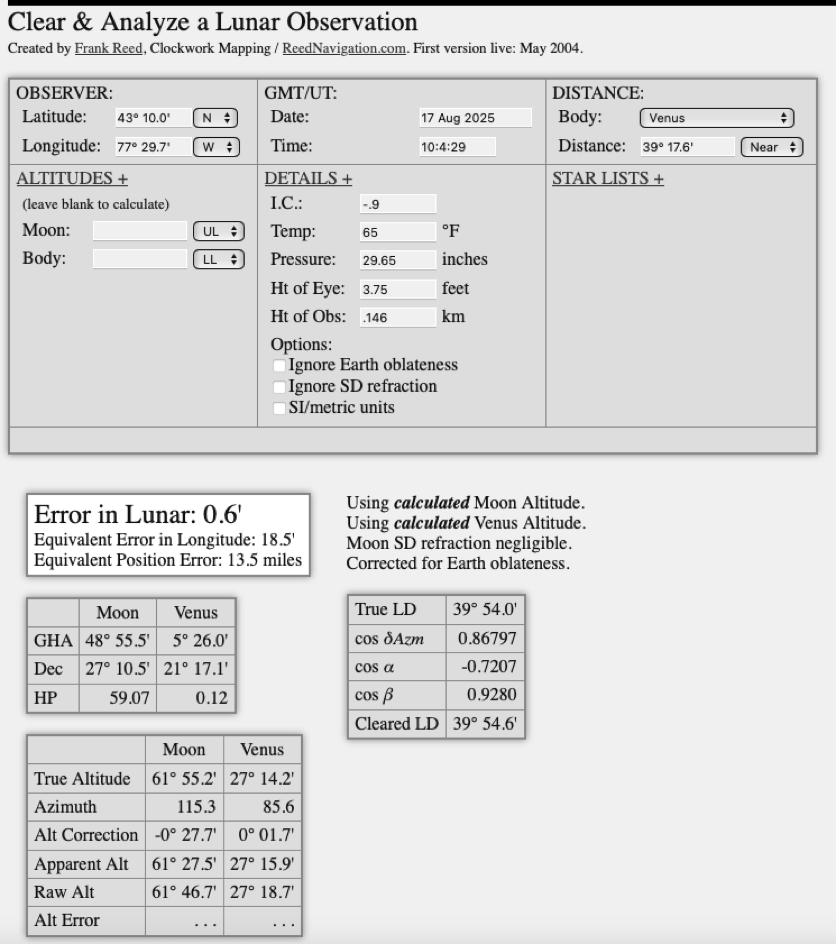
I was using a Davis Mark 25. I totally eliminated side error and validate IE each time I go out. After much practice, I'd get "good enough" results for Altitude Sights (Sun, Moon, planets, Stars) as long as I kept head or glasses from touching the scope/sextant. Good enough for Altitude sights is Not good enough for Lunar sights as your Web app shows. But while doing Sun-Moon Lunars (Moon was ahead of the Sun), I just discovered that my horizon filters gave sun ghost images (looked like a Venn diagram). I then tried Baadar solar filters; no ghost images; but cumbersome. I didn't try flopping the Sextant to view Sun through Index Filters and Moon through the Horizon without filter.
Thanks for explaining the methodology used for Error in Longitude derived from Error in Lunar. Standard Rate 12 sec per .1 arc minute was what I was missing!
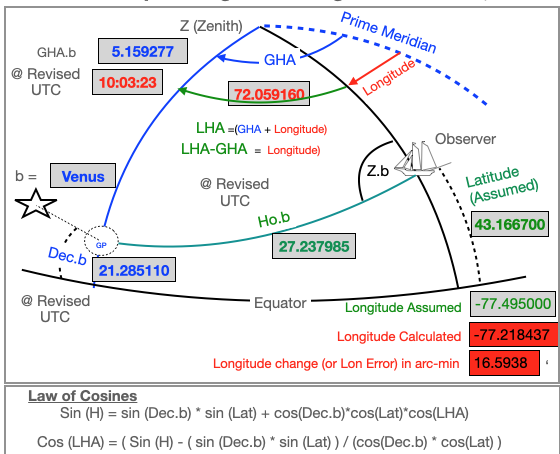
I tried out a low precision way to derive Revised Longitude with the Time change (Lunar Derived Time minus Assumed DR Time) is small. Use Earth's 15°/hour rotation rate (.25 arc-min/sec). My delta Time was -66 seconds (used Predicted Lunar Distances Table). Assuming my LD observation was correct, my revised longitude position would be East of my Assumed Longitude by 16.6 arc minutes. 12.1 nm east of assumed position. But assumed position was GPS, my time of sight was accurate, so I had Sight Error (16.6 arc minutes, 12.1 nm).
And here is a screen shot of my test case and solving the Navigation Triangle to determine Longitude
Thank you for teaching Lunars. I enjoyed the class. I particularly enjoy doing Lunar sights in my backyard. My next step is to spring for a metal sextant.
Bob Bossert