NavList:
A Community Devoted to the Preservation and Practice of Celestial Navigation and Other Methods of Traditional Wayfinding



From: Frank Reed
Date: 2025 Apr 18, 09:03 -0700
Venus passed through inferior conjunction, between Earth and Sun, on March 23. It's now a morning sky object, the "morning star", and it is once again very bright and relatively easy to see in daylight. Venus transits the meridian (due South or due North --very nearly selected by your hemisphere since the Dec is quite close to zero) at about 10:45am local time for most northern observers in mid-latitudes. (Local Mean Time +1 for DST).
To estimate the altitude of any celestial body as it transits the meridian, whether the Sun at L.A.N., Venus in daylight, or a star in the middle of the night, first get the altitude of the celestial equator at transit which is simply 90°-Lat, where Lat is your best estimate of latitude (signed). Add the object's declination onto that, also as a signed value (+ is North, - is South). If the result is greater than 90°, subtract 90 from it, and face North instead. So if your latitude is 38.5° N, and the Dec of Venus is 1.25° N, as it is today, then the altitude of the celestial equator is 51.5°, and the estimate of the altitude of Venus at transit is 52.75°. That's plenty accurate enough to find it in binoculars, and then you can grab it in your sextant, or if your eyes are good enough, you can easily see it without optical aid. It's very bright.
If you can observe the altitude of Venus at transit with your sextant, of course you can determine your latitude with excellent accuracy. It's just Lat = Z.D. + Dec (same as the Sun at Local Apparent Noon) where, Z.D., the zenith distance, is 90°-Alt, with Alt here being the corrected Alt (also known as Ho).
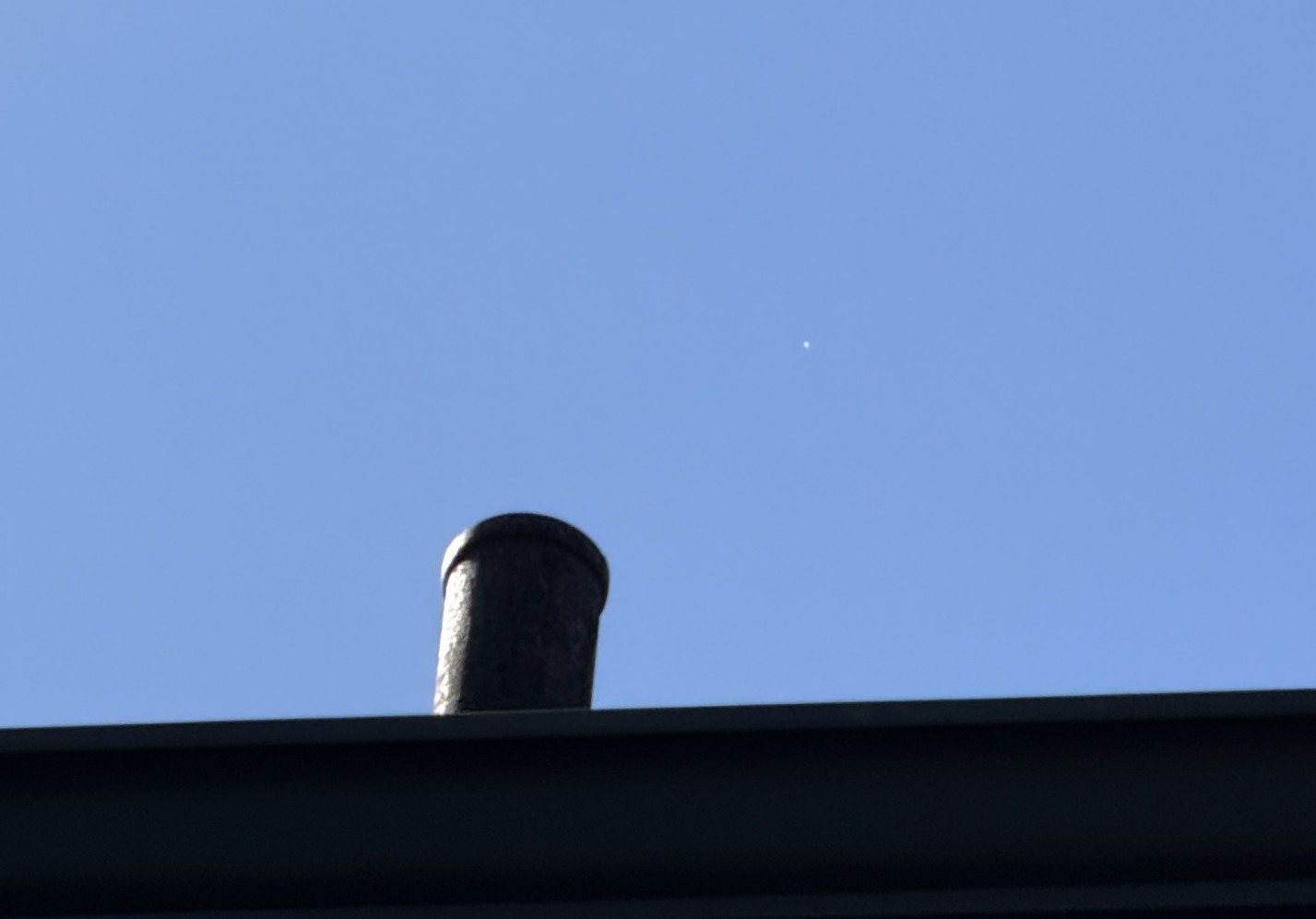
Here's today's photo. Fortunately, the phone camera decided to leave the focus close to infinity so Venus showed up clearly. Some of you may recall I took a nearly identical photo with Venus near that same little chimney a couple of months ago when Venus was trailing the Sun, a couple of hours after noon instead of before noon, as it was today.
Frank Reed