NavList:
A Community Devoted to the Preservation and Practice of Celestial Navigation and Other Methods of Traditional Wayfinding



From: Frank Reed
Date: 2026 Apr 3, 09:57 -0700
Hello David C.
First to the PS in your last message, you wrote:
"PS A few years ago I worked a sight by this method. At The time I liked to think that I was the first person to do this in nearly a century !"
Ah yes, I do remember that. Just a few years ago, as you said. I think we established that a few others had experimented with "Cloudy Weather" Johnson's Tables, but it's likely that only a small handful had gone as far as you did, working actual sights by his methods. Back then Paul Bedel posted a detailed analysis of Johnson's methods (link below) with this little preface:
"see my own study on different Johnson's tables and books (page 19 in the attached file) ... written in french language but figures and formulae are international language !
File: Cloudy-weather-Johnson.pdf
It's an interesting little diversion, a side-topic in the late 19th century history of navigation. But I would add that this is "library history". Which is to say, we're looking at old books and pdfs of old books, but this is different from the actual practice of navigation. Did Johnson have an impact? Do we have evidence that real practicing navigators actually used his books and methods? That's the "real" history...
Back to the top of your message, you wrote:
"Frank I think you are describing the double chronometer method. In the late 19th century Mr AC Johnson of "Cloudy Weather" fame described how the latitude could be calculated by this method:
Take two time sights separated by a suitable time period. Then calculate two longitudes using an assumed latitude. Finally calculate a latitude correction."
Well, no. And in fact I need to emphasize here that I was suggesting something radically easier. That's why I closed my last message with a one word summary: "Easy." I was not in any way suggesting an antique methodology or some obscure technique. We all know how to solve this problem of getting a latitude from two altitudes.
Anyone who has any form of sky simulation app can do this (text-based... or graphical, like Stellarium). And anyone who has ever solved any two-body fix should be able to do this though it's somewhat difficult getting a starting point given the "construction" of some of the methods when you don't know the time, or the date, or the longitude! So pick one at random until things line up. Or start on the prime meridian and pick a date and time that roughly approximate the sky that you see. Work from there...
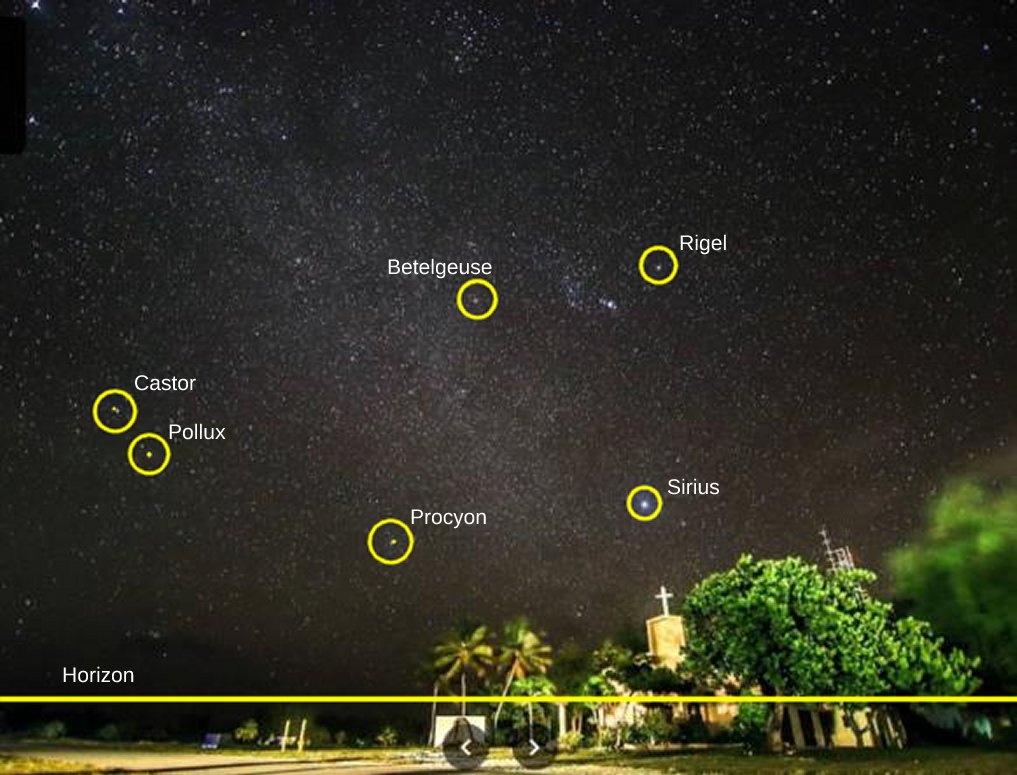
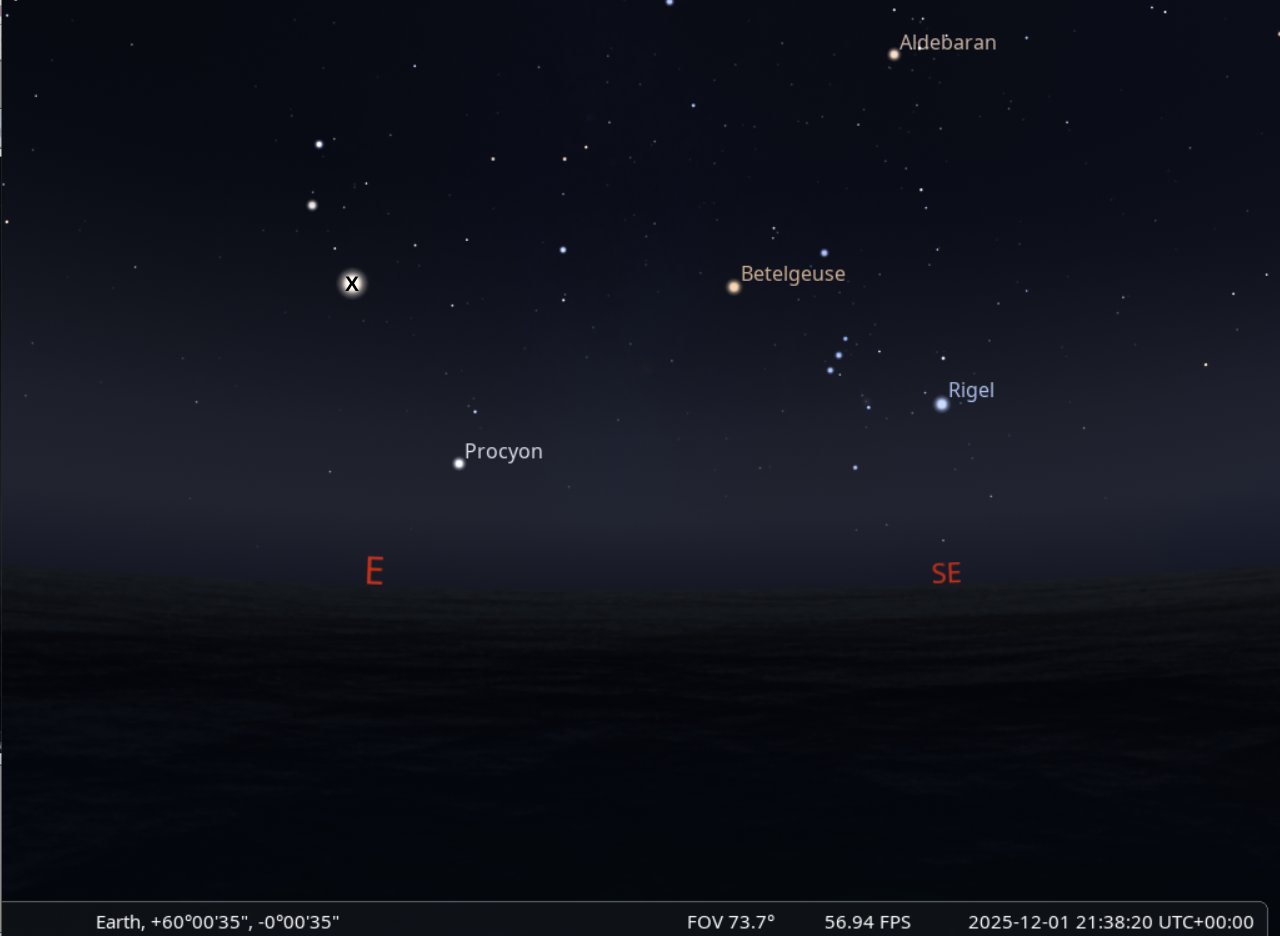
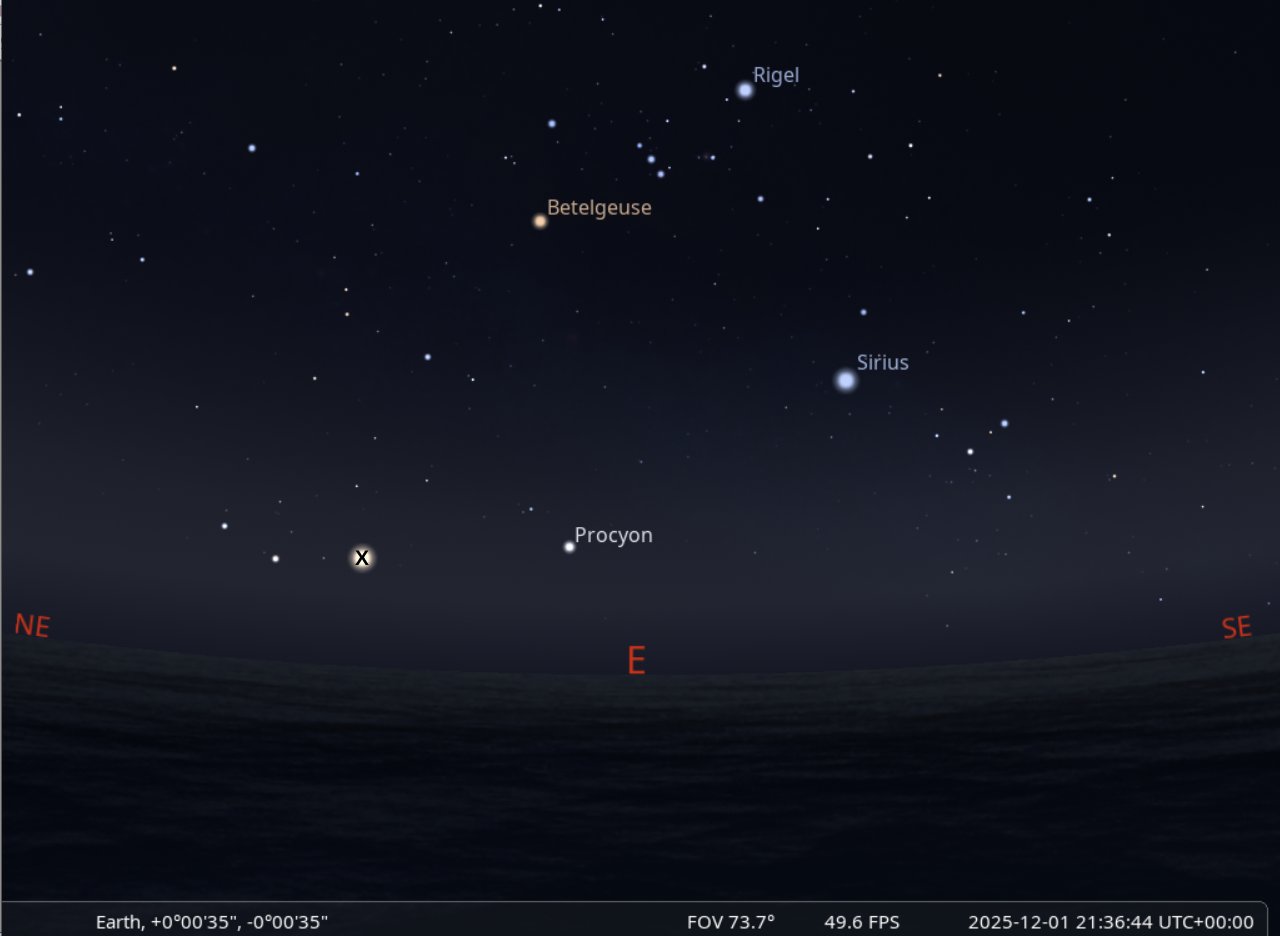
In the images below I have circled some bright stars. One image is a "markup" of the original photo. Notice how Sirius and Procyon are aligned relative to the horizon. Next look at the images produced by Stellarium showing the view facing east on the prime meridian around 2130 UT on 1 Dec 2025. I put an "X" through Jupiter since its position changes year to year, and it was not in this part of the sky when the original photo was taken. One simulation shows the sky from the equator. The other shows the view from 60°N. Key astronomy here: you get from one view to the other by a pure, simple rotation about the east point on the horizon. Look at the positions of those bright stars relative to the horizon in the two simulations... Imagine (or draw) rays extending to each star from the "E" at the east point. Notice that from one image simulation to the other, each ray is rotated 60°, exactly the change in latitude.
So what latitude would correspond to the positions of the stars in the original photo? Again, we can do this by the standard methods of celestial navigation. Or you can just "dial up" the sky that you need by rotating the view around the east point! :)
Frank Reed