NavList:
A Community Devoted to the Preservation and Practice of Celestial Navigation and Other Methods of Traditional Wayfinding



From: Wolfgang Köberer
Date: 2025 Nov 4, 09:39 -0800
I don't want to spoil the fun of retro-engineering astronavigation in airships through perusing tables for maximum usable heights etc., but the truth is: there was no astronavigation on airships - at least not on the big German pre-WWI airships that crossed the Atlantic. One could possibly see the horizon, but there was this big bulky superstructure overhead which blocked the view to the sky, alas. No way to take a noon sight for instance.
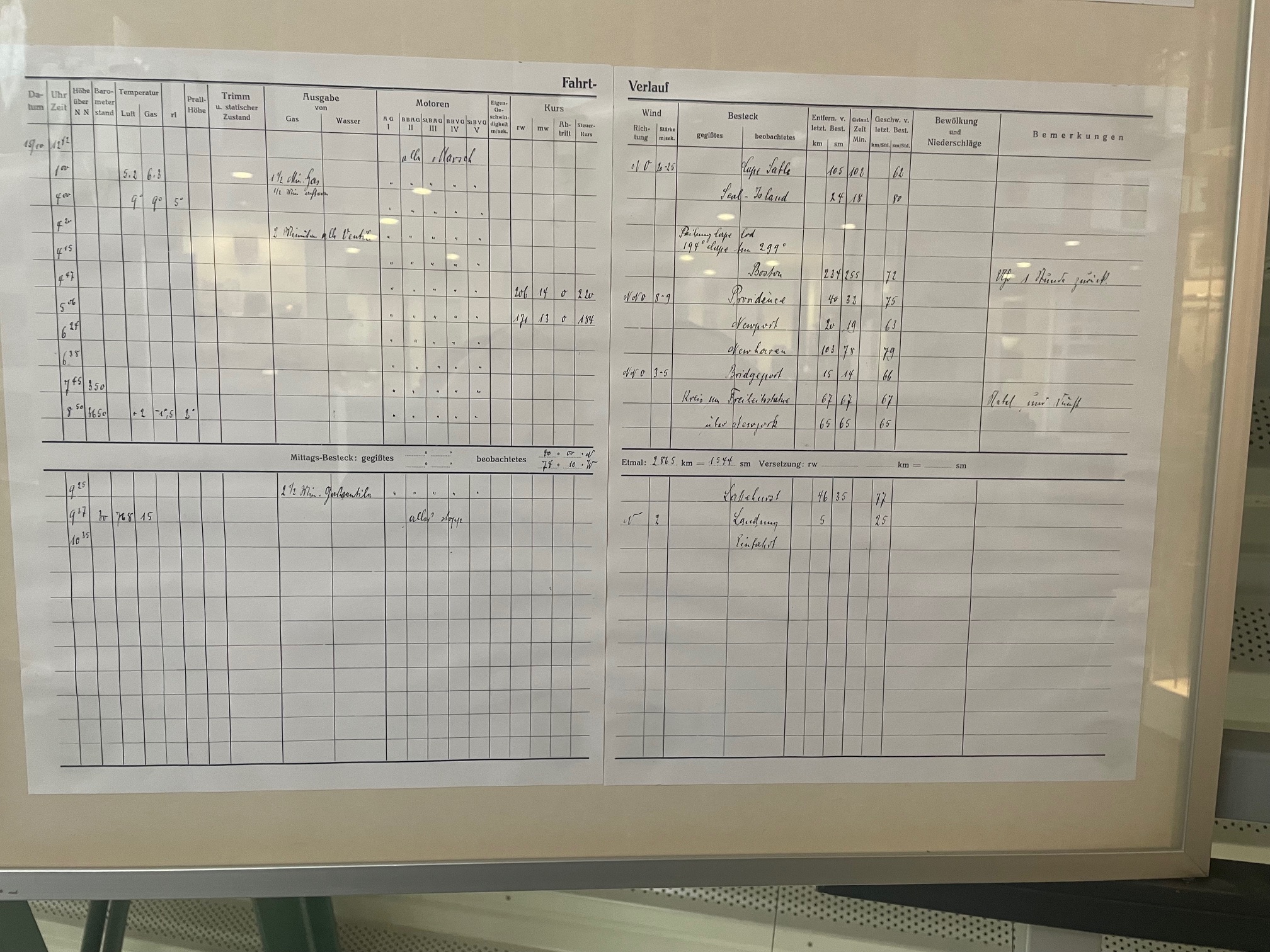
Consequently navigation was strictly dead reckoning, the tricky part being the estimate of drift. There was a special procedure for that. And Dave Walden must have read some other book, but in the Dick/Robinson book it is clearly stated that "celestial navigation was superfluous" (p. 61). Dick not only described the dead reckoning but also added a chart of the May 1936 trip to the US. In the attached scan you can see well that there are no LAT/LON data even in mid-ocean. The picture of the log book "Fahrtbericht" that I am attaching also notes as "Besteck" (i.e. position by dead reckoning) simply positions by sight without data. So the pictures with an observer handling a sextant were just show not reflecting any actual practice.
Years ago I asked the Zeppelinmuseum in Friedrichshafen for information on astronavigation on the big airships and drew a blank (I guess they didn't even know what astronavigation was). The Museum in Zeppelinheim (close to Frankfurt) where many of the people flying the airships lived only has a compass and a pair of dividers. So absent any instruments for astronavigation in the relevant museums I suppose that the question of astronavigation on airships is closed.
Astronavigation in airplanes is a completely different question. There is a Portuguese publication on the Coutinho/Cabral crossing of the South Atlantic in 1922 by my friend Zé Malhao Pereira (the only historian of navigation who was skipper of a big sailing vessel, the Portuguese sail training ship Sagres) with a detailed discussion of their astronavigation. It can be downloaded here: https://academia.marinha.pt/pt/edicoes/EdicoesDiversas/Livro%20Gago%20Coutinho%20a%20Navegac%CC%A7a%CC%83o%20Ae%CC%81rea.pdf. And there was a lively discussion of astronavigation in balloons and planes before and after WWI in German aeronautical journals, but also in French publications. Much can be found in the bibliography of the NACFA Report Nr. 125.
Regards
Wolfgang