NavList:
A Community Devoted to the Preservation and Practice of Celestial Navigation and Other Methods of Traditional Wayfinding
Re: Exorcizing the Evil Effects of Parallactic Retardation (Modified by Fred Hebard)
From: Fred Hebard
Date: 2004 Mar 20, 16:10 -0500


From: Fred Hebard
Date: 2004 Mar 20, 16:10 -0500
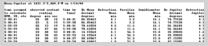
This is a repost of my previous message, with the table included as
text in the body of the file, as well as a pdf, as requested by George
Huxtable.  (The pdf was made from a jpg, so the text is not editable).
My previous version of the table contained a blunder, which, however,
did not affect the net result.  The blunder was that my ephemerides for
Jupiter were advanced by one hour.  I guess I should have noticed
something was up when the distance between the Moon and Jupiter was
reputed to have changed 17 degrees in 5 hours!  This time, I double
checked the calculations with the U.S. Naval Observatory site's
computer (http://aa.usno.navy.mil/).

In January, George Huxtable surprised us all by saying that he no
longer felt that parallactic retardation affected the accuracy of
observation of time by lunar distance.  I've finally had time to look
at this numerically, and, by golly, George is right, which should come
as little surprise to most of us.

The table below gives some simulated observed distances between the
Moon and Jupiter on 1/14/04 at 1*31.3'S latitude and 0*0.0'W longitude.
  The altitudes of the Moon and Jupiter, and the Moon's refraction,
parallax and semi-diameter plus Jupiter's refraction were calculated
using the time in the first column.  The horizontal parallax of the
Moon was taken from the Nautical almanac and used to calculate the real
parallax for the Moon at that altitude and latitude, using Young's
Method of Clearing that George Huxtable presented to the list in
2002-2003.

Observations near the equator give the greatest "parallactic
retardation," combined with the time when the moon is near zenith,
which is 5:00:01 hours in the table below. The retardation can be seen
by comparing the difference between the "observed sextant reading" of
lines 1 and 4, 19'34" of arc, with that of lines 5 & 8, 29'52" of arc.
The Moon is only moving through 19'34" of apparent arc between 5:00:01
hours and 5:59:59 hours (lines 1 & 4), when it is near zenith, compared
to 29'52" of arc between 0:00:01 hours and 1:59:59 hours (lines 5 & 8),
when it is near the horizon.

The thinking has been that if the moon is moving through such a smaller
swath of apparent arc (19'34"), then any errors in measurement of
distance will be magnified.  If the error is 30" of arc, one will be
measuring to only 1 part in 39 (30"/19'34"), rather than 1 part in 60
(30"/29'52").  This is the supposed "evil effect of parallactic
retardation."

However, George has been trying to point out to us that there are two
components to measuring a lunar distance, one the distance itself, and
two the altitude of the bodies.  The Moon's parallax is fixed by
observation of its altitude, not the distance, and it is the large
shift in the _COMPUTED_ parallax between 5:00:01 and 5:59:59 that gives
rise to the retardation.  Between 5:00:01 and 5:59:59, the computed
parallax of the Moon increases from 3.2' to 11.6' of arc, almost a
4-fold difference.  In contrast, between 0:00:01 and 0:59:59, the
parallax decreases from 56.3 to 51.2, only a 10% difference.

But if one holds the parallax constant, in this table by holding the
assumed time constant, such as at 5:00:01 between lines 1 and 2, then
the observed sextant reading has to increase by 34'7" of arc, from
22*28'12" to 23*2'19", to move the time by lunar up by one hour.   You
can also see that the observed sextant reading decreases 34'27" between
lines 3 and 4 of the table to move the lunar time back one hour from
5:59:59 to 5:00:01.  The error has dropped back to 1 part in 60.  AND
IN A REAL LUNAR, PARALLAX IS HELD CONSTANT BECAUSE IT IS FIXED BY THE
ALTITUDE MEASUREMENT.

So this is what George has been trying to tell us.  Perhaps he can
explain these numbers more clearly than I have; but it was the numbers
themselves that convinced me.

Fred Hebard

Moon-Jupiter at 1d31.3'S,0d0.0'W on 1/14/04

time assumed  observed sextant  time by   Hc Moon  Refraction  Parallax
  SemiDiameter  Hc Jupiter  Refraction
to calculate       reading        lunar   decimal        Moon      Moon
          Moon     decimal     Jupiter
HPM, SD, etc  degree  min sec             degrees         min       min
           min     degrees         min
5:00:01          22   28   12   5:00:01   86.85463        0.1       3.2
          16.1    70.77158         0.3
5:00:01          23    2   19   5:59:58   86.85463        0.1       3.2
          16.1    70.77158         0.3
5:59:59          22   13   19   5:00:01   78.61850        0.2      11.6
          16.1    56.36603         0.7
5:59:59          22   47   46   5:59:58   78.61850        0.2      11.6
          16.1    56.36603         0.7
0:00:01          20   28   53   0:00:01   14.15560        4.1      56.3
          15.8    32.29832         1.6
0:00:01          20   58   45   0:55:53   14.15560        4.1      56.3
          15.8    32.29832         1.6
0:59:59          20   28   53   0:04:27   28.69067        1.9      51.2
          15.8    47.15395         0.9
0:59:59          20   58   45   0:59:59   28.69067        1.9      51.2
          15.8    47.15395         0.9
File: