NavList:
A Community Devoted to the Preservation and Practice of Celestial Navigation and Other Methods of Traditional Wayfinding



From: Frank Reed
Date: 2025 Oct 6, 11:56 -0700
Back to that 3:4:5 triangle story...
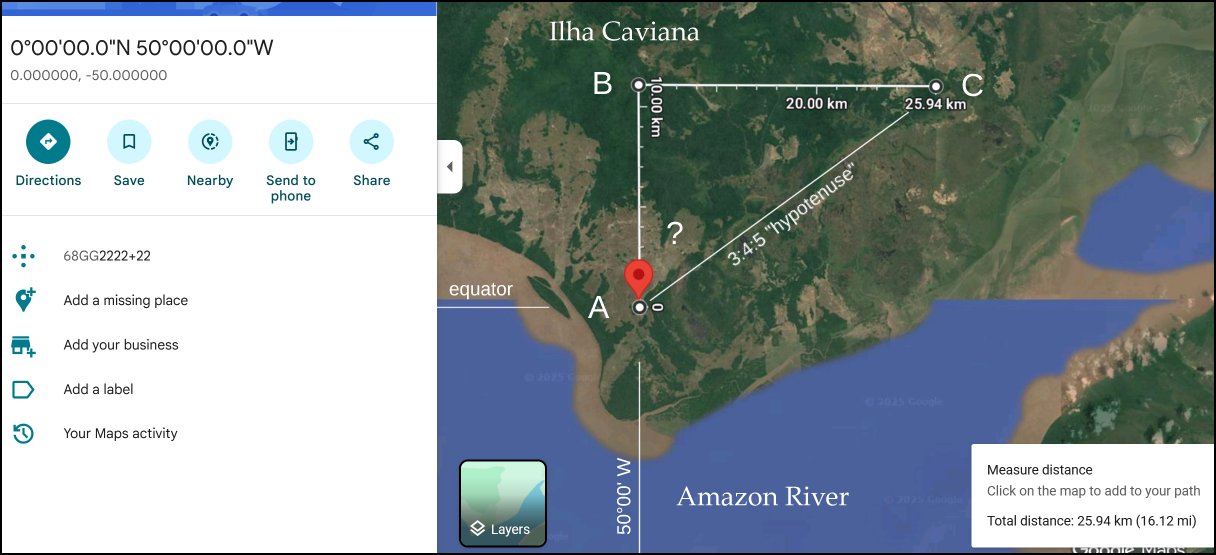
Let's visit "Ilha Caviana" or "Caviana Island" at the mouth of the Amazon River. The equator crosses this island, as well as the meridian of 50°W longitude, and it's flat, all of which makes it nice for certain lat/lon calculation scenarios.
Let's build three simple towers with flagpoles at the top that we can observe with sextants from a distance. The flagpoles will be positioned by GPS at the following locations:
- A: 0°00' N, 50°00' W
- B: 0°06' N, 50°00' W
- C: 0°06' N, 49°52' W
Notice that these three points make a 3:4:5 triangle. The west side is 6' of latitude in length. The north side is 8' of longitude in length. The northwest corner is a right angle, and the remaining side, the hypotenuse, should be almost exactly 10' (of what?) in length. Let's assume that the positions are accurate to 2 meters or maybe a little better --reasonable with common GPS devices. If this triangle could be drawn on the ground, and if its sides could be measured with chains or laser-ranging, we could guarantee it's a 3:4:5 triangle. By simple plane trigonometry, we could then calculate the corner angle between B and C viewed from point A. It would be 53°07.8' as measured with a sextant. But we don't have that here... We have latitude and longitude coordinates. So what is the corner angle at point A, looking at B and C? In other words, if you are standing atop the southern tower, right next to flagpole A, and you measure the angle between flagpoles B and C, which are very close to six and ten nautical miles away respectively, what angle will you find? Similarly, instead of measuring with a sextant, if you decided to set an exact rhumbline course from A to C, what course would that be? Do these things match? Should they??
Just some food for thought for the calculating crowd! I don't have correct answers (necessarily) nor any tricks up my sleeve. Just something to ponder. For the rhumbline side of this, you may want to look at one of those long-ish equations for meridional parts. There's one in modern editions of Bowditch. I will add one note here: I think you'll find that the difference in this corner angle, compared to the simple 53°07.8' above, is easily measured with a sextant. So is it a 3:4:5 triangle or not?
Don't worry too much about the little map I'm including here. I have attempted to illustrate what I have described above. I hope it's close.
Frank Reed
Clockwork Mapping / ReedNavigation.com
Conanicut Island USA