NavList:
A Community Devoted to the Preservation and Practice of Celestial Navigation and Other Methods of Traditional Wayfinding



From: Joe Plazak
Date: 2026 Mar 17, 18:21 -0700
Fun question, and I also think that there will be a wide range of answers here. I'll add a few quotes:
Harold Gatty, in his 1934 article entitled "Accuracy in Aerial Dead Reckoning" claims an "accuracy of four or five miles, which can be obtained under fairly good conditions by an experienced man."
https://www.usni.org/magazines/proceedings/1934/november/accuracy-aerial-dead-reckoning
P.V.H. Weems, in the 1942 edition of Air Navigation, sets both a time and accuracy goal: "if a position within 5 miles may be obtained in 5 min. or less, then celestial navigation is of real value to aviation."
In that same edition, Weems also shares a letter from Fred Noonan, which says: "The accuracy of fixes was very gratifying. By that, an accuracy of approximately ten miles is implied. My experience is that such a degree of accuracy is about the average one may expect in aerial navigation."
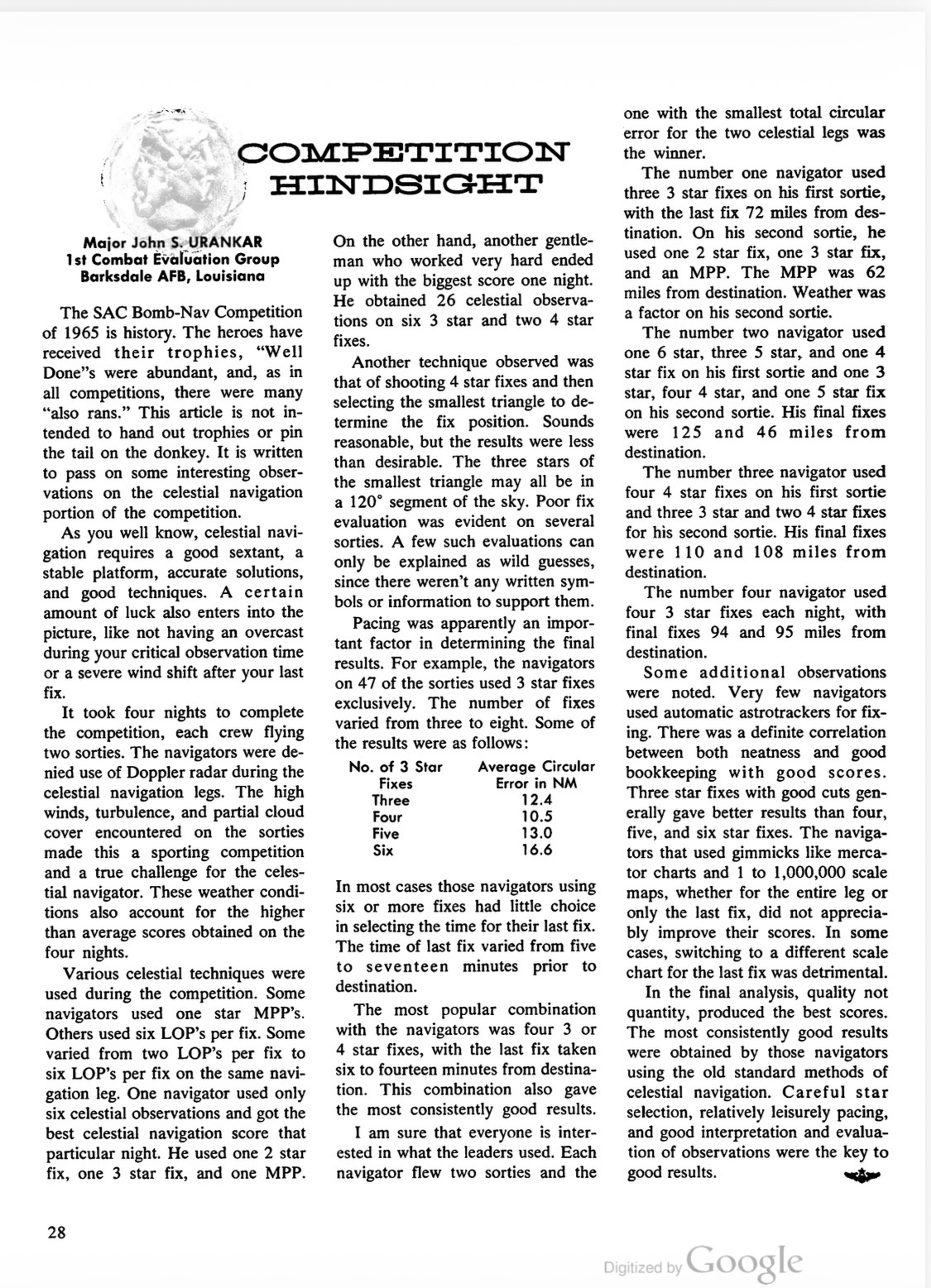
And finally, I'm attaching a 1965 article from The Navigator which describes the 1965 SAC Bomb-Nav competition. The author writes that "The high winds, turbulence, and partial cloud cover encountered on the sorties made this a sporting competition and a true challenge for the celestial navigator." He then proceeds to describe average circular errors ranging from 10.5nm to 16.6nm.
-JP