NavList:
A Community Devoted to the Preservation and Practice of Celestial Navigation and Other Methods of Traditional Wayfinding


From: Diego Melas
Date: 2026 Nov 5, 23:16 -0800
Werner,
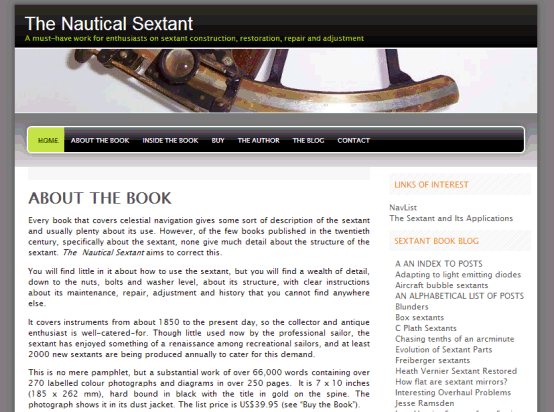
The tripod is doing more than steadying your hands. A bubble sextant is
a pendulum, and in flight the bubble departs from the true vertical
under every acceleration, turn and gust. That is the dominant error of
the instrument in its intended use. Mounted on a tripod ashore it
disappears entirely, and the bubble becomes an artificial horizon with
mechanical stability no hand can give it. The good results you report
are not the optics improving, they are the largest error source being
removed.
The stopwatch procedure you describe is the right one. Reaction time at
the button costs two or three tenths of a second, under 0.1 arcminutes
of hour angle, which is nothing beside the pointing uncertainty. The
one thing worth watching is the watch rate over a long session: a
mechanical stopwatch one second out after four hours is 15 arcseconds
of longitude, still small, but a second comparison with the time signal
at the end of the session closes the account for free.
What limits you now is the instrument itself, so I would suggest the
next step is a series rather than a single shot. Take 6 to 10
observations of the same body over a few minutes and plot altitude
against time. Altitude changes by at most 15 arcminutes per minute of
time, less at higher latitudes and away from the prime vertical, so the
run is a straight line to well within the precision of the instrument.
Fit it, read the altitude off the line at a chosen instant, and the
blunders show up as the points that do not sit on it. The averaging
gains you a factor of 2.5 to 3 on the random error, which is what the
averaging mechanisms built into those sextants were doing mechanically.
Avoid a run across culmination, where the curve is no longer straight.
Diego Melas