NavList:
A Community Devoted to the Preservation and Practice of Celestial Navigation and Other Methods of Traditional Wayfinding



From: Frank Reed
Date: 2026 Jan 19, 18:12 -0800
Trammell H, you wrote:
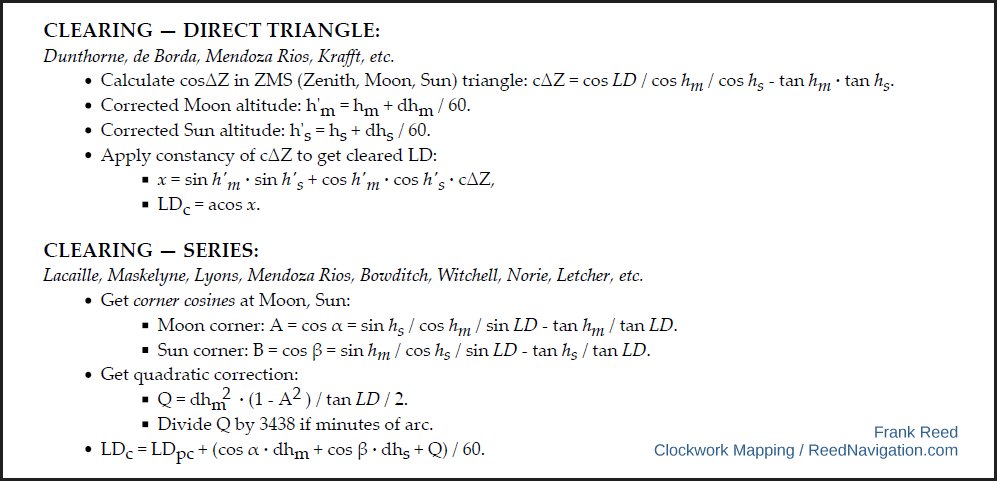
"In Frank Reed's "Lunars are Easy" https://www.reednavigation.com/lunars/easylun.html he corrects the observed lunar distance with the "cosine corners" based on ..."
First of all, coincidental timing! Or at least, I assume that's all it is. :) I have been running through a rebuild of two of my websites in the past two weeks. Some NavList members who signed up for upcoming workshops and the new "Celestial Season Pass" may have noticed some changes. But that old "easy lunars" essay got re-done only in the past 48 hours.
Second, how did you come across this? Did you see a link for it somewhere recently? I ask because I saw an uptick in activity on that page last month, and I have been wondering what generated that interest. Do you happen to know how you came across it? You should have a look at the updated content here: ReedNavigation.com/lunars/easylunars/. Please let me know if you spot any typos or technical problems (they exist, I am sure).
I'll get back to you tomorrow with more details in reply to your question. Before I forget, one issue: that angle you're identifying as LHA is not LHA —it's a difference in azimuth. Call it δAzm or ΔZ... But not LHA. :) The math is fine, and that's the key thing here, but the identification is just wrong.
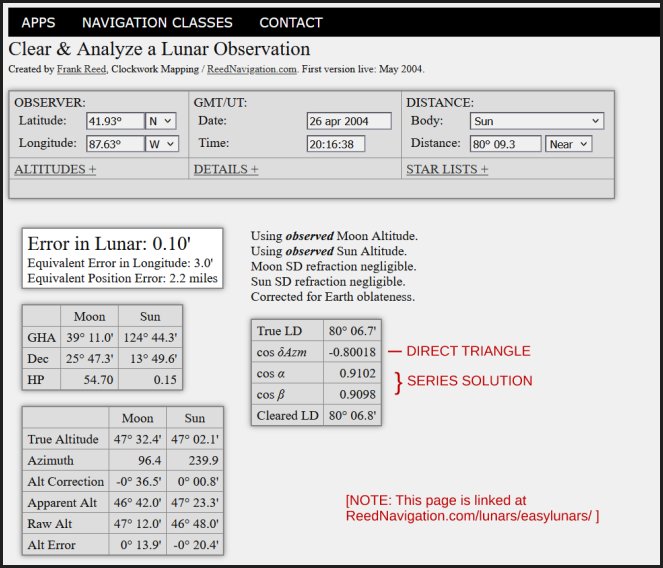
I'm including below a screen cap from materials for my Lunars workshop, which is happening (online) again in just a few weeks. Also that same "Chicago scenario" analyzed in my lunars web app (see the link at the end of easylunars).
Frank Reed
Clockwork Mapping / ReedNavigation.com
Conanicut Island USA