NavList:
A Community Devoted to the Preservation and Practice of Celestial Navigation and Other Methods of Traditional Wayfinding



From: Frank Reed
Date: 2026 Jan 21, 09:51 -0800
Trammel H, you wrote:
"I don't think all of the extra web traffic was me reloading the page while practicing my lunar math"
Heh. :) No, probably not ...unless you have the world's best randomizing VPN :). The traffic on that page has been geographically spread around the globe. Actually, I think it's A.I. prompting (and now AI-enhanced Google searches) that are directing traffic to that old essay. But I'm still curious if you remember how you personally learned about it. Do you recall?
Regarding that little snippet from my Lunars workshop Guidebook, you wrote:
"It seems that I've rederived the "Direct Triangle" approach that you show in the workshop materials, although using different trig functions."
Yes. You're in good historical company. After lunars ceased to be commonly used in marine navigation around 1850, there were still articles published regularly (every few years) announcing that the "problem of lunars" has finally "at long last been solved" and here is a new method "better and more accurate than anything that has come before." The introductions to the article frequently seem to have that superlative tone. But when you look a bit further, they're almost always "different trig functions", and, almost always, trig substitutions that were already familiar from those earlier decades when lunars were actively applied to navigation.
There is an almost endless supply of "trig identities" out there, and it's an interesting math game to see if you can invent an arrangement of the terms that is actually new. But here's the kicker: whether it's a new arrangement or not, if it's the "direct triangle" solution, then it's the "direct triangle" solution. Very little is gained from these trigonometric re-arrangements (though they're certainly fun, and they can lead to interesting "use cases" like your fascinating slide rule). There can be, however, some computational benefits for certain calculating regimes...
Looking at my page from my workshop, you asked:
"Does the tangent in calculating the ΔZ have bad behaviour as the height of the moon or sun increase, or in practice you wouldn't be shooting them at near 90 degrees overhead anyway?"
How could it? The arrangement of the terms does not create computational singularities. If the "direct triangle" solution in general has no problem at high altitudes —and, fundamentally, it does not)— then fear not! :) The only real limitation that can pop up in these computational settings is when we run into issues with the maximum number of digits available in our tools.
In the late 18th and early 19th centuries, solving lunars by the direct triangle approach was moderately problematic because it required trig and log-trig tables with more significant digits than average. That led to the great popularity of series methods, which were dominant in that period. So if you're interested in lunars as components of navigation history, then the series methods are important.
In the late 20th century, when digital computation became available, many navigation enthusiasts shunned standard methods of working celestial problems, like the "great circle" or "law of cosines" solution, based on some advice dating from the 1980s that suggested that haversines were better since they could manage some of the computational loss of accuracy that occurred under some circumstances. That was true for so-called "single precision" math but the issue evaporated when "double precision" (fifteen digits) became the nearly universal standard at the end of the 20th century.
So why the unique arrangement of trig terms in my own version? Where does that tangent come from? Honestly, it's nothing. It's just a re-arrangement that avoids "parentheses" and is easier to punch up on a common scientific calculator.
Can you describe your goal with lunars? What are you aiming to achieve? You don't need to come up with anything complicated here. :) I'm just interested to hear where this is going for you. What "market" in celestial navigation are you hoping to hit? Are you thinking of some modern application of lunars? Hobbyist? There are lots of options here, of course!
Repeating your included image from your previous post: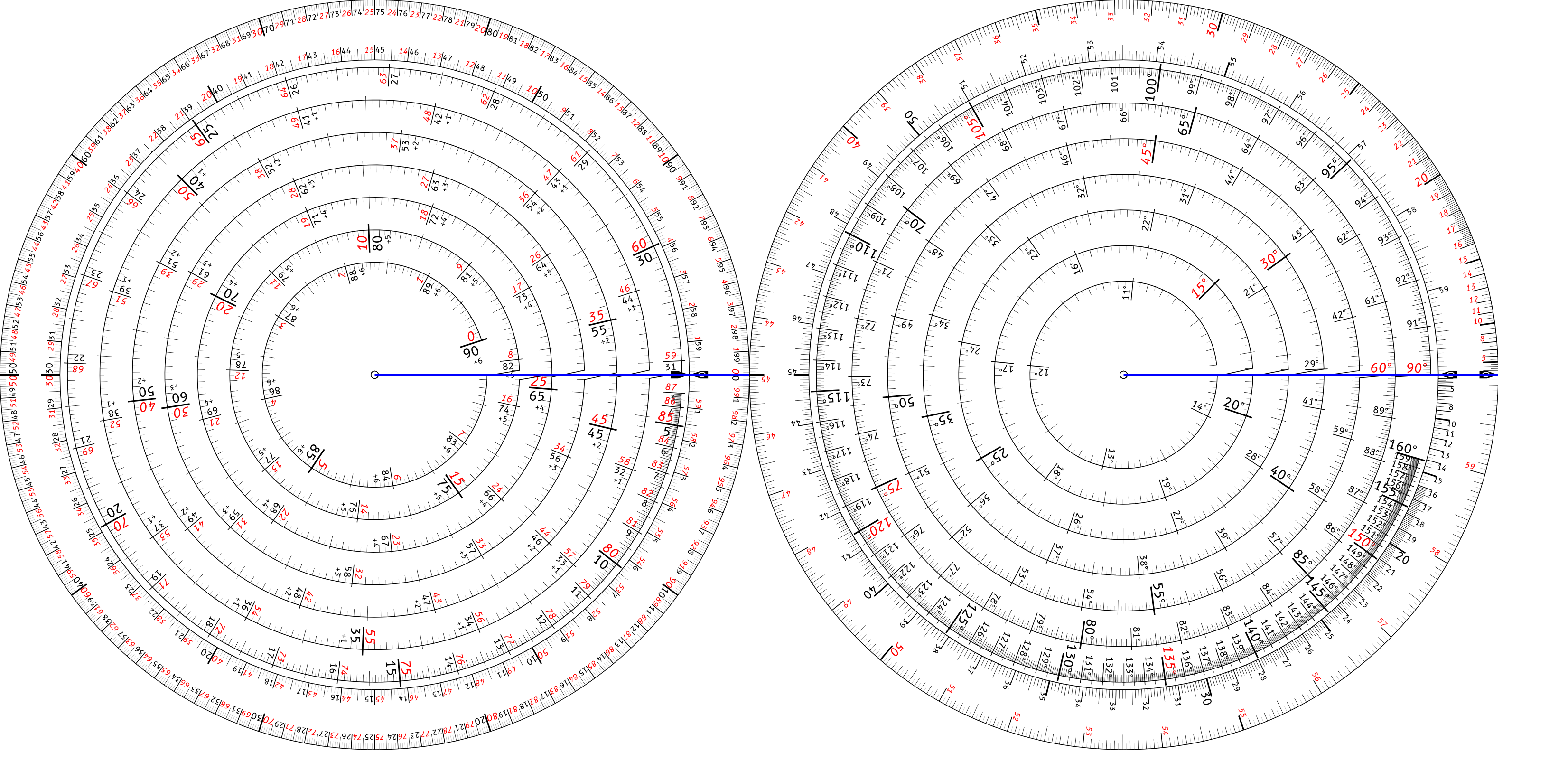
That looks slick! While slide rules are "not my thing", I do hope that other NavList members will contribute some thoughts here! Celestial slide rules have been a popular topic over the years... Is this your own design? Do you sell it? Or do you have a design that can be downloaded and produced in a DIY form (home-made or "do it yourself")?
Thanks,
Frank Reed
Clockwork Mapping / ReedNavigation.com
Conanicut Island USA
PS: I have a "style book" request. Could you please use some other notation for multiplication? Anyone (you also?) who comes from a coding/programming background (including spreadsheet work) is comfortable with x * y for multiplication, but a majority of navigators and navigation enthusiasts find the 'asterisk' for multiplication confusing, or at least surprising! :) Here are some other options: · , · , • , ⋅ , ⋅ , × . Note that the second "multiply dot" is the bold version of the first. The last one, the mutiply "X", ×, is not an x. Thanks.