NavList:
A Community Devoted to the Preservation and Practice of Celestial Navigation and Other Methods of Traditional Wayfinding



From: Trammell H
Date: 2026 Jan 19, 07:38 -0800
In Frank Reed's "Lunars are Easy" https://www.reednavigation.com/lunars/easylun.html he corrects the observed lunar distance with the "cosine corners" based on the refraction and parallax for the two bodies:
A = (sin(H_sun) - cos(dist)*sin(H_moon))/(cos(H_moon)*sin(dist))
B = (sin(H_moon) - cos(dist)*sin(H_sun))/(cos(H_sun)*sin(dist))
corrected_LD = observed_LD - dh_Moon*A + dh_Sun*B
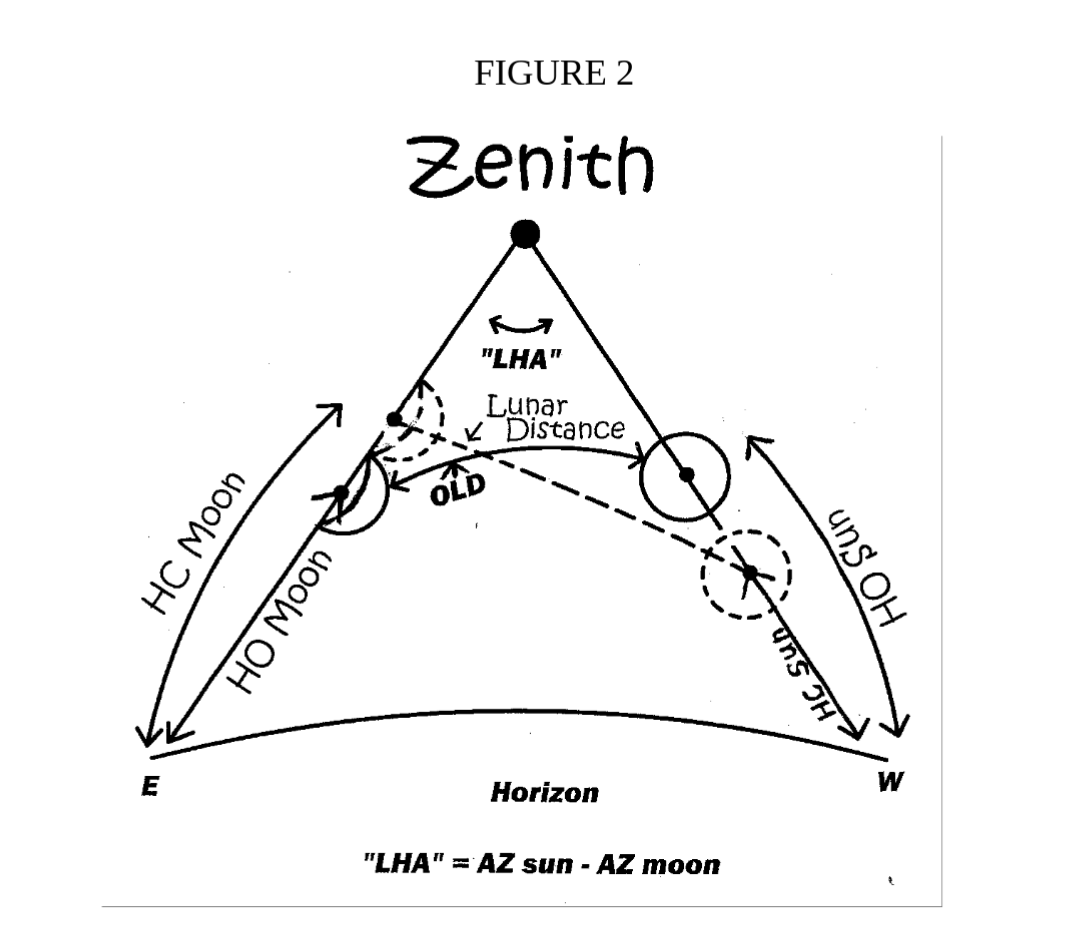
Is this better than computing the new arc length between the corrected heights? If we assume that the refraction and parallax corrections are entirely upwards, then it seems to me that we could perform less math by computing the "LHA" between the two observations and then using that angle in the spherical triangle to compute the arc length (similar to what is shown in the figure from Wendel Brunner's "Longitude by the Method of Lunar Distance").
Starting with the usual triangle:
cos(OLD) = sin(Hm)*sin(Hs) + cos(Hm)*cos(Hs)*cos(LHA)
Rearrange to find cos(LHA) (no need to take arccos since we'll use it as is):
cos(LHA) = (cos(OLD) - sin(Hm)*sin(Hs)) / (cos(Hm)*cos(Hs) )
Then compute the actual LD:
LD = arccos(sin(Hm+ Dm)*sin(Hs+Ds) + cos(Hm+Dm)*cos(Hs+dS)*cos(LHA))
(You can also use the all haversine form if you prefer, which has some nice properties and works well on a sliderule)
The resulting value is quite close to Frank's example (not sure which is the "true" result) and seems to work on synthetic tests as well. Is there something that I'm missing?