NavList:
A Community Devoted to the Preservation and Practice of Celestial Navigation and Other Methods of Traditional Wayfinding



From: Frank Reed
Date: 2026 Sep 2, 21:52 -0700
I'm sorry, but this app is at "alpha testing" level. In other words, it needs a lot of work.
The interface is designed strangely. This is your biggest issue... One small example: the app launches in French (fine), but it is suprisingly difficult to find the setting to switch to English if the user happens to switch away from the "Observer" page. That's "random" interface design --not designed according to a plan, but cobbled together. I could go on at length, but you really just need to sit down and think through a complete overhaul of the interface.
The app has some quirky display and data entry bugs. For example on the "Observer" page, there is a spot to enter the "Date and time". I enter D=2, M=9, Y=2026. Now I want to go to the same day in July. So just replace 9 with 7. Good luck (I did find a way to do it, but it's nearly impossible). This may be a platform-specific bug, so I should add that this was on Windows 10. Also, if I left out the year here, the app later generated a spurious error message. It should have defaulted to the current year. That would be "expected" behavior.
The star chart is just plain ugly...
As for the astronomical data, design issues again take center stage... I notice that your "planning" page calculates predicted star altitudes to a tenth of a second of arc. Why in the world would that level of precision be appropriate for a celestial navigation app --especially in the planning phase? If a navigator is trying to set up for twilight sights, predicted altitudes and azimuths to the nearest whole degree are more than sufficient. Instead you're going 4.5 orders of magnitude smaller than that. That's pointless.
Why include so many faint stars? How is that a benefit?? Why include Uranus, Neptune, and Pluto as potential objects for sight reduction? That's pointless, too.
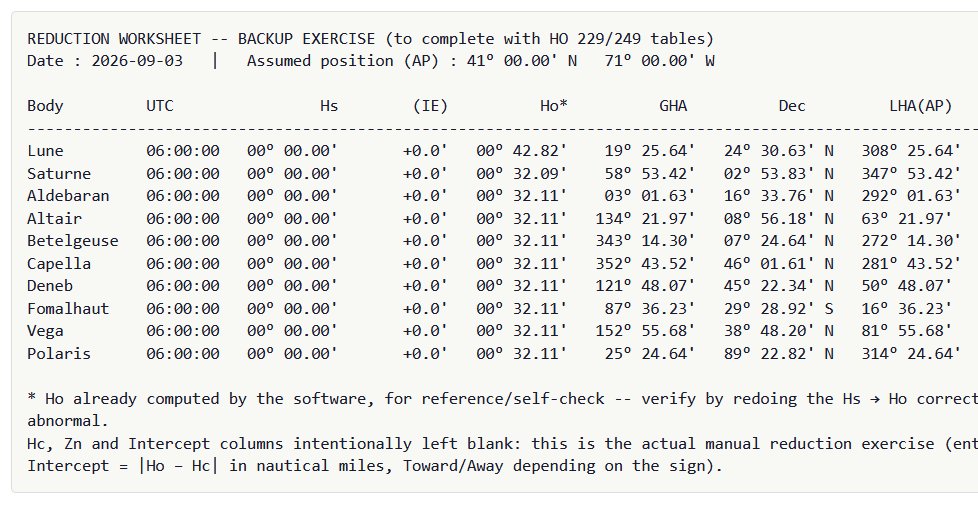
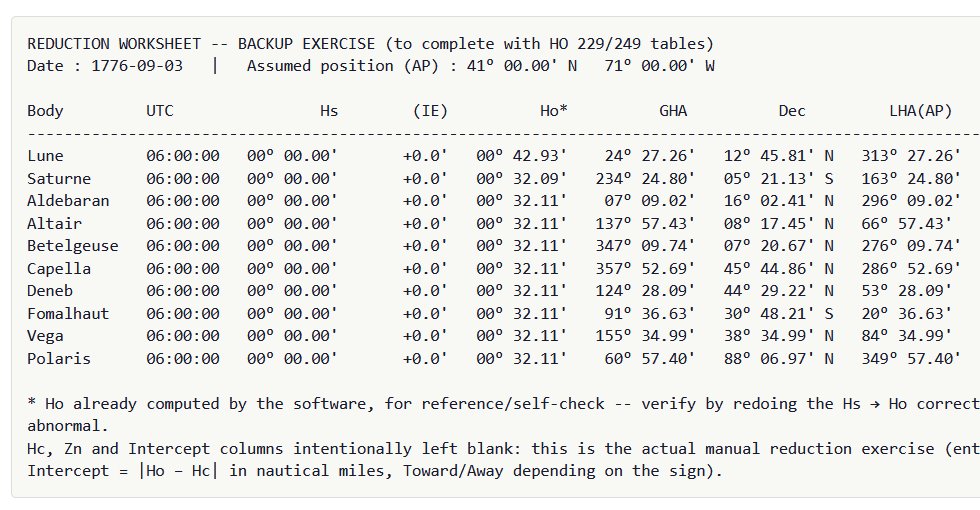
As Dave Walden has already noted, there are problems with coordinates for stars. Solar System objects appear to be fine, as I would expect (since you're using JPL coordinates directly --good choice). Your star coordinates are not terrible, but they're surely less accurate than you intend. Curiously, the GHAs are good, but the Declinations have errors of multiple "tenths" of a minute of arc, as Dave W said. That's weird, but I would bet it's a trivial bug. Also of note, the errors are nearly the same over centuries. The tables below compare GHA and Dec data from your app for 1776 and 2076. You will find, for example, that the Dec of Vega is wrong by 0.5 minutes of arc in both years. Similarly the Dec of Altair is wrong by about 0.33 minutes of arc in both years.
Frank Reed