NavList:
A Community Devoted to the Preservation and Practice of Celestial Navigation and Other Methods of Traditional Wayfinding



From: Frank Reed
Date: 2026 May 10, 19:20 -0700
Interesting contributions, everyone!
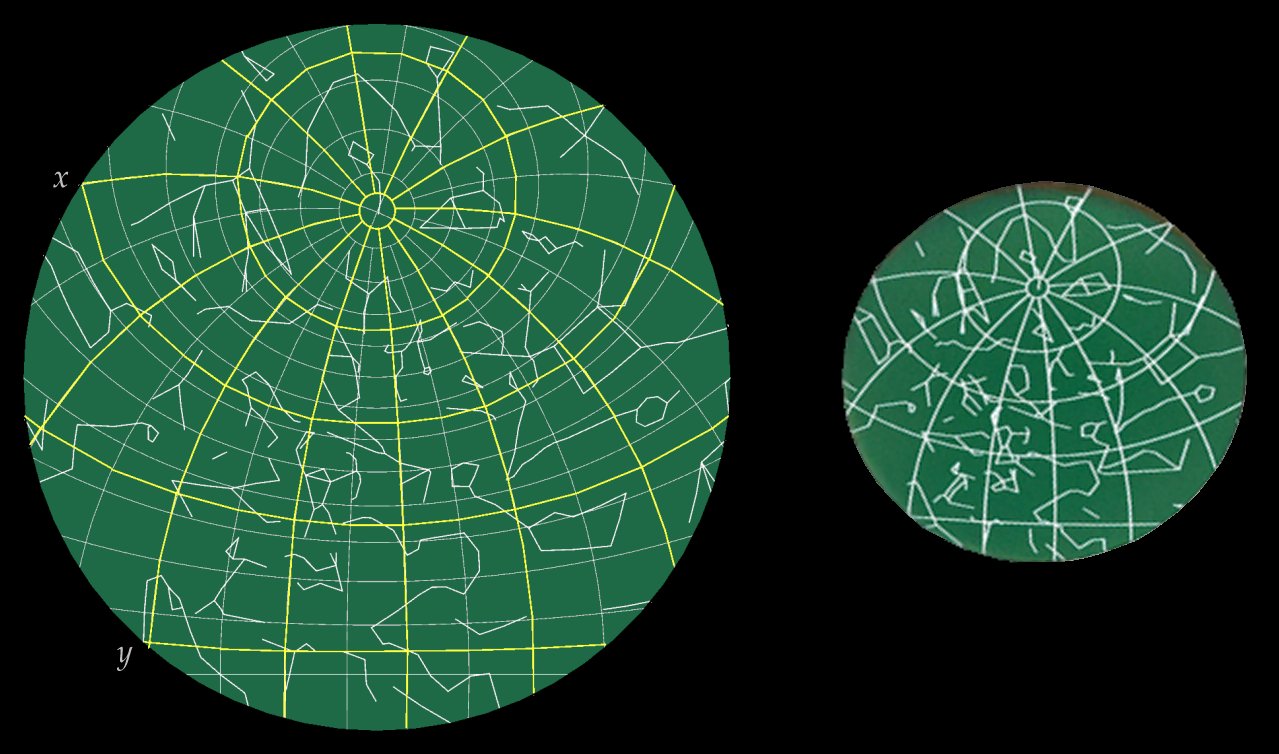
If anyone is still skeptical of the little star chart on this bracelet, I'm including here a sky simulation that closely matches the alignment of the constellations in the original photo. I'm confidence that the people creating and selling these things are using some genuine astronomy app to create the unique sky appearance for each customer's "special event" date and location. :)
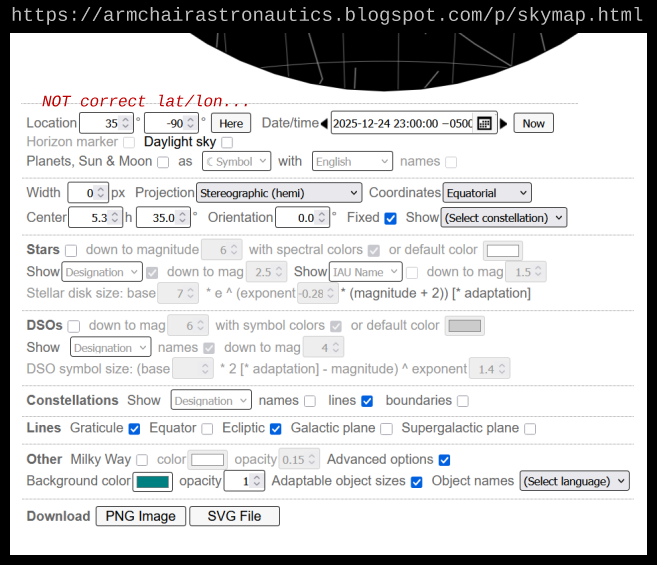
The simulation, on the left below, was created using a tool that I have posted about before (with some manual modifications). The tool is a fun little astronomy web app created years ago that you may find entertaining all by itself... here: https://armchairastronautics.blogspot.com/p/skymap.html. The code is all available, too, if you want to build something new with it. I'm also including an image of the settings that will produce something close to the sky simulation image.
I have marked two "corners" on the star chart. Points x and y are very near the effective horizon. They are also at simple coordinate junctures. Point x is at Dec +25°, SHA 180°. Point y is at Dec -35°, SHA 240°. Suppose we assume, for the sake of the puzzle, that both of these points are, in fact, at 0° true altitude. Given that we also know GHA Aries from the date and time (Josh, I'll trust your 154° for that), then this becomes an unambiguously solvable navigation problem, right? It's another two-star case where the altitudes happen to be zero.
If all of these assumptions are taken as given, where are we? And then, for "extra credit" :), what happens to the fix, if we assume both altitudes are 3° instead of 0°?
Frank Reed