NavList:
A Community Devoted to the Preservation and Practice of Celestial Navigation and Other Methods of Traditional Wayfinding



From: Joshua Carty
Date: 2026 May 10, 12:08 -0700
Interesting, David Pike!
Here's what I did.
I start with the basics:
#1: the declination of a star at the zenith is equal to the latitude of the simulated observer who ordered this trinket.
#2: the SHA of the meridian, which is the same as the SHA of the zenith, is equal 360° - LHA(Aries). Or as Frank Reed recently described it: SHA(meridian) + LHA(Aries) = 360°. This is also the same as RAmer = LHA(Aries)
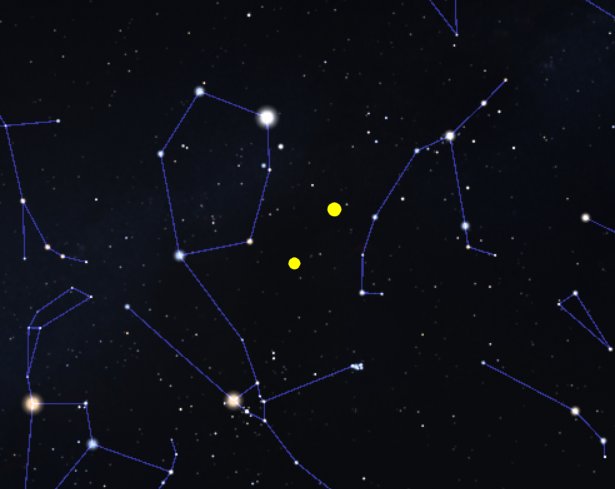
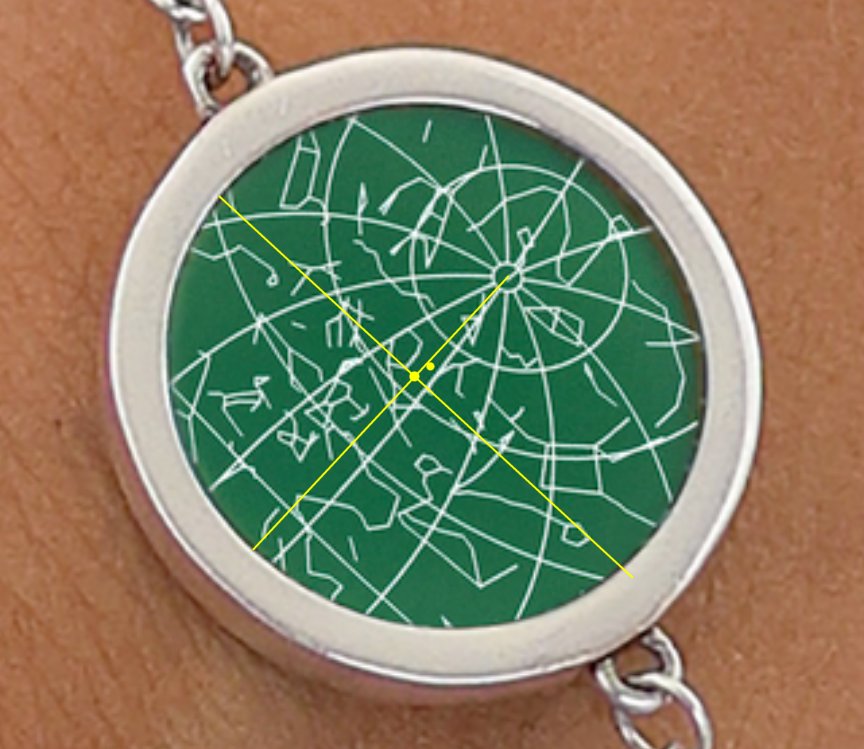
The point of this is that I can get Latitude aand LHA(Aries) if I can read off the location of the zenith. I tried this two ways and compared against the standard constellation lines in Stellarium. These lines look exactly like the constellation lines in the trinket. You can see in my version of the trinket constellations that I came up with two different zenith points. In Stellarium I estimated these points are:
Point A: RA=66°, Dec=40°
Point B: RA=69°, Dec=32°.
RA(Zenith)=LHA(Aries). And LHA(Aries) = GHA(Aries) + Long. So I need GHA(Aries). That depends on date (year, month, day) and GMT ONLY! And we have that! I can calculate GHA(Aries) from (360/365)*days+15*hours using the total "days" from September 21 and "hours" of GMT. The date is December 25 --> days=95 and hours =4 from the setup. I get GHA(Aries)=154 degrees. If I use a longitude (W is negative) of -88 degrees then my LHA(Aries) would be 66 matching Point A or the longitude is -85 then it matches Point B.
Putting together the pieces, the trinket design matches 40°N, 88°W somewhere within a few hundred miles of Champaign, Illinois. *OR* it matches 32°N, 85°W which is somewhere within a few hundred miles of Columbus, Georgia. I think I will put my guess halfway in between and say 36°N, 86.5°W, but I will follow Frank's advice and not get "lost in precision". I don't think there's any way to be more accurate than 5° on the position.
Josh