
NavList:
A Community Devoted to the Preservation and Practice of Celestial Navigation and Other Methods of Traditional Wayfinding



From: Dustin Baenen
Date: 2025 May 10, 07:23 -0700
Norman, I have no idea what your doing here, after reading through your posts I'm starting to agree with Frank and I think your just playing games. At the end of the day at least it's building some traffic for Navlist. Maybe Norman is Frank's new ChatGPT CelNav Chatbot? If this is engagemnt bait I'll bite for one post. Your obsession with arc correction reminds me of something Col. Jeff Cooper used to call "preoccupation with inconsequential increments". Your obessing about something that doesn't matter for practical use. Especially with the particualar sextant you are using.
If you are not an AI chatbot and you are interested in getting the most out of your plastic sextant I suggest you find a copy of David Birch's book on plastic sextants. Thermal expansion plays a larger role in plastic sextant accuracy than arc error. Measure your IC before and after a round of sights to see how it has changed. I have the exact same sextant as you. With an AH I have been able to take sights to the limit of the instruments practical accuracy. Men have circumnavigated the world with that sextant. No made up quadratic equations needed. If you want help or opinions please post real data not vague unlabled scatter plots.
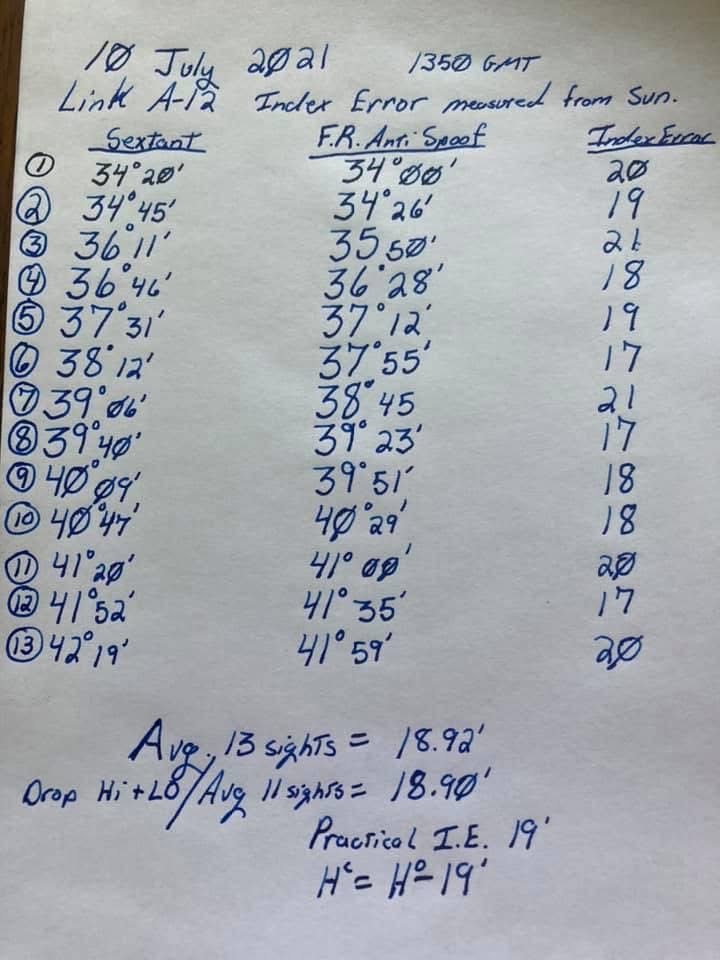
I've never attempted to measure arc error on any of my sextants but I am including an example of raw data to measure index error on a Link A-12 Sextant. It is non trivial to zero out the index error on this sextant, I use Franks Anti Spoof app to meaure the error and live with what I get. The first image is the direct sextant sights compared to the Anti-Spoof app and my determination of correction. The second image is a couple sets of sights used to determine positon with that sextant and correction. The A-12 uses a vernier scale just like the MkIII.
db
44 30 N
88 00 W
.jpeg "Click to enlarge.")






