NavList:
A Community Devoted to the Preservation and Practice of Celestial Navigation and Other Methods of Traditional Wayfinding


From: Frank Reed
Date: 2025 May 24, 10:37 -0700
Here's another thread I had planned to get back to but did not. In this case, a little vacation may have been useful...
Norman B.: in your last post, about two weeks ago, you included an image that we can actually pull some data from. Here's your plot: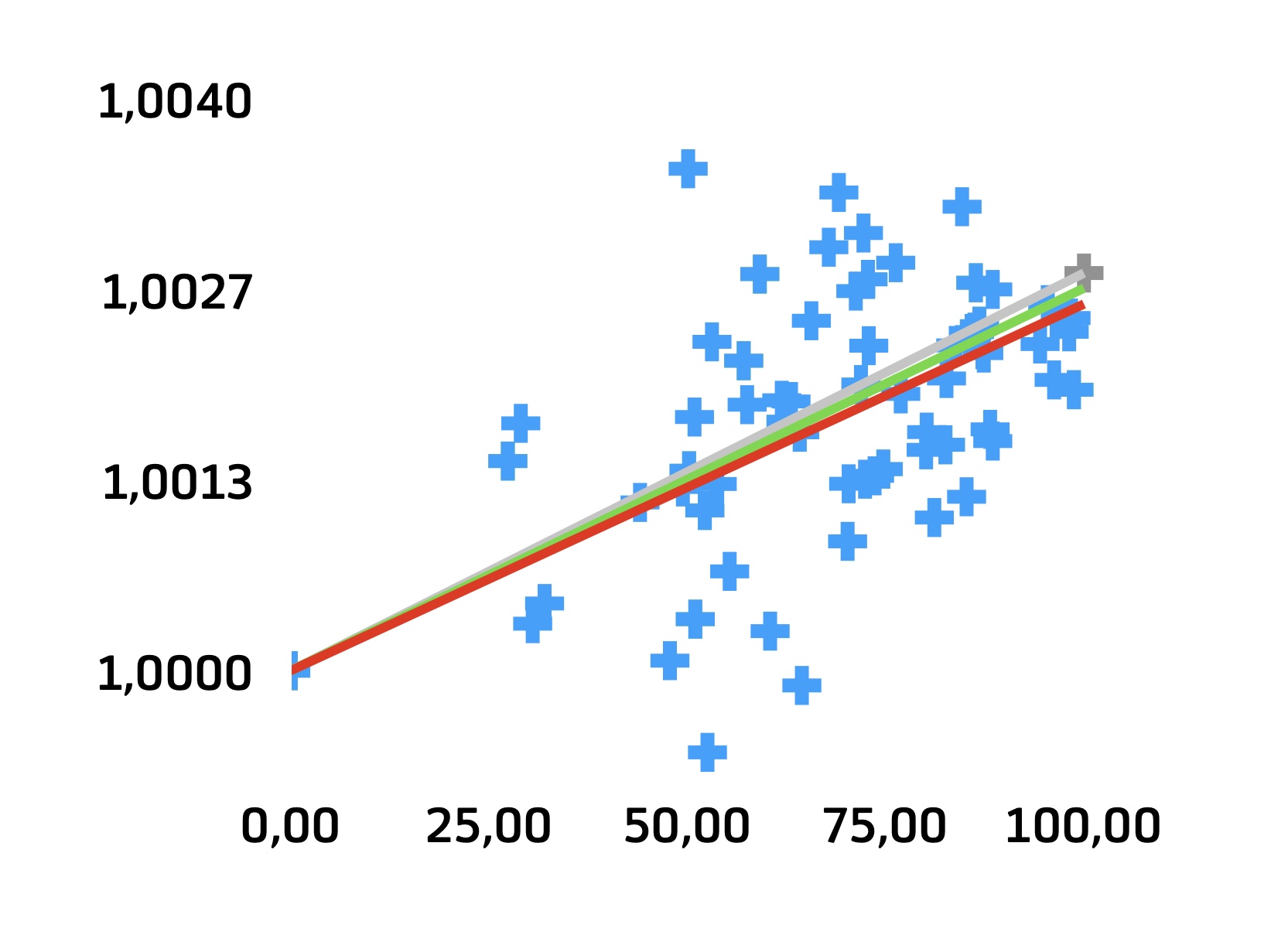
The lines you've drawn in here don't really help as I see it, so I am ignoring those. But the graphic itself is very useful, and finally it's something that we can work with. I was able to process this image and pull out a version of the original sight data that is certainly good enough for the precision of the Davis Mk 3.
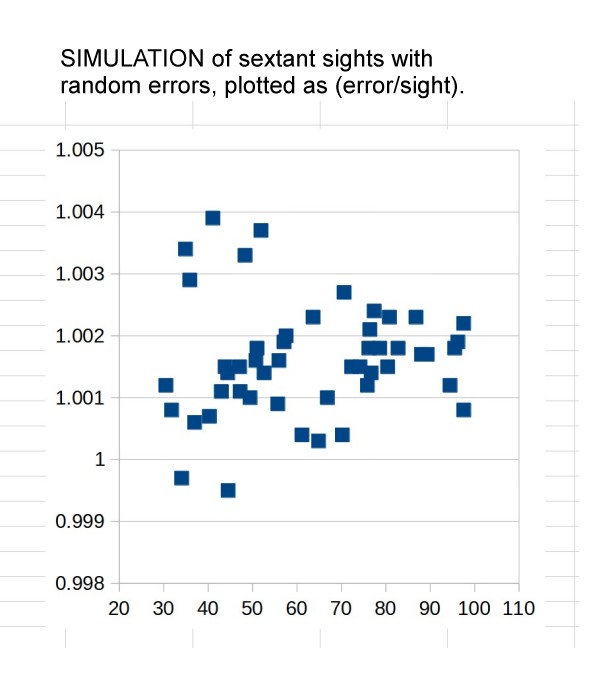
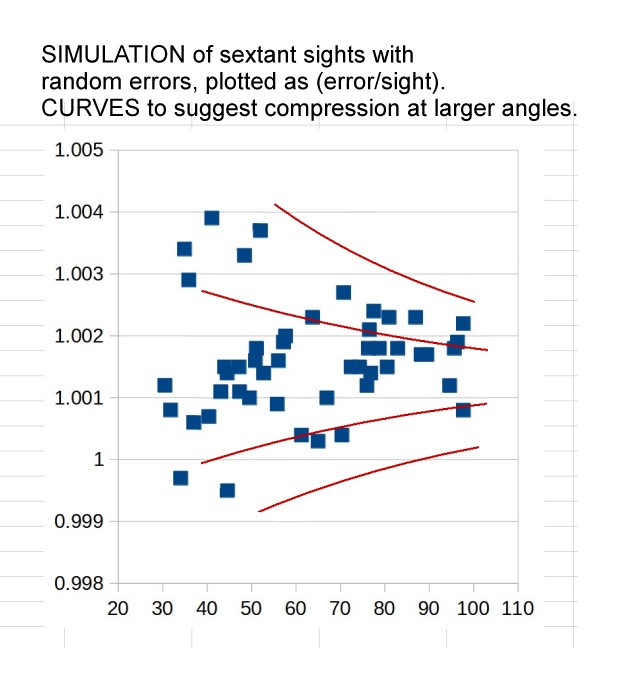
One thing I noticed in your graph is that there is an apparent "compression" of points on the right side, as if there is less error on the right. That isn't actually the case, but it makes sense given what you plotted. You were looking for a factor that could be applied to any angle to yield a fixed systematic arc error increasing with angle. The principle is a good one, but in terms of the graphic, I think you'll agree that it's "problematic". I simulated some sights using a constant linear scaling of systematic error with random error on top of that. Then I plotted the raw sight (with simulated error) divided by the actual sight. The catch is that this reduces the apparent scale of the error for larger angles (towards the right) and compresses their apparent "spread". In my plots below [attached] I have a simulated example case and also a graphic with "curves" designed to suggest how the points are squeezed together at larger angles. The curves are merely suggestive. The disadvantage of this style of plot is that it forces any fitted line to follow the points at larger angles with greater weight.
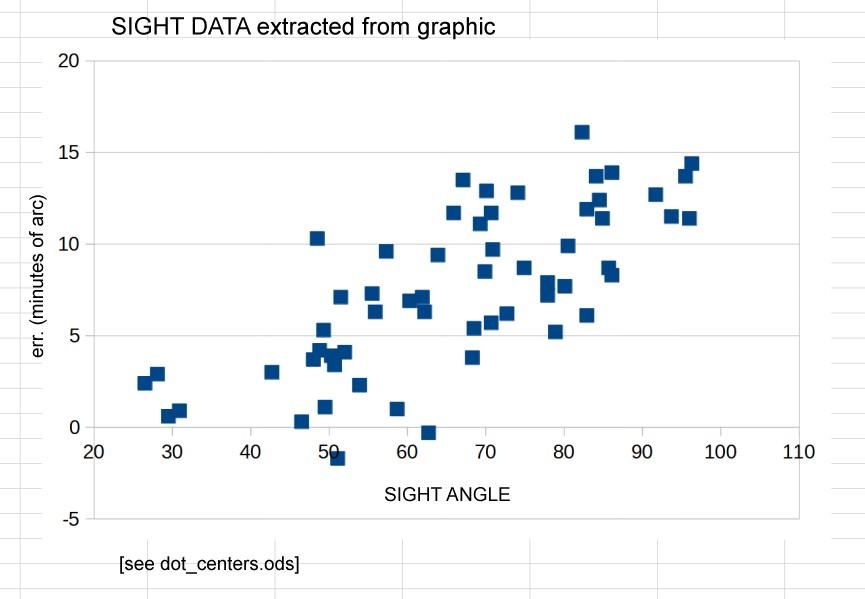
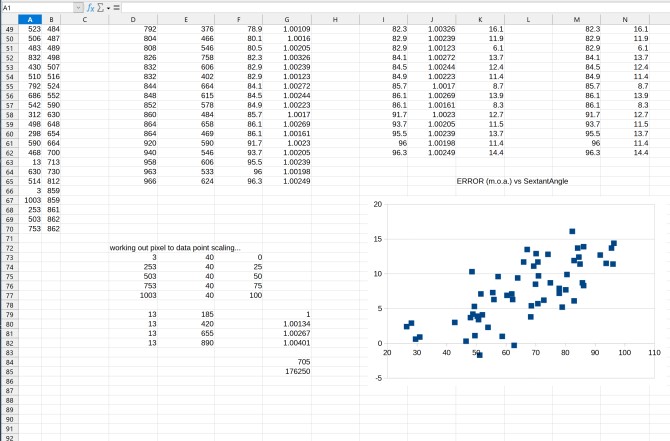
Next I took your plot, marked off the scale points, and also highlighted the center of each of the crosses for the data points. It would then have been a simple, tedious task to go through and pull out pixel coordinates of each point. Fortunately, with the graphic carefully cleaned up, this is a task that basic A.I. tools can process with relative ease. However, it's important to check the "work" that it does. So I asked an A.I. tool to collect the pixel coordinates of each dot, then I re-plotted those on top of the original plot to confirm that they were good. This recovered at least 95% of the original graph though a couple of the 'crosses' were hidden or unclear in the original. Nonetheless, that's plenty of data to work with. It was then possible to recover good estimates of the original errors at each angle.
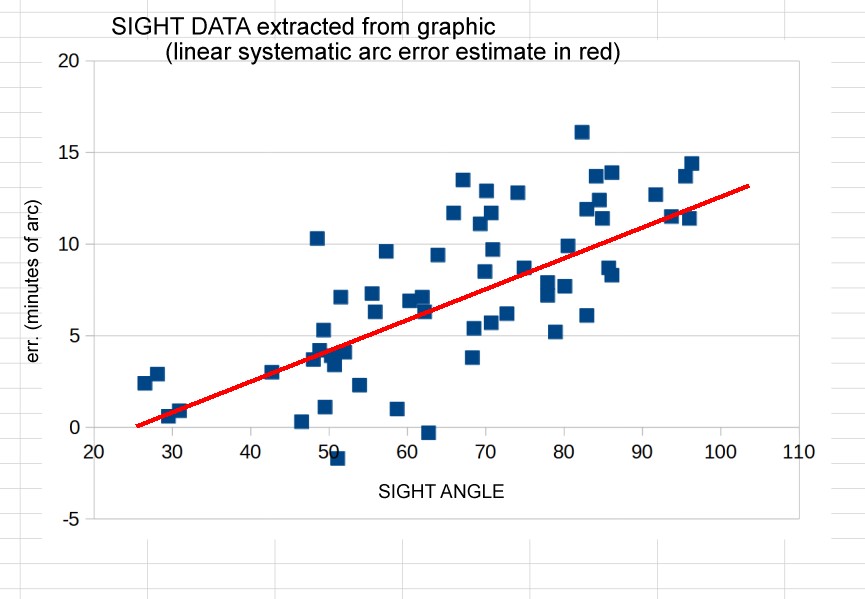
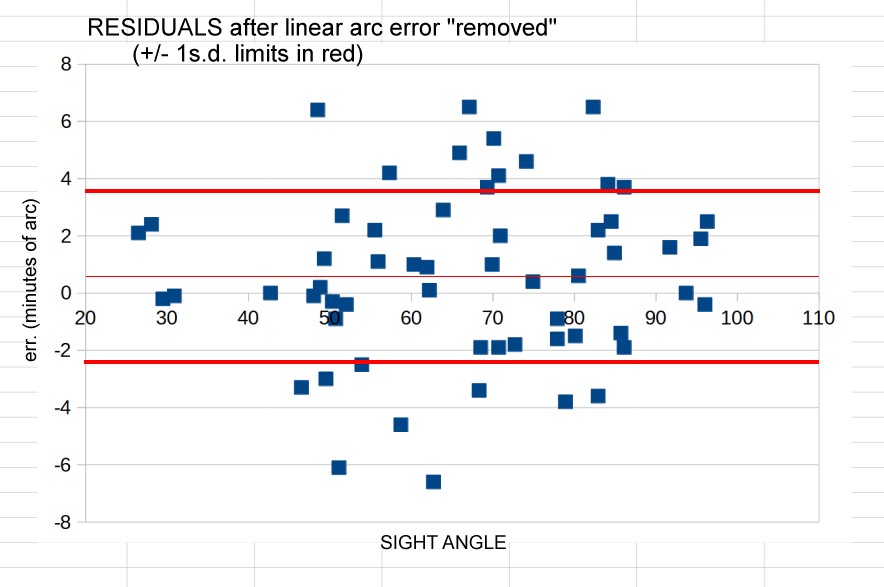
I took all of the data points, dropped them into a spreadsheet, converted the x,y pixel coordinates back to sight angles and pure errors in minutes of arc. Then I tried two simple linear functions through the data. The simpler one, and the one that I would recommend for eliminating the systematic arc error is (SextantAngle-25°)/6 for the error in minutes of arc (and nothing defined for angles below 25°; call it zero). Both linear functions produce fair results, and they confirm something imporant. After correction, your sights are certainly very good. Perhaps not as good as you had previously suggested, but much better than most people would expect from a Davis Mk 3 sextant and comparable to some favorable results described a few years back by Greg Rudzinski. The standard deviation in the sights is just about 3.0 minutes of arc. To emphasize for anyone following along who hasn't thought in "s.d." terms in a while, this "standard deviation" implies that roughly 62% of sights are within +/-3.0 minutes of true and roughly 95% are within +/-6.0 minutes of true. I'm attaching the spreadsheet I created for this and also some graphics, but I didn't think it was worth commenting/documenting it in any detail. I have already spent enough time on this...
Frank Reed