NavList:
A Community Devoted to the Preservation and Practice of Celestial Navigation and Other Methods of Traditional Wayfinding


From: David Pike
Date: 2026 Oct 26, 16:46 -0700
Gary Lapook you wrote: “You need the book, Precision Astrolabe” by Francis M. Rogers
Gary
Thankyou. That is the book I was looking for, except my version was hardback and fatter than that. Does your version go on to describe a lot more about DR and celestial provision in US aircraft up to about 1939, or am I getting that mixed up with a different book by Rogers?
With respect to using the shadow of the bodies length to calculate height above the sea, this method was used by Maitland from the R34 in 1919*. The R34 was 634ft long whereas the FairyIIIF was only 34ft 4” long. Coutinho’s Fairy IIID floatplane might have been 6ft longer (around 40ft), because of the floats. In any case, Maitland’s calculations can have been expected to be considerably more accurate than Coutinho’s.
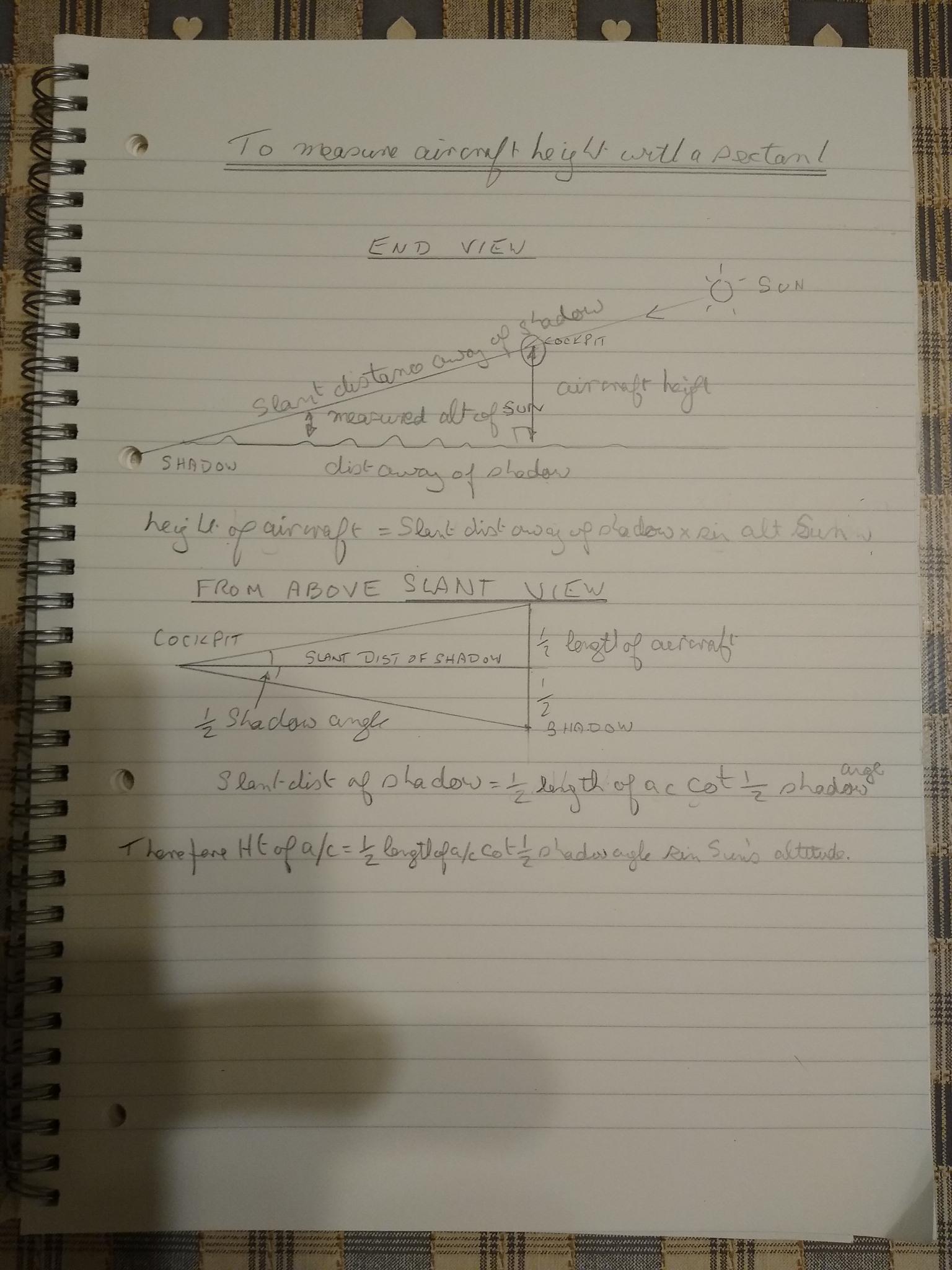
However, in contrast to Rogers, a recent paper generated by three Portuguese authors** states that Coutinho used the FairyIIID’s wingspan and not its length to calculate aircraft height and goes on to calculate a formula which Coutinho might have used to allow for the fact that, as the Fairy IIID was a biplane, a correction has to be made for the distance apart of the wings. Whilst it’s true that the Fairy IIID’s wings were longer that its length and might have given a more accurate result, this seems unduly complicated since it can easily be shown that if fuselage length had been used the formula is simply aircraft height = 0.5 aircraft length x cot 0.5 measured shadow angle x sine the Sun’s measured altitude.*** One wonders how much either publication had been peer reviewed?
As far as aiming off is concerned. It appears Coutinho used it towards the end of a long leg, whereas Chichester used it from the start of a leg.
* Maitland, E. M. (1920). The Log of H. M. A. R34, Journey to America and Back. Hodder and Stoughton Limited, London.
** https://www.academia.edu/126488981/Coutinhos_Method_for_the_Altitude?email_work_card=thumbnail
*** See my diagram attached